
Sudan is working with other countries to compensate victims of slavery.
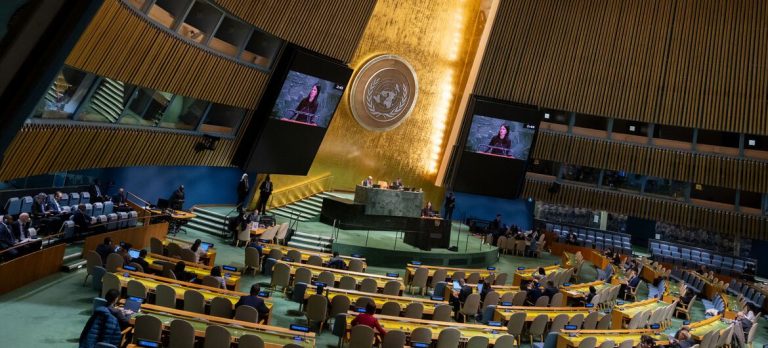
The United Nations General Assembly held an event to mark the International Day of Remembrance of the Victims of Slavery and the Slave Trade, adopting a resolution by a vote of 123 in favor. The resolution, submitted by Ghana and approximately 60 other countries, declares that the trafficking of enslaved Africans and the enslavement of Africans based on race constitutes “the most heinous crime committed against humanity.”
123 countries voted in favor of the resolution, 3 voted against it (the United States, Israel, and Argentina), and 52 abstained.
The Arab countries that co-sponsored the resolution, according to its draft, are: Tunisia, Algeria, Comoros, Djibouti, Sudan, Somalia, Egypt, Morocco, and Mauritania.
The resolution unequivocally condemns the enslavement of Africans and the transatlantic slave trade, “as one of the most inhumane and enduring forms of injustice.”
The General Assembly reaffirms in the resolution its collective recognition of the profound and lasting effects of the abhorrent systems of slavery and colonialism, and of the continuing racial discrimination and neocolonialism against Africans of African descent.
It emphasizes the importance of addressing the historical injustices suffered by Africans and people of African descent in a manner that promotes justice, human rights, dignity, and recovery. It affirms that demands for reparations are a concrete step towards rectifying historical injustices.
In its resolution, the General Assembly calls upon Member States to engage in a comprehensive and good-faith dialogue on restorative justice, including a full and formal apology, measures for reparation, compensation, rehabilitation, and satisfaction, and guarantees of non-recurrence.
Among those participating in the event commemorating the International Day were the Secretary-General of the United Nations and the President of the General Assembly.
“A Betrayal of Dignity”
At the start of the event, the UN Secretary-General described these practices as a profound betrayal of human dignity. Millions of Africans were abducted and stolen from their families and communities, and trafficked across the Atlantic Ocean under horrific conditions.
He noted that one in seven people did not survive this journey. He also pointed to their enslavement in the Americas, where generations were brutally exploited as laborers and denied their most basic rights. “These atrocities were at the heart of the global economic and social system,” he said. “A system born of greed, built on lies, and enforced by violence.”
This system, which lasted for more than 400 years, continues to affect the world today, the Secretary-General said. He stated that commemorating the International Day is more than just remembering; it is a time to confront the enduring legacy of inequality and racism. “We will never forget the victims of slavery,” he said.
Guterres called for confronting the false narrative of racial difference and the ugly lies of white supremacy, dismantling its harmful claims online, in the media, in schools, workplaces, in politics, and “within ourselves.”
The Secretary-General also called for action to achieve truth, justice, and reparations, urging the removal of barriers that prevent many people of African descent from exercising their rights and reaching their full potential, and a renewed commitment to human rights and equality.