
A Strategic Blueprint: Rescuing and Rebuilding Sudan’s Engineering and Technical Corps
By: Abdelrahman Mohamedzain (Magdi),
In The Citizen (Issue 59, 1st September 2025), the powerful essay “A Cry for Urgent Rescue: Saving Technical and Vocational Education in Sudan” captured the depth of our crisis. Sudan’s technical and vocational education is collapsing.and with it, the competence of our engineers and technicians. The diagnosis is clear. But the question remains: where do we go from a cry for help?
The answer lies in moving from diagnosis to treatment. This article sets out a practical strategic blueprint to bridge the competence gap and rebuild the technical corps Sudan so urgently needs.
The Core Proposal: An Alliance for Competence
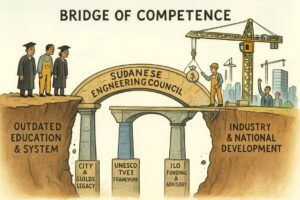
The way forward is not to create new, parallel structures, but to intelligently integrate and empower the assets Sudan already possesses. The vision is an alliance.rooted in Sudanese institutions yet strengthened by international partnerships.that unites regulators, modern training systems, global advisors, and Sudan’s proud City & Guilds legacy.
1. The Sudanese Engineering Council: The Regulatory Backbone
The Sudanese Engineering Council must be revitalized as the central pillar of reform. Its role should expand to include:
National Qualifications Framework (NQF): Creating a unified NQF that maps City & Guilds certificates, UNESCO TVET outcomes, and academic degrees. This provides clarity, parity, and a career ladder for technicians and engineers alike.
Accreditation and Quality Assurance: Certifying training centres to ensure graduates meet professional standards, ending the flood of meaningless certificates.
Tiered Licensing: Establishing a structured register for technicians and engineers, with clear pathways for career progression.
2. UNESCO’s Sudan TVET Project: Modernizing the Method
The UNESCO TVET initiative must serve as the engine of curriculum modernization. Its role is vital for:
Competency-Based Training: Updating City & Guilds syllabi to meet modern demands.reconstruction, renewable energy, and digital skills.
Trainer Development: Re-skilling instructors nationwide in modern pedagogy and technology.
Needs Assessment: Identifying skill gaps in critical sectors such as energy, agriculture, and construction.
3. The International Labour Organization (ILO): The Global Bridge
The ILO provides both credibility and resources. Through its regional presence and City & Guilds connections, it can:
Fund Rehabilitation: Finance the refurbishment of training centres, scholarships, and trainer development.
Advisory Guidance: Ensure Sudan’s qualification system aligns with international standards.
Job Linkages: Connect graduates with employment through apprenticeships and placement programs.
4. The City & Guilds Legacy: Sudan’s Historic Asset
Far from obsolete, the City & Guilds tradition is a treasure. It represents:
Human Capital: Thousands of skilled Sudanese technicians trained under its system.
Continuity: A living link between Sudan’s past expertise and future potential.
Global Recognition: A pathway for Sudanese technicians to compete in international labour markets.
A Roadmap for Action
A joint committee.comprising the Engineering Council, the Ministry of Labour, UNESCO, the ILO, and veteran City & Guilds experts—should be mandated to:
1. Finalize and adopt the National Qualifications Framework.
2. Launch pilot programs in refrigeration, electrical installations, and agricultural technology.
3. Use ILO resources to train instructors and restore flagship training centres.
4. Establish a national graduate tracking system to measure real employment outcomes.
Conclusion: From Cry to Collective Mission
The cry for urgent rescue was necessary. But now Sudan must act. By uniting regulators, modern training methodologies, global partners, and our historic assets, we can transform the crisis into opportunity.
If we summon the political will and embrace this collective mission, Sudan can rebuild its engineering and technical corps.equipped not only to survive, but to lead the nation’s recovery with skill, confidence, and pride.
Abdelrahman Mohamedzain (Magdi), Occupational Health and Safety Activist; Member, Society of Environmental Engineers (SEE-UK); Member, American Society of Heating, Refrigeration and Air Conditioning Engineers (ASHRAE-USA)