
Dengue War

By: Mohammed Ahmed Al-Filabi
(Environmental Affairs Specialist)
She held her baby’s body as she cried, emphasizing, even to those who couldn’t hear her complaint, that she had never left him unclothed for a single moment, and that she had been warding off mosquitoes, flies, and hunger, because she knew firsthand what dengue fever could do. They took him off her and took him to the cemetery, but none of them dared to tell her that she might have transmitted the disease to him.
In another story, despite the unsuitability of the post-war environment, especially in the capital, Khartoum, our university professor friend ignored warnings and went there to check on his office and home. However, he returned infected with dengue fever, the latest weapon in the absurd April 15, 2023 war in Sudan.
The United Nations Office for the Coordination of Humanitarian Affairs (OCHA) sounded the alarm in October of last year, warning of rising cholera and dengue fever cases in Sudan, and confirming that hunger levels had reached “above the threshold of famine.”
In early September, a significant increase in dengue fever cases was detected in Khartoum, Gedaref, and other cities. It is rare for a family to be without a patient, and some entire families are contracting the disease.
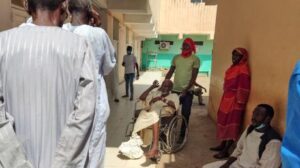
The few hospitals are overcrowded, amid complaints of high treatment costs. Recent press reports indicate that more than 6,000 dengue fever cases and nine deaths have been recorded in Khartoum alone.
The World Health Organization and the United Nations Children’s Fund (UNICEF) have previously stated that thousands of children and civilians are at risk of dengue fever, as well as other diseases such as cholera, measles, and malaria, due to poor sanitary conditions and the destruction of infrastructure.
The collapse of health services and the destruction of healthcare centers and hospitals have made accurate data collection and care extremely difficult.
The widespread displacement of millions of Sudanese has also made it difficult to track the spread of diseases in camps and crowded areas, considering the prevalence of a culture of war, even in describing environmental phenomena, they are likened to drones.
Widely circulated satirical videos depict the state of those who returned to their homes after the sound of gunfire had partially ceased, only to be greeted by something far more dangerous: hunger, a lack of services, and environmental degradation everywhere, in addition to these ubiquitous insects. These are the Aedes aegypti mosquitoes, which are active day and night, but bite most frequently at dawn and dusk. This mosquito becomes infected with the virus when it feeds on the blood of an infected person, then transmits it to a healthy person through its bites. While linguistically, “distress” refers to hardship, and difficulty, in Sudan’s reality, it is the continuation of what the war began.