
From Toxic Gold to Clean Air: A Sudanese Blueprint for Sustainable Development

By: Abdelrahman Mohamedzain Abdeldafe Ahmed (Magdi)
The arid landscapes of the Abu Hamed region in Northern Sudan tell a story of immense potential shadowed by severe peril. Beneath the surface lies wealth that has driven communities for generations, but the method of its extraction—using highly toxic cyanide and mercury in artisanal gold mining—has cast a long shadow over the environment and public health. The result is a tragic paradox: the pursuit of prosperity is systematically poisoning the very means of survival—water, soil, and air.
The environmental and health dimensions of this crisis are stark. Cyanide leaching solutions, milling residues, and contaminated wastewater seep into aquifers and rivers, degrading agricultural land and biodiversity. The human cost is even higher, with communities suffering from skin diseases, digestive ailments, and chronic illnesses linked to heavy metal exposure. Economically, this pollution cripples agricultural productivity and burdens families with escalating medical costs, destroying traditional livelihoods.
However, rising from this challenge is a powerful, homegrown solution. The groundbreaking research of Sudanese student Nada Omar presents a visionary, dual-purpose innovation: producing high-quality activated carbon from local agricultural waste. This isn’t just a scientific exercise; it’s a sustainable blueprint for remediation and economic empowerment.
The mechanism is elegantly scientific. Activated carbon is a potent adsorbent, capable of capturing gold cyanide complexes from contaminated tailings, thus recovering valuable material and significantly reducing the toxicity of mining effluents. The economic benefit is immediate—the recovered gold generates revenue that can be reinvested into community projects, health initiatives, and further environmental restoration. Socially, producing this carbon from abundant resources like peanut husks and date pits creates local jobs, reduces waste, and eliminates reliance on expensive imported materials.
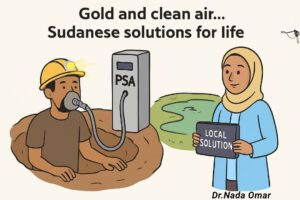
This principle of adsorption—using a material to capture specific molecules—extends far beyond the mining sector, offering solutions to other critical challenges. This is where established technologies like Pressure Swing Adsorption (PSA) and Vacuum PSA (VPSA) come into play, creating a holistic model for national development:
Sustainable Mining: Using locally produced activated carbon for cyanide mitigation and gold recovery.
· Healthcare Revolution: PSA oxygen plants can be deployed to generate medical-grade oxygen for rural hospitals, a need critically highlighted by the WHO and the recent pandemic, ensuring life-saving resources are available inland.
· Occupational Safety: Portable PSA oxygen generators can protect miners working in deep, confined pits—a dire need as reported by the ILO—preventing suffocation and saving lives.
· Industrial & Agricultural Growth: PSA technology can generate nitrogen for food preservation, cold storage facilities, and chemical manufacturing, boosting local industry and reducing post-harvest losses.
The path forward is clear. We must advocate for:
1. Pilot field trials of Nada Omar’s activated carbon units in Abu Hamed.
2. Integration of PSA technology for oxygen in healthcare and mining safety, and for nitrogen in agriculture and industry.
3. Establishing a community responsibility council to manage revenues from recovered gold, ensuring transparent reinvestment into health, education, and environment.
4. Capacity building programs to train local youth and women in operating these new technologies.
Nada Omar’s research offers more than a fix; it offers a new paradigm. It demonstrates that Sudan’s greatest resource is not just its gold, but the ingenuity of its people. By embracing this model, we can turn the tide on pollution, protect our communities, and build a sustainable economy. It is a future where gold recovery and clean air go hand in hand—a truly Sudanese solution for life.
References & Further Reading:
·World Health Organization (2021). Oxygen sources and distribution for COVID-19 treatment centres.
· International Labour Organization (2019). Reports on Mining Safety and Health in Africa.
· Marsden, J. & House, I. (2006). The Chemistry of Gold Extraction. SME Publications.
· Deng, H. et al. (2010). “Activated carbons prepared from peanut husk…” Journal of Hazardous Materials.
About the author; Abdelrahman Mohamedzain Abdeldafe Ahmed (Magdi)
Occupational Health and Safety Eco Activist
Society of Environmental Engineers(SEE-UK) Member
RACHP Engineer and ASHRAE Member