
UN Envoy to Sudan: No Military Solution to Conflict, El Obeid Raises Growing Concerns
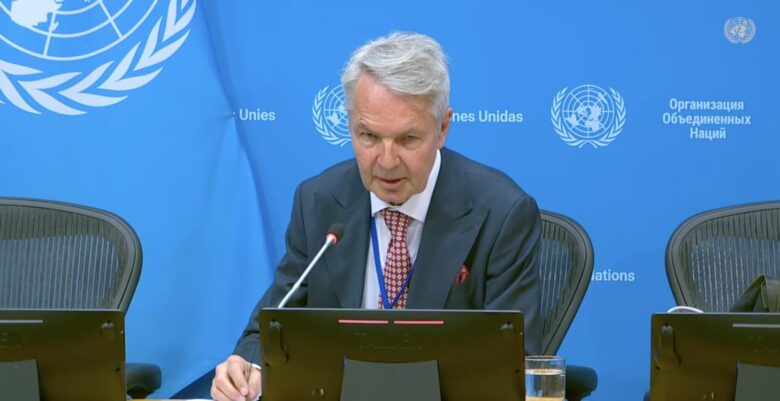
The Personal Envoy of the UN Secretary-General to Sudan, Pekka Haavisto, you expressed his concern about the escalating violence in and around El Obeid, warning that any further military escalation could endanger thousands of civilians and deepen the already dire humanitarian crisis in Sudan.
In a press statement at the UN headquarters in New York on Thursday, Haavisto said that the situation in El Obeid, the capital of North Kordofan State, has become increasingly alarming in recent days, with continued hostilities and repeated drone attacks.
He added: “We are deeply concerned about the ongoing hostilities around the city, including the repeated drone strikes. These attacks are already affecting civilians and humanitarian access to the city. Any further escalation of the situation will put thousands of people at risk.”
The UN envoy likened the current situation in El Obeid to what happened in El Fasher, North Darfur: “Unfortunately, the situation is somewhat reminiscent of previous developments in Darfur and around El Fasher, and underscores the immediate risks to the civilian population.”
Haavisto explained that he had spoken by phone on Friday with Rapid Support Forces commander Mohamed Hamdan “Hemedti” to discuss the developments in El Obeid.
He said: “He (Hemedti) assured me that he has no intention of harming civilians and that he intends to protect the humanitarian corridors leading to the city.”
Drone Attacks Add New Risks
The UN envoy stressed that the conflict in Sudan continues unabated, warning that the increasing use of drones adds a dangerous new dimension to the war. He noted the increasing attacks targeting civilians and civilian infrastructure. “The use of drones as part of this conflict is on the rise, as are attacks targeting civilians and civilian infrastructure,” he said.
Despite the ongoing violence, Haavisto highlighted what he described as a positive political development. He said that the Quintet, comprising the African Union, the Intergovernmental Authority on Development (IGAD), the League of Arab States, the European Union, and the United Nations, had successfully convened meetings that brought together Sudanese political parties, political forces, and civil society organizations.
The first meeting was held in Berlin earlier this year, followed by another in Addis Ababa.
“This is the first time in three years that political parties and political actors have come together to try to resolve the conflict and find common ground for the peace process in Sudan. I think that in itself is good news,” he said.
The UN envoy added that his plans include continued engagement with Sudanese parties and regional actors, including a visit to Nairobi and consultations with Chad, South Sudan, and Uganda. Haavisto reiterated the UN’s support for the efforts of the Quartet, comprising the United States, Saudi Arabia, the United Arab Emirates, and Egypt, aimed at achieving a humanitarian truce.
He said, “We hope that the Quartet will be able to make progress on a humanitarian truce, which would greatly help improve the humanitarian situation for civilians on the ground.”
No Military Solution
When asked if there was any hope of ending the conflict, Haavisto acknowledged that both sides still believed they could achieve military gains. He said, “It seems that both sides still believe they can achieve something militarily in this conflict. Unfortunately, the conflict continues as long as there are those who believe that they or their group can achieve gains through military means.”
However, he noted that regional governments are increasingly rejecting the idea of a military solution. He added, “The message was very clear: they do not believe that a military solution to this conflict is possible,” referring to the outcomes of his recent visits to the Gulf states. Despite the enormous challenges facing Sudan, the UN envoy said the resilience of ordinary Sudanese people still offers reasons for cautious optimism, pointing to women calling for reconciliation despite the grave abuses they have suffered, and to communities already beginning to rebuild their lives in parts of Khartoum.
He said: “People have a remarkable capacity to reinvest in their lives and livelihoods after conflict. This gives us a measure of optimism in this extremely difficult situation.”