
Foreign Policy: “Rapid Support Forces” are Terrorist:
Agencies
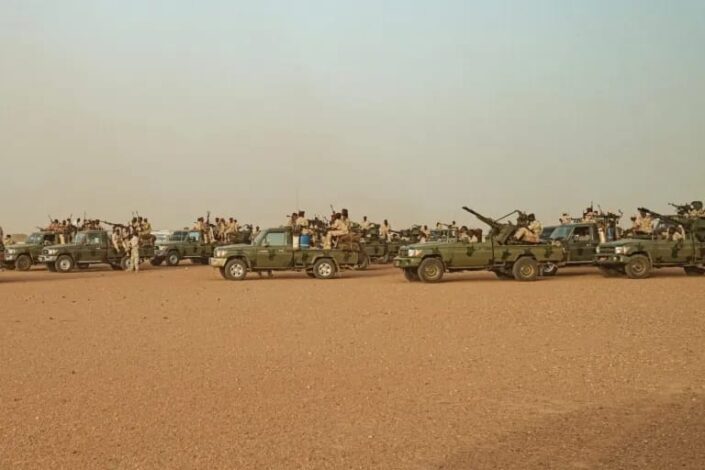
Sudan’s war enters its fourth year with no end in sight. Since April 2023, the conflict between the country’s army and the Rapid Support Forces (RSF) militia has displaced nearly 14 million people, including more than 4 million who have fled to other countries. International attention has waned even as the violence intensifies and the humanitarian catastrophe deepens. And international mediation efforts appear to be as stalemated as the fighting, and Sudan’s self-declared leaders cannot even agree on who should get a seat in any future political talks.
The American magazine “Foreign Policy” sounded the alarm regarding the military and political developments in Sudan as the armed conflict enters its fourth year, stressing that the international community faces a pivotal legal and moral obligation to end the policy of “passive neutrality” and the equating of atrocities committed by both sides of the conflict. The magazine described this policy as having failed to curb the war and instead providing political cover for the Rapid Support Forces to proceed with the division of the country and entrench impunity.
In a prominent analytical report, the magazine called on the US administration and the international community to expedite the designation of the Rapid Support Forces as a “Foreign Terrorist Organization (FTO),” based on three main dimensions that define the current Sudanese catastrophe:
1. The Legal Foundations of “Terrorism and Genocide”
The report, relying on investigations by the United Nations and human rights rapporteurs, confirmed that the field practices of the Rapid Support Forces (RSF) went beyond military definitions to constitute the full legal foundations of “terrorism” and “genocide.” It highlighted:
The systematic targeting of civilians: through summary executions, the use of rape and sexual slavery against women, and the targeting of people with disabilities, as occurred in the massacres of El Fasher and El Geneina in Darfur.
The destruction of infrastructure: the deliberate bombing of hospitals, camps for internally displaced persons (IDPs), water and electricity networks, and the agricultural sector to forcibly displace the population.
The institutionalization of violations: the reinstatement of commanders implicated in the Darfur atrocities to field duty by order of the high command, demonstrating the adoption of terrorism as a political and military tool.
2. The Partition Plan and the “Parallel State”
The report warned of a dangerous shift threatening to dismantle Africa’s third-largest country, following the Rapid Support Forces’ establishment of “parallel governance structures” in the Darfur region. These structures include security and defense councils, banking institutions, and a separate currency. Foreign Policy cautioned that this scenario threatens to create a safe haven for terrorism, jeopardizing the security of the Red Sea and the entire regional balance.
Conversely, the report noted an international and regional consensus (including the P5+1, Egypt, Saudi Arabia, and Turkey) on the necessity of preserving the Sudanese Armed Forces as the sole legitimate “constitutional institution” guaranteeing the prevention of the state’s complete collapse.
3. The Weapon of Sanctions and the Stifling of Financing Networks
The magazine called for the activation of measures to pursue and freeze the assets of financial networks, gold traffickers, and arms suppliers who facilitate the continuation of the war and who use the United Arab Emirates as a primary hub for their activities.
The report explained that designating the Rapid Support Forces (RSF) as a terrorist organization would strip its parallel administration of political legitimacy and end the “unjust equivalence” between a rebel militia and the regular army, thus providing the latter with sufficient guarantees to engage in serious negotiations leading to a civilian transition.
Protecting Humanitarian Action (The Yemen Model)
The report addressed concerns about the impact on the flow of humanitarian aid—given that the number of displaced persons and refugees is approaching 14 million—citing the example of US sanctions against the Houthis in Yemen. It noted the US Treasury Department’s ability to issue strict “general licenses and exemptions” that protect the work of aid organizations and ensure the flow of food and medicine, while exempting vital civilian communications services such as Starlink base stations.
Report Conclusion:
Foreign Policy concluded its report by emphasizing that designating the RSF as a terrorist organization is not merely a symbolic step, but a legally and economically enforceable tool of pressure. The international community’s failure to establish a moral “red line” will only accelerate the fragmentation of Sudan and deepen the humanitarian catastrophe.