
Is Exporting Female Lambs a “Crime” or an Economic Necessity?

The Great Sudanese Sheep Debate ;
By Eng. Abdelrahman Mohamed Zain (Magdi)
Health, Safety & Environment Editor – The Citizen
Member, Society of Environmental Engineers (SEE-UK)
Associate Member, ASHRAE-USA
Following my recent dialogue with Professor Faisal Al-Zubair on Eid sacrifice guidelines, my inbox was flooded with messages from readers. But the most passionate responses did not concern meat quality or veterinary inspections. Instead, they focused on a far more controversial issue: the export of female sheep (ewes) from Sudan.
A heated social media campaign has emerged under hashtags such as:
#Crime_of_Exporting_Females
#Hamari_Breed_Red_Line
#Where_is_the_Livestock_Minister
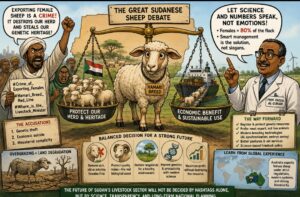
Activists describe the export of live female sheep — particularly the highly valued Hamari breed — as “a historical crime against the national economy” and “a threat to Sudan’s genetic livestock heritage.”
But is the situation truly that simple?
To explore the issue beyond emotion and political rhetoric, I returned to Professor Faisal Al-Zubair Ahmed Omar, Professor of Theriogenology at the Faculty of Veterinary Medicine, University of Khartoum, and Advisor on Animal Genetic Improvement, to examine the issue through science, economics, and international livestock management experience.
The Accusations:
What the Campaign Claims
The online campaign raises three main concerns:
1. Genetic Resource Loss
Activists argue that exporting Hamari and other purebred ewes transfers Sudan’s valuable genetic resources to foreign countries, potentially allowing competitors to reproduce Sudanese breeds and weaken Sudan’s future advantage in livestock markets.
2. Economic Damage
Critics warn that removing productive females from the national herd could reduce reproduction rates, increase meat prices locally, and eventually weaken Sudan’s livestock export sector.
3. Administrative Negligence
Some social media activists accuse officials of insufficient oversight regarding female livestock exports.
However, these accusations remain claims circulated on social media and have not been independently verified by The Citizen.
Professor Faisal’s Scientific Perspective:
“Let Science and Numbers Speak”
Professor Faisal did not dismiss public concerns emotionally. Instead, he emphasized the need for evidence-based livestock policy.
“For many years, discussions about female livestock export or slaughter have often been influenced by political pressure and commercial interests rather than scientific livestock management criteria,” he explained. “Major policy decisions should involve specialists in animal production, veterinary science, genetics, and rangeland management.”
He then referred to livestock population estimates:
The 80% Reality
According to estimates discussed during the interview:
Total sheep population in Sudan: approximately 42 million head
Females: approximately 33.6 million head
Males: approximately 8.4 million head
This means females constitute nearly 80% of the national flock.
Professor Faisal argues that maintaining excessively large numbers of breeding females without modern range management places enormous pressure on Sudan’s fragile natural grazing systems.
“Overgrazing contributes directly to land degradation, declining pasture quality, and environmental stress,” he noted.
For this reason, he believes that exporting or culling a controlled proportion of females does not necessarily threaten the national herd — provided the process is scientifically managed and carefully regulated.
Priority-Based Selection:
Which Females Should Be Removed First?
Professor Faisal insists that any export or slaughter policy involving females should follow a strict scientific hierarchy:
Females with reproductive or chronic health problems
Old ewes beyond productive age
Healthy females only when necessary to reduce pressure on rangelands and after proper veterinary and production assessments
“Scientific herd management is not about random removal,” he explained. “It is about improving the overall productivity, health, and sustainability of the flock.”
An Important Clarification:
Breeding Export vs. Slaughter Export
Professor Faisal also emphasized the need to distinguish between two very different export categories:
Export for Slaughter
Animals exported primarily for meat production and immediate slaughter.
Export for Breeding and Genetic Improvement
Animals exported specifically for reproduction and breed development programs.
The economic and genetic implications of these two categories are entirely different and should not be confused in public debate.
The Counterintuitive Argument:
“The Greater Biological Risk May Actually Be Male Export”
One of Professor Faisal’s most surprising observations concerns male sheep.
Because Sudan’s flock already contains a relatively limited proportion of males, the excessive export or slaughter of healthy breeding rams may reduce fertilization efficiency within the national herd.
“High-quality males are biologically critical,” he explained. “A reduction in strong breeding rams can negatively affect fertility and future flock productivity.”
He described excessive live male export as a “silent biological drain” if not scientifically monitored.
The Hamari Breed:
Fertility and Regeneration Capacity
Professor Faisal highlighted the well-known fertility advantages of Sudanese sheep breeds, particularly the Hamari breed, which is recognized for high twinning rates and strong adaptation to Sudanese pastoral environments.
He explained that flock regeneration depends on:
Genetics
Veterinary care
Nutritional quality
Seasonal pasture conditions
“If traditional pastoral systems are properly managed in regions such as Butana, Kordofan, and Darfur, the flock can regenerate effectively,” he said.
International Perspective:
The Australian Example
A fellow livestock specialist and colleague of Professor Faisal also challenged the idea that exporting females is automatically “a crime.”
He pointed to the example of Australia, one of the world’s leading livestock-exporting nations.
“Australia exports female cattle and sheep regularly for breeding purposes under highly regulated systems,” he explained. “The issue is not the export itself, but whether the country has modern production systems, genetic programs, and scientific management.”
However, he also acknowledged that Australia’s success depends on advanced infrastructure, including:
Electronic livestock tracking systems
Genetic improvement programs
Modern pasture management
Strict veterinary and export regulations
He argued that Sudan should focus on strengthening its own production systems rather than relying solely on restrictive export policies.
The Way Forward:
Science, Technology, and Regulation
Professor Faisal does not advocate unrestricted export policies. Instead, he proposes a modern livestock strategy based on science and sustainability:
Key Recommendations
Register Sudanese genetic resources internationally to protect national livestock heritage and food security.
Prioritize exporting processed meat instead of relying heavily on live animal exports.
Expand semi-intensive and modern breeding systems using:
Artificial insemination
Estrus synchronization technologies
Advanced reproductive management
Improve veterinary services and pasture management systems.
Shift livestock policy discussions from emotional political debate toward expert-led scientific planning.
“Modern livestock production is governed by economics, sustainability, and science,” he concluded. “The objective is to maximize national economic benefit without destroying the resource itself.”
Balanced Verdict:
Crime or Economic Necessity?
The concerns raised by activists should not be dismissed. Sudan has experienced periods of poor resource management, weak regulation, and short-term economic decision-making.
Any export of female breeding stock should therefore be transparent, scientifically justified, and carefully monitored.
However, Professor Faisal and other livestock specialists argue that a complete ban on all female exports may oversimplify a highly complex issue.
The real questions are:
How many females should be exported?
Which categories should be selected?
Under what veterinary and genetic controls?
What investments are being made in modern breeding systems and pasture recovery?
Final Reflection
The future of Sudan’s livestock sector will not be decided by hashtags alone, but by science, transparency, long-term planning, and responsible management of one of the country’s most strategic national resources.
What Do You Think, Reader?
Should Sudan prohibit all exports of female sheep to preserve its genetic livestock heritage?
Or should the country adopt a regulated scientific model similar to major livestock-exporting nations while investing heavily in genetic improvement and sustainable production systems?
Write to: mr.zainrac@gmail.com
Eng. Abdelrahman Mohamed Zain (Magdi)
Health, Safety & Environment Editor – The Citizen
Member, Society of Environmental Engineers (SEE-UK)
Associate Member, ASHRAE-USA