
From Classrooms to Mining Fields: Why Sudan Needs a Revolution in Health, Safety, and Environment
By The Citizen Editorial Team
In a country endowed with vast natural resources and a youthful, creative population, one critical question persists: why do we still lag in building a preventive culture that protects people before profits, health before production, and the environment before exploitation?
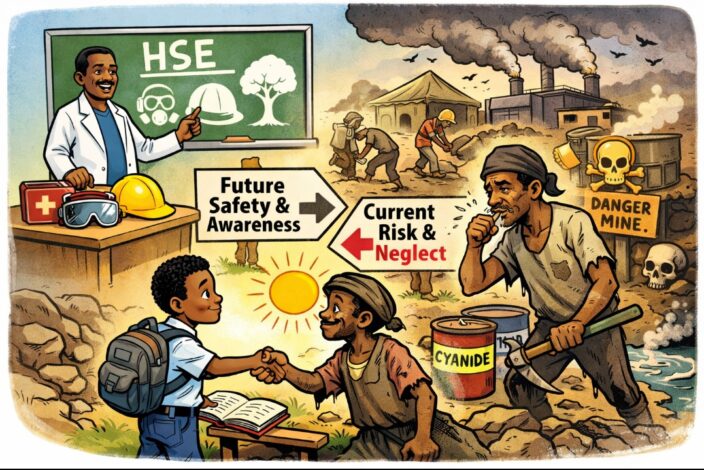
As Sudan prepares for a post-war reconstruction phase—and as artisanal gold mining continues to sustain millions—a harsh reality emerges: the challenge is not a lack of resources, but the absence of a deeply rooted Health, Safety, and Environment (HSE) culture from the very beginning.
What may seem like two separate issues—education and safety in high-risk industries—are, in fact, deeply interconnected.
First: Safety Begins in the Classroom
Engineer Abdelrahman Mohamed Zain (Magdi), an expert in industrial refrigeration and safety culture, highlights a fundamental gap:
“In Sudan, we still teach reading, writing, and arithmetic—but we do not teach our children how to protect themselves, how to respond to danger, or how to respect the environment. This is not a minor oversight; it is a structural flaw in our educational philosophy.”
He adds:
“No education system can claim to prepare future generations while ignoring the principles of health, safety, and environmental awareness from early childhood.”
Integrating HSE education from kindergarten through university is no longer optional—it is a national necessity. However, Magdi warns:
“Modern curricula have no value if delivered through outdated methods based on memorization and fear. Safety is not something to be memorized—it must be practiced, observed, and experienced.”
This calls for a transformation in teaching methods, shifting from passive learning to interactive engagement through simulations, hands-on training, and dynamic classroom environments.
Second: When Safety is Absent in Artisanal Mining
While the classroom reflects one side of the issue, the mining fields reveal its consequences.
A forthcoming scientific seminar organized by the Loyalty Organization of the University of Gezira, in collaboration with its alumni association, will address a critical topic:
“Cyanide and Mercury Compounds Used in Gold Mining and Their Health Impacts”
The session will be delivered by Professor Nasr Eldin Kabashi (Islamic University of Malaysia), alongside distinguished academics.
What is happening in artisanal mining areas?
Unregulated use of cyanide and mercury
Severe contamination of water, soil, and air
Rising cases of neurological, liver, and kidney diseases
Weak enforcement of international safety frameworks such as the International Cyanide Management Code and the Minamata Convention on Mercury
According to the World Health Organization, mercury exposure can severely damage the nervous system, particularly in children, while cyanide exposure can be rapidly fatal even in small quantities.
The question is: why does this gap persist?
The answer leads us back to the starting point: workers in mining fields were never taught—during their formative years—what danger means, how to use protective measures, or how to report hazardous incidents.
Third: The Hidden Link – Education and Field Management
What appears to be two separate problems is, in reality, one systemic issue: safety culture is not embedded in the foundational development of individuals.
Schools do not instill preventive behavior
Universities graduate engineers with limited real-world risk assessment training
Mining sites often operate without qualified safety supervisors
Environmental degradation continues with weak regulatory enforcement
Thus, the call for an educational revolution is not merely academic—it is the cornerstone of industrial and environmental reform.
Fourth: What If We Got It Right?
Imagine a different scenario:
A primary school student learns through interactive tools that cyanide is toxic and mercury vapor harms the brain
A high school student participates in emergency evacuation drills in simulated lab environments
A university graduate enters a mining site equipped to read Material Safety Data Sheets (MSDS), issue work permits, and report near-misses
A mining worker consistently uses personal protective equipment because safety behavior has been ingrained through vocational training
Only then can Sudan transition from chaotic resource exploitation to safe and sustainable resource management.
Fifth: Reconstruction as a Historic Opportunity
As emphasized by Engineer Magdi, post-war reconstruction must go beyond rebuilding infrastructure:
“It is an opportunity to rebuild Sudan on foundations of awareness, discipline, and safety. Every reconstructed school must meet safety standards. Every university must activate emergency systems. Every mining operation must prioritize prevention over production.”
This requires bold national decisions:
Mandatory integration of HSE education across all levels
Compulsory practical safety training for workers in mining and industry
Strict enforcement of international frameworks like the International Cyanide Management Code and the Minamata Convention
Allocation of mining revenues to environmental awareness and training programs
Conclusion: Integration, Not Fragmentation
The Citizen affirms that addressing education and mining safety must be approached through an integrated framework combining engineering, public health, environmental policy, and education reform.
The problem is not merely toxic substances or weak curricula—it is:
Poor governance
Weak regulatory systems
Lack of awareness and training
And most critically, the absence of a preventive culture from early childhood
Final Recommendations
Ministry of Education: Develop a national, interactive HSE curriculum from early education to secondary school
Universities and Technical Institutes: Introduce mandatory courses in risk assessment, laboratory safety, and environmental management with real field training
Ministry of Energy and Mining: Enforce safety regulations, require certified safety officers, and establish an environmental compensation fund
Media Organizations: Launch national campaigns such as “Safety Starts at School” and “Safe Mining for Safe Lives”
Civil Society: Translate scientific outputs into accessible awareness materials for workers in mining areas
Final Word
Safety is not just helmets, goggles, or gloves. It is about respecting systems, people, public spaces, the environment, and life itself.
This is the essence of modern civilization.
The question remains:
Will we begin building a new Sudan—from classrooms to mining fields—today, or wait for another disaster to awaken us?
The choice is ours.
The Citizen – Weekly Edition