
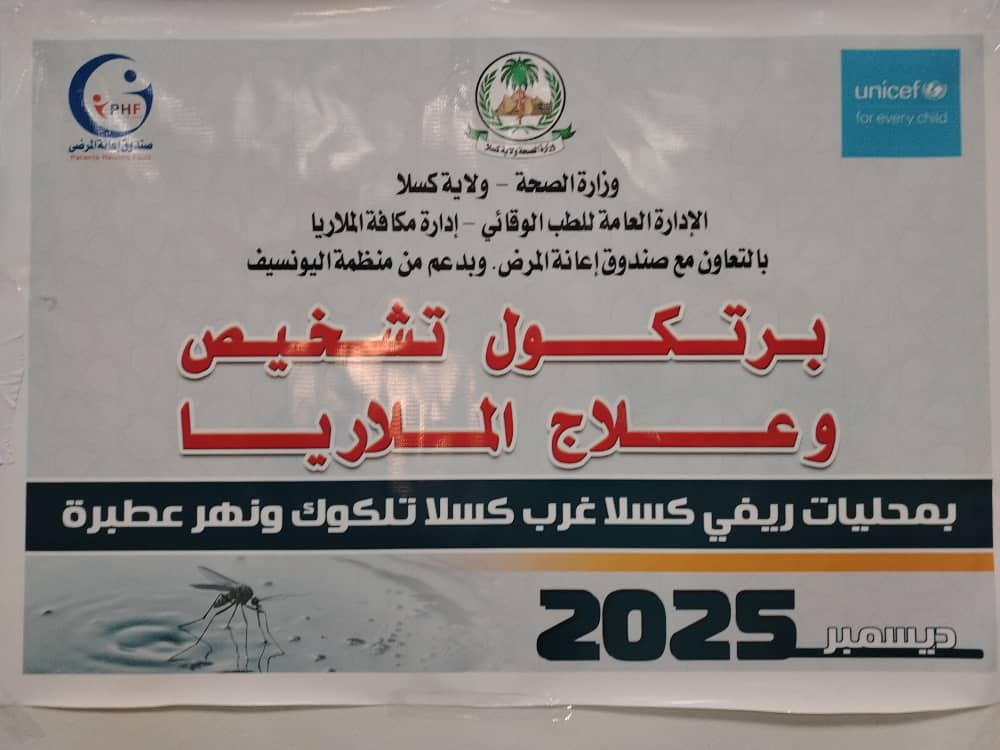
A Training Course on the Protocol for the Diagnosis and Treatment of Malaria in Kassala State
Kassala/The Citizen
Kassala State Ministry of Health, represented by the General Directorate of Preventive Medicine, in cooperation with the Patient Assistance Fund, with the support of UNICEF, organized a training course on the updated malaria diagnosis and treatment protocol, targeting the rural localities of Kassala, West Kassala, Talkok, and the Atbara River.
The representative of the Director General of Kassala Health Ministry, Hassan Mohamed Ali, confirmed that the training on the diagnosis and treatment protocol for malaria came at the right time with the entry of the winter season, noting that one of the most important strategies for control is early detection and treatment. Through the protocol, this is achieved, appreciating the role of partners from international and UN organizations, especially UNICEF and the Patient Relief Fund.
The Partnership Officer at the National Malaria Control Program, Al-Rasheed Mohamed Ali, stressed the great political commitment of the state government to support the fight against malaria, especially since it continues to represent the country’s number one health problem and an economic burden.
The Director of the Malaria Control Program at Kassala Health, Munira Bashir, revealed that the training courses target the cadres working in the field in all localities, provided that this course will be allocated to four localities. She announced the printing of 300 copies of the protocol that will be distributed to centers in the localities supported by the Patient Assistance Fund, stressing the commitment to its implementation.
The representative of the Patient Assistance Fund, Muawiya Abdel Jalil, announced that the training includes 188 cadres from four localities to raise their efficiency, which is considered a strategic direction.
The UNICEF representative confirmed that the organization, in partnership with federal and state health authorities, is working to increase the capacities of cadres as the first line of defense, noting that the protocol helps reduce the number of patients and deaths due to malaria.