
Pressure mounts on the Australian government to reconsider its arms sales policy to the UAE
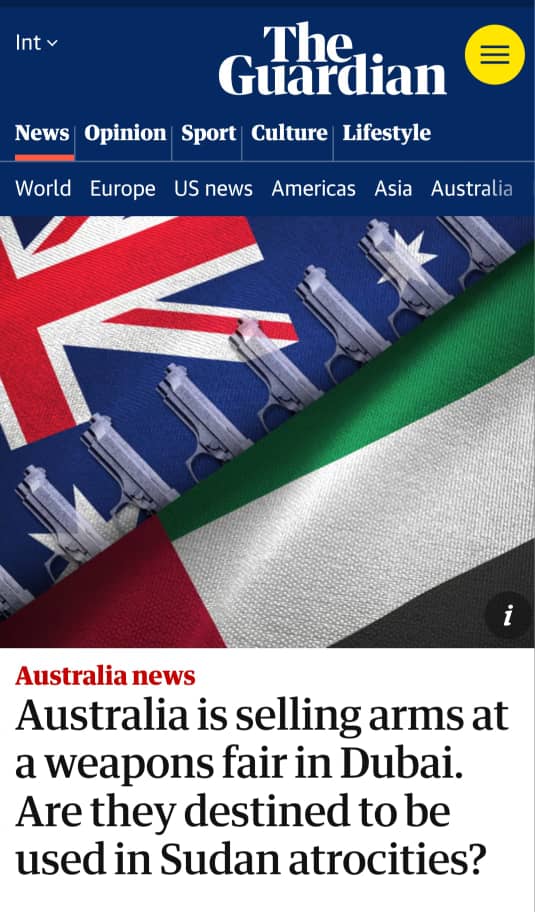
The Guardian (Australian edition) accused the Canberra government of exporting weapons and military equipment to the United Arab Emirates while turning a blind eye to the fact that these weapons ultimately find their way to Sudan, specifically Darfur, to be used by the UAE’s allies – the Rapid Support Forces (RSF) – even as its foreign minister signs a statement with a group of countries condemning this paramilitary militia, which has been accused of committing war crimes, genocide, and ethnic cleansing in Sudan in general and in Darfur in particular.
The article, authored by journalists Henry Bellot and Ben Dohert, was titled “Australia sells weapons at a Dubai arms fair. Are these weapons being used in Sudan’s atrocities?” It indicated that Australian companies exported nearly $300 million worth of weapons over five years to the UAE, which denied shipping these weapons to the paramilitary group in Sudan.
Australia is participating in the Dubai Airshow, which began last Monday and is considered a showcase for the latest military aircraft and air defense technologies. The Australian defense team occupies a significant portion of the space, with a central pavilion in the arms exhibition area, where more than 35 Australian companies will be represented. This prominent position for Australia is perhaps well-deserved. The United Arab Emirates is, by far, the largest market for Australian arms imports, with nearly $300 million worth of weapons and ammunition shipped there over the past five years.
The newspaper reports that in Australia, parliamentarians, human rights organizations, and religious groups have called for a suspension of defense arms exports to the UAE, citing consistent reports by UN investigators that the UAE has armed a militia accused of genocide in Sudan. The Sudanese paramilitary Rapid Support Forces are accused of carrying out a campaign of mass killings, rape, and torture that intensified with the capture of El Fasher last month in the famine-stricken Darfur region.
The newspaper notes the growing pressure on the Australian government to reconsider its policies. This month, the Quakers Australia contacted Foreign Minister Penny Wong, arguing that Australia cannot be certain—due to the opacity of its arms export regime—that Australian-made weapons are not being diverted to armed groups elsewhere.
The Medical Association for the Prevention of War, along with other civil society organizations, has also called for an urgent parliamentary review of Australia’s arms exports, arguing that the current export system lacks accountability.
The journalists point out that thousands of civilians are believed to have been killed, and that the scale of the reported killings is substantial, supported by satellite imagery, the presence of bodies on the ground, and widespread discoloration of the land, stained with blood.
According to recent UN expert reports, the Rapid Support Forces—formerly allied with the Sudanese government but now fighting against it—acquired sophisticated weapons from the United Arab Emirates via Chad and Libya, using these weapons to kill non-Arab Sudanese.
The United Nations is investigating arms supplies to Sudan:
The newspaper confirms that over the past five years, Australia has exported $288 million worth of weapons and ammunition to the United Arab Emirates, according to government figures, a huge increase from 2019. However, Australian export data does not include details on the type and quantity of weapons exported to the UAE.
The UAE is arguably the largest export market for Australian defense companies:
Separate figures from the UN’s Comtrade database indicate that the UAE received $197 million worth of arms, ammunition, spare parts, and accessories from Australia over the past five years, and that Australia was the UAE’s fourth-largest arms supplier during that same period.
But there is growing evidence that the UAE is arming the Rapid Support Forces (RSF), largely in exchange for gold. An estimated $13.4 billion worth of Sudanese gold is smuggled out of the country illegally, dwarfing legitimate trade: most of it ends up in the UAE.
In April, a UN panel of experts revealed a significant number of cargo flights originating from the UAE, reportedly carrying weapons, ammunition, and medical supplies to the RSF via Chad.
The UAE has denied any involvement in arms smuggling, insisting that its flights were humanitarian missions, delivering supplies to a field hospital, sewing machines, and copies of the Quran. But British-made targeting systems and armored personnel carrier engines have been found at combat sites in Sudan. Bulgaria has also stated that weapons it supplied to the UAE were re-exported without authorization, and some ended up in Sudan.
The UAE military itself has previously been accused of war crimes and violating arms embargoes – including in Yemen and Libya – though the UAE denies committing such crimes.
The Australian government supports expanding defense sales:
Despite concerns from human rights groups, the Australian government believes its defense relationship with the UAE has the potential to expand further. In a memo to defense companies last month, the Australian Trade Agency (Austrade) said that the UAE’s “comprehensive and ongoing defense procurement program represents real opportunities for Australian suppliers.” The government covered the costs for dozens of companies to showcase their products “face-to-face with the UAE Ministry of Defence” in Dubai.
A government briefing paper stated: “At least one senior retired Australian Defence Force officer will be present to lead the delegation. They will provide advice and support, in addition to their inherent credibility.”
The paper poses the question: When you start selling weapons to regimes like the UAE, what do you expect to happen? These weapons will be used in some of the world’s deadliest conflicts.
Human Rights Watch, on the other hand, said that Australia is obligated under international law to ensure its military trade does not contribute to human rights abuses.
Daniella Gavson, director of Human Rights Watch Australia, said: “But Australia doesn’t have laws in place that require it to monitor where and how these exports are used after they are exported.”
“It’s impossible” to prove that the weapons are not being used in Sudan:
A spokesperson for the Australian Department of Defence said that it has “a robust and transparent framework for export controls that is in line with international obligations.”
The spokesperson added that Australian law addresses “a range of issues, including… policy, human rights, and national security.” Regional security and Australia’s international obligations, including the Arms Trade Treaty, are also at stake. Laws came into effect last year to provide greater oversight of the transfer of “controlled goods” to foreign recipients.
The Department of Defence did not respond to the newspaper’s questions about whether and how weapons are monitored after being exported to the UAE.
However, the Australian government has condemned the atrocities committed in Sudan and called for a three-month “humanitarian truce.” Wong was a signatory to a joint statement by 27 countries expressing “grave concern about reports of systematic and ongoing violence against civilians.”
Philip Kastner, a senior lecturer in international law at the University of Western Australia, told the Guardian that while it is difficult to confirm the re-export of Australian-made weapons to Sudan, “I would say it is impossible to confirm the opposite: that these weapons have certainly not been used in Sudan.”
Kastner argued that weapons do not bring peace. “It may be an increasingly lucrative business for Australian companies, but we need to ask ourselves, as a society, are we really seeking to increase our wealth through arms manufacturing?”