
A Silent Threat, Cooking Gas Misuse in Refrigerator and AC Repairs
By Eng. Abdelrahman Mohamed Zain Abdeldafi (Magdi)
In recent months, Sudan has witnessed a concerning trend that goes beyond the rising cost of living. The sudden surge in the price of cooking gas cylinders is not only the result of economic factors but also linked to an unexpected consumer group—domestic refrigeration and air-conditioning technicians.
These technicians, in the absence of proper regulatory frameworks, are increasingly using cooking gas (LPG) as a substitute refrigerant or cleaning agent in refrigerators and air conditioners. This practice is technically unsound, unsafe, and environmentally destructive.
“Using cooking gas in cooling systems is not innovation—it is negligence.”
The Growing Misuse of Cooking Gas
Originally intended for household cooking, LPG has now found its way into repair workshops and even homes during on-site servicing of fridges and air conditioners. Instead of using appropriate refrigerants such as R134a, R600a, or R290, some technicians rely on cooking gas cylinders due to their availability and lower cost.
This misuse is highly problematic:
Safety Risks: LPG is highly flammable, creating serious fire and explosion hazards.
Technical Damage: It causes irreversible harm to compressor systems and Refrigeration and Air conditioning circuits.
Environmental Impact: It undermines global commitments to safe and sustainable refrigerant practices.
“Sudan cannot afford to lag behind international environmental obligations.”
The Gap: Lack of Regulation and Training
This alarming trend exposes a deeper issue—the absence of a structured framework to regulate the refrigeration and air-conditioning (RAC) profession in Sudan. Unlike many countries, Sudan has no licensing system for RAC technicians, no mandatory health and safety training, and no alignment with international environmental protocols.
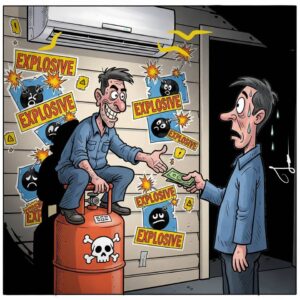
The result? A wide gap in competency levels among technicians, ranging from highly skilled engineers to poorly trained individuals improvising with dangerous substitutes like cooking gas.
“The real crisis is not the gas itself—it is the vacuum in policy and training.”
Why Sudan Must Act Now.
Sudan stands at a crossroads. The deadline of December 31, 2024, for countries to sign or ratify the Montreal Protocol and Kigali Amendment, has already passed. However, due to the war and exceptional national circumstances, Sudan still has the opportunity to request an extension.
Failure to act means:
Losing access to international funding for training and technology upgrades.
Being excluded from technical support programs by UNEP and other agencies.
Allowing unsafe practices, like LPG misuse, to continue unchecked.
By signing and implementing the Montreal Protocol, Sudan can access financial assistance, build technician capacity, and align itself with global environmental protection efforts.
A Call for Immediate Action
The misuse of cooking gas in refrigeration and AC systems is not just a technical malpractice—it is a national environmental and public safety threat. The government, through the Higher Council for Environment, must urgently:
1. Request an exceptional extension from UNEP to ratify the Montreal Protocol.
2. Develop a licensing framework for refrigeration and air-conditioning technicians.
3. Launch national training programs to raise awareness of health, safety, and environmental practices.
“Sudan’s refrigeration sector must transform—from unsafe improvisation to professional, sustainable practice.”
The time to act is now.
By addressing this issue with urgency, Sudan can protect its people, safeguard its environment, and reclaim its rightful place in the global effort against climate change and ozone depletion.
Eng. Abdelrahman Mohamed Zain Abdeldafe (Magdi)
Occupational Health, Safety and Environment Activist
Member, Society of Environmental Engineers, SEE-UK
Member, ASHRAE – Sudan Chapter
Email: mr.zainrac@gmail.com