
Sudan Announces from Geneva a 50% Reduction in the Burden of Unvaccinated Children
Geneva /
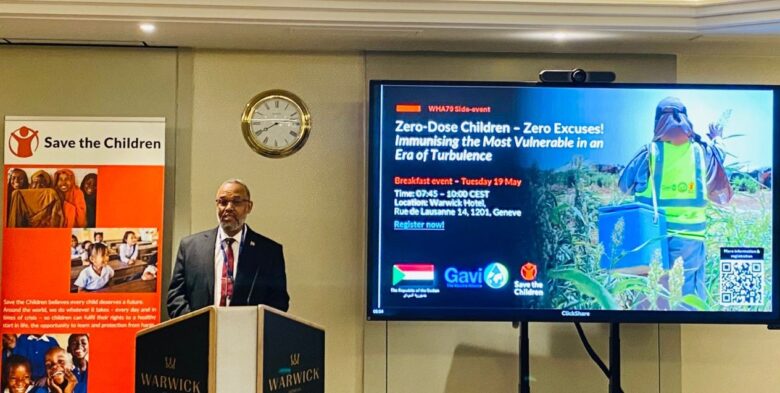
Sudan’s Federal Minister of Health, Dr. Haitham Ibrahim, announced on Tuesday, May 19, 2026, from Geneva that Sudan has succeeded in reducing nearly half of the national burden of children who have not received any vaccinations within just two years, despite the challenges the country has faced due to the rebellion of the Rapid Support Forces militia.
This announcement was made during the minister’s participation in a side event of the 79th World Health Assembly, dedicated to the issue of “Zero-dose children — No excuses! Immunizing the most vulnerable children in times of disruption.” The event was organized by Save the Children, with participation from Sudan and Gavi, the Vaccine Alliance, as part of the Assembly currently taking place in Geneva.
The minister explained that Sudan had been carrying one of the highest burdens of unvaccinated children in the world, with more than 1.2 million children missing vaccinations. Most of these cases were concentrated in Darfur, Kordofan, Khartoum, and Al Jazirah, due to the destruction of health facilities, mass displacement, and disruptions to vaccine supply chains caused by the militia’s rebellion.
He noted that in 2024, Sudan launched the “Catch-up Vaccination Initiative,” internationally known as “The Big Catch-Up,” in collaboration with the World Health Organization (WHO), UNICEF, Save the Children, and Gavi. By May 2026, the country had vaccinated approximately 450,000 children and achieved coverage exceeding 90% in nine out of the seventeen states included in the campaign.
The minister emphasized that this success was driven by integrating immunization services with broader humanitarian response efforts, engaging local communities and their leaders, and shifting from fixed service models to mobile outreach teams capable of reaching displaced populations in the most affected areas.
However, he warned that declining international funding threatens to undermine these gains, calling on the international community to adopt sustainable and flexible financing mechanisms that balance immediate humanitarian needs with long-term health system development.
He concluded by stating: “Reaching these children is not just about vaccines; it is about dignity, justice, and protecting the future of every child.”