
Sudanese Embassy in Djibouti breifs diplomatic missions on developments in the war in Sudan
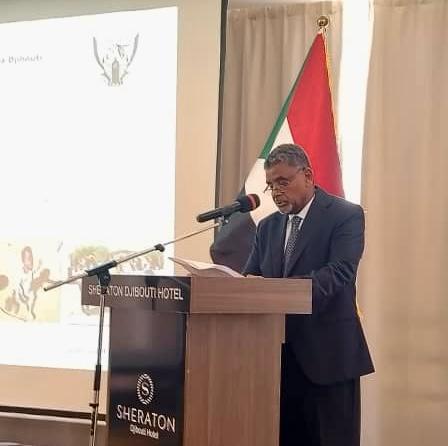
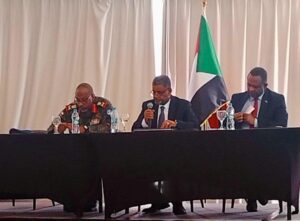
The Sudanese Embassy in Djibouti held a briefing today, Thursday, April 24, 2025, for diplomatic missions in Djibouti on developments in the war in Sudan.
The meeting reviewed the plan that the rebel Rapid Support Forces militias hoped to achieve, with external support and encouragement.
The meeting also addressed the military situation on the ground, the violations committed by the Rapid Support Forces militias, and the atrocities and negative consequences they have caused to civilians and civilian facilities.
In his speech, Ambassador Mohamed Saeed Hassan, Sudan’s Ambassador to Djibouti, pointed out that the abhorrent rebellion of the Rapid Support Forces militias on April 23 is the greatest challenge the country has faced since independence, posing a threat to the existence of the Sudanese state and seeking to fragment its unity in submission to foreign agendas.
The rebellion’s primary goal is to change the state’s identity and carry out demographic replacement, along with the systematic destruction of production centers and essential service centers.
The militia has enlisted the help of mercenaries and criminals from Africa and beyond.
His Excellency also stated that this war would not have continued to this point without the destructive foreign intervention that provided material and military supplies, including weapons and equipment.
This is why Sudan filed its complaint against the UAE, first before the Security Council and then before the International Court of Justice.
Military Attaché, Major General Alaa El-Din Abdullah, spoke about the plan implemented by the armed forces, which was not rushed until its components were fully completed and minimized human losses as much as possible.
His Excellency also indicated that the military situation, following the transition of the army and its supporting forces from a defensive to an offensive position, has achieved significant results and sustained significant losses among the enemy.
He added that despite the rumors the rebel militias are spreading, the reality on the ground belies their claims, evidenced by the noticeable decline and transition from attacking military sites to attacking safe villages. Regarding the siege of El Fasher, His Excellency indicated that the forces of the 6th Infantry Division are achieving good results every day, inflicting heavy losses on the enemy in equipment and lives.
He added that the siege imposed by the militia does not harm the armed forces stationed there, but rather the first and final victims are the citizens.
He emphasized that the armed forces, which hold the initiative, have prepared for El Fasher and all of Darfur, and that the expected results will satisfy all the people of Sudan, and the people of Darfur in particular.
Counselor Omar Essam spoke about the repercussions of the militia’s war, its violations, and the dangers this poses to the region unless they are addressed.
He said that the militia has received weapons exceeding its needs, many of which have leaked into the markets and fallen into the hands of terrorist organizations.
He explained that the rebellion had released more than 19,000 prisoners, including terrorists and ISIS members, adding that terrorism typically resorts to areas with fluid security.
He emphasized that Sudanese intelligence, in cooperation with friendly and sister agencies, has continued to operate according to a highly professional approach to limit, disrupt, and uncover the movements of terrorist organizations and groups.
He addressed the activities of mercenaries brought in from West Africa on an ethnic basis and from outside it by the Rapid Support Forces militia, some of whom are members of terrorist organizations. He also addressed the terrorist operations, killings, rapes, systematic thefts, and sabotage that have affected most of the infrastructure and private and public property.
He also addressed the issue of the current siege of El Fasher and explained the militia’s intentions in doing so. He explained that the greatest harm is being done to the citizens with the intention of displacing them, similar to what happened in Khartoum, Gezira, Al-Geneina, and finally Zamzam camp, where events occurred that did not take into account the elderly, women, or children, and even medical teams were assassinated.
He refuted the militia’s allegations that Zamzam was a military base, explaining that the main reason is that the camp’s residents are from non-Arab ethnicities (Fur and Zaghawa), comparing what happened in Zamzam to what happened in Al-Geneina.