
Egyptian Journalist and Visual Artist Fatima Hassan to The Citizen:
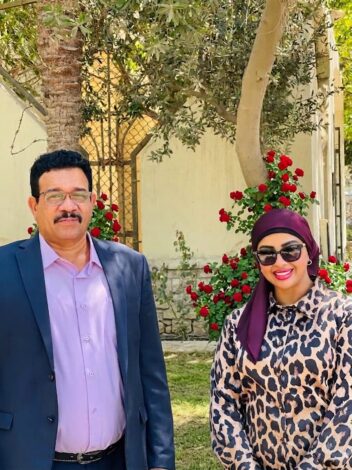
“To me, a painting is a feeling that words cannot express.”
”Journalism and art are not two separate paths for me; rather, each completes the other.”
”My advice to young beginners: Do not fear starting, and do not wait to become a professional before you
begin.”
Interview by: Mohamed Babiker
Introduction
Fatima Hassan is a prominent Egyptian visual artist and media personality known for her unique artistic style, which fuses traditional folk heritage and its warm spirit with touches of contemporary art. Alongside her creative career in painting and art exhibitions, she has achieved a striking media presence through presenting television shows focused on culture, the arts, and community awareness.
Her artwork embodies Egyptian women and the local environment using vivid details, joy, and warm colors. She constantly strives to connect art with the general public and simplify aesthetic concepts to make fine art a part of daily life. She stands as a model of a well-rounded creator who has successfully left an impactful mark bridging the screen and the canvas.
Ms. Fatima Hassan’s journey embodies a distinctive creative brilliance and a rare, insightful perspective through which she skillfully blends the principles of media work, the sensitivity of fine art, and the precision of drawing. Speaking with genuine candor and a refined human touch, she has proven her extraordinary ability to face the camera with poise and mastery on
her show,
Samra —breathing life into the broadcast space and turning the act of live painting into a dynamic, spontaneous, and profound dialogue.
This interview offers a thoughtful look into the mind of an artist and broadcaster who managed to deconstruct the isolation of elitist art, converting it into a tangible everyday language that engages the mind and touches the soul. I met her in Cairo for this candid conversation, where she spoke with complete transparency, emphasizing that art and journalism are a single path aimed at raising social awareness.
Below is the transcript of the interview:
Q: How was the idea for the show Samra born? And what was the main message you wanted to convey through it?
A: The idea for Samra came from my desire to bring visual art closer to people, rather than keeping it confined to exhibition halls and museums. I always felt that a broad audience loved art but sometimes didn’t know how to approach or understand it. So through the program, I tried to present art in a simple, human-centered way that combines dialogue, drawing, information, and talent discovery. The core message is that art is a part of our lives, and every human being has an inner space they can express through art, even if they aren’t a professional artist.
Visual art is sometimes viewed as an elite art form.
Q: How were you able to present the fundamentals of drawing and portraiture in a simplified manner suitable for different age groups in the segment First Year of Drawing?
A: I firmly believe that visual art has no age limit or social class. In First Year of Drawing, I try to approach drawing as a simple language whose fundamentals anyone can learn. I don’t want the viewer to feel that drawing is complex or requires extraordinary talent; instead, I show them that practice, patience, and understanding the basics can make a world of difference. I always like to start from the simplest point, because the most beautiful thing for me is watching someone say, “I didn’t know how to draw,” and then discover that they actually can.
The segment 40 Matches relies on live drawing and real
-time interaction.
Q: What challenge does an artist face when drawing in front of a camera and within a limited time?
A: Drawing in front of a camera is entirely different from drawing inside a studio. In the studio, you have your own time and quiet; you can step back and make adjustments. But in front of the camera, there is a fixed time, studio lighting, movement, dialogue, and an audience waiting for the final result. The real challenge is maintaining my focus while simultaneously interacting with the guest and the viewer. However, I love this challenge because it lets me experience the moment of drawing differently, producing a result filled with more soul and spontaneity.
Q: How does the program contribute to discovering young talent and fostering a culture of art collecting in society?
A: Discovering talent is a fundamental part of Samra’s mission, especially since many children and young people possess genuine talent but need someone to discover and encourage them. Therefore, I place great emphasis on featuring young talents and giving them a platform before the public.
As for art collecting, I want to change the idea that a painting is merely something to look at or an unreachable luxury. Acquiring a piece of art means acquiring a feeling, a memory, and an aesthetic value
—and at the same time, you are supporting the artist and helping sustain the art movement.
Q: Your artwork noticeably addresses women’s issues and the human condition. What is the primary driving force behind these themes in your paintings?
A: The human being is what preoccupies me most, and women in particular—with all the feelings, experiences, and human details they carry. I do not paint a woman merely as a shape or a set of attractive features; I try to seek out the story behind the face and the eyes. Sometimes, a painting is an attempt for me to read feelings that words fail to express.
Q: How do you select the colors and techniques used to express the hidden emotions within the secrets of portraiture?
A: To me, color is not just an aesthetic element; it is a language and music within the canvas. Sometimes I use calm colors when I want to convey contemplation or nostalgia, and other times I turn to stronger colors when the mood is full of energy or conflict. In portraiture specifically, I pay close attention to the eyes and facial expressions, because I believe true character reveals itself in the subtle details, not just in external resemblance.
Q: How has your perspective on the canvas and the artistic space evolved between your early career and your recent exhibitions?
A: In my early days, I was more concerned with mastering form and detail to achieve a polished image. Over time, the canvas became a broader space to express thought and emotion. I started asking myself, “What do I want to say?” rather than just “What do I want to paint?” This shift gave me more freedom in dealing with color, line, and space, leading me to seek my own signature rather than just a beautiful form.
Q: As a member of both the Journalists’ Syndicate and the Fine Artists’ Syndicate, how does journalism feed your imagination as an artist, and how does your artistic sensibility serve your media work?
A: Journalism has allowed me to see human nature from many different angles. My journalistic work
—especially direct engagement with people and diverse stories—has made me more capable of reading characters, emotions, and subtle details. Conversely, art has given me the ability to see the story behind the headline and pay attention to detail, rhythm, and composition. I believe journalism and art are not two separate paths for me; each completes the other.
Q: How do you view the current state of the fine arts movement? What does Arab media need to transition fine arts from elite status to mainstream popularity?
A : In Egypt and the Arab world, we have very important artistic talents and experiences. However, in my opinion, the problem is not the existence of art, but rather how it reaches the public. We need art media that is closer to the people—media that speaks about art in simple language without losing its value or depth. We also need more programs and platforms that introduce young artists, explain artworks, and connect art to the daily life of the citizen. When the audience understands a painting and feels that it speaks to them, art will naturally become an integral part of society rather than something distant.
Q: What painting or artistic project do you still aspire to accomplish that has not yet seen the light of day?
A: I always have many projects and ideas in my mind, some of which require time to materialize the way I envision them. But what I aspire to most is a major project that bridges visual art and media, telling human stories through images, paintings, and words. I love the idea of a painting being the start of a story, and that behind every face, there is a story worth telling.
What advice would you give to young people and children who want to enter the world of visual art or art media?
The most important advice is not to be afraid of starting. Don’t wait to become a professional before you begin; start, then learn and develop yourself. Look at artists’ works, read, visit exhibitions, try different materials, and don’t compare yourself to others. In media specifically, I tell young people: Be authentic, because the audience can feel who speaks from the heart and who is just trying to appear on camera. Talent is important, but continuity and learning are far more vital.