
Your Next Step Could Be Your Last!

Step Voltage and Touch Voltage ; The Hidden Electrical Hazards That Can Kill—and How to Protect Yourself and Others
“One wrong step can be fatal. Understanding electrical hazards today may save your life tomorrow.”
By Eng. Abdelrahman Mohamed Zain (Magdi)
Every year, thousands of people around the world are killed or seriously injured by electricity,not because they intentionally touched an energized conductor, but because they unknowingly stood in a dangerous location or attempted to rescue a person or an animal without understanding the hidden electrical hazards around them.
When a medium-voltage or high-voltage power line falls to the ground, many people assume that the danger exists only where the conductor is lying. In reality, the surrounding ground itself can become energized, creating an invisible but potentially deadly hazard. Depending on the system voltage, soil resistivity, moisture content, and environmental conditions, the danger zone may extend several meters from the point of contact.
This phenomenon is known as Step Voltage, while the hazard associated with touching an energized object while standing on the ground is called Touch Voltage. Both are recognized as major electrical hazards in internationally accepted safety standards, including NFPA 70E, IEEE Std. 80, IEC 60479-1, and OSHA electrical safety guidance.
Understanding Step Voltage
When an energized conductor contacts the ground, electrical current spreads outward through the soil in all directions. The electrical potential is highest at the point of contact and gradually decreases with distance.
If one foot is positioned at a higher electrical potential than the other, a voltage difference exists between the feet. Electrical current can then flow through the body, potentially causing severe injury or deat even if the person never touches the power line itself.
Touch Voltage, on the other hand, occurs when a person touches an energized object,such as a vehicle, fence, pipeline, or metal structure. that has become energized by contact with a fallen power line while standing on the ground. In this case, electrical current may pass through the arms, chest, and legs, significantly increasing the risk of fatal injury.

Can Running Save Your Life?
The scientific answer is ; No.
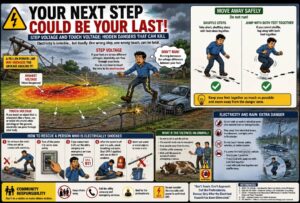
Running naturally increases the distance between your feet, creating a greater voltage difference across your body and allowing more electrical current to pass through you.
Electrical safety practices, consistent with the principles of NFPA 70E and OSHA, recommend the following:
Move away using small shuffling steps, keeping both feet as close together as possible.
If shuffling is not practical, hop away with both feet together while maintaining your balance.
Avoid long strides or separating your feet.
Never approach a fallen power line or any object in contact with it.
Always assume every fallen power line is energized until the electric utility confirms it has been de-energized.
How to Rescue an Electrical Shock Victim Safely
One of the most dangerous mistakes is rushing to help without first assessing the electrical hazard.
NFPA 70E emphasizes a fundamental principle:
The rescuer’s safety must always come first.
Therefore ;
Never touch the victim if they are still in contact with the electrical source.
Disconnect the electrical supply only if it can be done safely.
If you cannot safely disconnect the power, immediately contact the electric utility and emergency services.
After the electrical hazard has been eliminated, check for breathing and pulse. If trained, begin Cardiopulmonary Resuscitation (CPR) and use an Automated External Defibrillator (AED) whenever available.
Never use water or metallic objects to move an energized conductor.
Remember ; A rescuer who ignores the electrical hazard can quickly become the next victim.
What If the Victim Is an Animal?
Livestock fatalities caused by fallen electrical conductors are common in agricultural and rural areas. Cattle, camels, sheep, horses, and other animals may unknowingly enter an energized zone created by a downed power line.
Never touch, pull, or attempt to rescue an animal before the electrical supply has been isolated. The animal itself may be energized.
Instead:
Keep everyone away from the area.
Notify the electric utility immediately.
Wait until qualified personnel confirm that the line has been de-energized before attempting any rescue.
Sadly, numerous fatal accidents have occurred when people tried to rescue livestock before the electrical hazard had been removed.
Electricity and Rain: A Deadly Combination
Electrical hazards become even more dangerous during heavy rain, flooding, and storms because water significantly increases electrical conductivity, allowing dangerous electrical potential to spread over much larger areas.
For this reason:
Never walk through standing water near damaged electrical infrastructure.
Stay away from flooded electrical distribution boxes, transformers, and street-lighting poles.
Never touch metal fences, gates, vehicles, or other conductive objects that may have come into contact with fallen power lines.
If a power line falls onto your vehicle, remain inside whenever possible. Leave the vehicle only if remaining inside presents a greater danger, such as fire. If you must exit, jump clear with both feet together without touching the vehicle and the ground simultaneously, then move away using small shuffling steps.
Community Responsibility
Curiosity has turned countless electrical incidents into preventable tragedies.
People often approach fallen power lines to take photographs, move the conductor, or rescue a person or an animal without realizing that the surrounding ground itself may be energized.
The safest response is always to,
Prevent others from entering the danger zone.
Contact the electric utility and emergency services immediately.
Wait for qualified personnel.
Never assume the area is safe until the utility confirms that the electrical supply has been disconnected.
A Message from the HSE Editor
Electricity is invisible.but it may be beneath your feet, flowing through the body of someone you are trying to rescue, energizing an injured animal, or hidden in floodwater that appears harmless.
Knowledge is more than information.
It can be the difference between life and death.
Never underestimate electricity.
Never assume a fallen power line is safe.
Never become another victim while trying to save someone else.
Don’t Touch. Don’t Approach. Call the Professionals. Rescue Only After the Electrical Hazard Has Been Eliminated.
References
NFPA 70E (2024) – Standard for Electrical Safety in the Workplace. National Fire Protection Association.
IEEE Std. 80-2013 – Guide for Safety in AC Substation Grounding. Institute of Electrical and Electronics Engineers.
IEC 60479-1 – Effects of Current on Human Beings and Livestock. International Electrotechnical Commission.
OSHA – Protection from Hazardous Differences in Electric Potential (Step and Touch Potential).
Electrical Safety Foundation International (ESFI) – Downed Power Line Safety Guidance.
Next Month in The Citizen Newsletter
“The Invisible Killer, Understanding Arc Flash and Why a Fraction of a Second Can Change a Life Forever.”
About the author:
Eng. Abdelrahman Mohamed Zain (Magdi)
Health, Safety and Environment (HSE) Editor
The Citizen Newspaper
ASHRAE member, Refrigeration Chair/ Sudan Chapter
mr.zainrac@gmail.com