
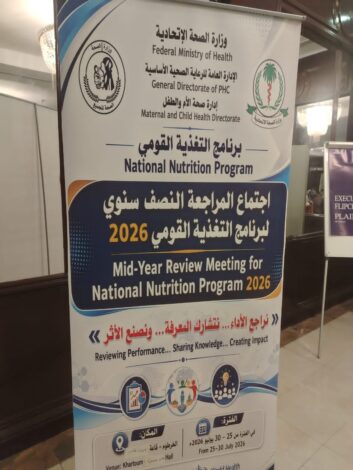
Launch of the 2026 National Nutrition Program Mid-Year Review Meeting
Khartoum /
The 2026 Mid-Year Review Meeting of Sudan’s National Nutrition Program officially opened today at the Holiday Villa Hotel in Khartoum under the theme: “Reviewing Performance, Sharing Knowledge, and Creating Impact.” The four-day meeting will be followed by a review of the results of the Integrated Nutrition Campaign and planning for the upcoming campaign.
Representing the Federal Ministry of Health’s General Directorate of Primary Health Care, Dr. Asmahan Al-Khair, Director of Maternal and Child Health, said the meeting provides an important opportunity to assess progress, evaluate performance, and review achievements, particularly as Sudan’s health sector enters a recovery phase. She emphasized the need to strengthen preventive interventions and develop locally tailored solutions to nutrition challenges that reflect the unique circumstances of each state.
Dr. Al-Khair noted that the global funding gap requires the most efficient use of available resources, while stressing the importance of stronger coordination within the national program, state-level nutrition teams, and partner organizations.
National Nutrition Program Director Salwa Sourkati described the meeting as a key milestone for conducting an objective review of first-half performance, exchanging experiences among states and partners, improving service quality, and strengthening nutrition indicators despite the country’s current challenges. She expressed hope that the meeting would produce practical action plans and implementable recommendations.
A UNICEF representative called for careful prioritization in light of the humanitarian impact of the ongoing conflict, reaffirming the organization’s commitment to working closely with the Ministry of Health, the National Nutrition Program, and national and international partners to improve children’s nutrition.
The World Food Programme (WFP) representative highlighted the worsening food security situation and the significant challenges facing Sudan, while commending the Federal Ministry of Health for its leadership in delivering essential services, particularly to vulnerable communities. The representative pledged continued and unwavering support to help achieve the program’s objectives.
Representing the World Health Organization (WHO), Dr. Nihaya Saleheen praised the National Nutrition Program for maintaining its activities despite the difficult circumstances. She called for homegrown solutions to malnutrition—”solutions that reflect our own context”—to help Sudan improve its nutrition indicators in line with global progress. She noted that assessments of more than 61% of health facilities providing nutrition services identified supply chain management, including storage and distribution, as the most significant challenge. Dr. Saleheen reaffirmed WHO’s commitment to supporting the program and emphasized the need to change harmful nutrition misconceptions to ensure that no child suffers from malnutrition.
Meanwhile, UNICEF’s Nutrition Cluster Coordinator in Sudan described the performance review as a vital opportunity to develop strong recommendations that will advance the country’s nutrition sector through transparent and constructive dialogue.