
An Interview with Sally Zaki: “I Pride Myself on Having a Path That Sometimes Goes Against the Current”
Introduction:
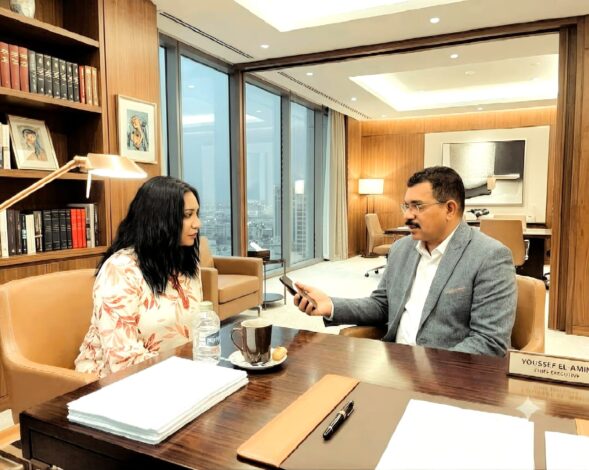
Sally Zaki is a figure of formidable character and keen intellect, known for her bold, independent views that defy political subservience. Her love for Sudan and its people transcends the narrow confines of party or factional loyalties. I met with her in Heliopolis, one of Cairo’s most distinguished districts.
She is a personality who has chosen to step away from “political subservience” rather than from politics itself, asserting that public service is a journey without an end, and that true leadership lies in the autonomy of decision-making, far from the constraints of blind obedience. She demonstrates that major turning points do not always mean that courage lies in remaining under the spotlight; rather, it can sometimes be found in the strength to withdraw from a “wrong path” to reclaim one’s “true compass.” This is how Sally Zaki, a former leader in the Democratic Bloc, has decided to author a new chapter in her national journey. Her resignation was not merely an exit from organizational corridors, but a cry against the culture of the “compliant politician”—a culture that consumes energy in the conflicts of narrow allegiances.
Sally Zaki has chosen to exchange the mantle of direct partisan politics for the “cloak of the independent intellectual,” believing that a nation is built not through subservience, but by presenting visions, ideas, and academic plans from within the platforms of civil society. In this interview, we delve into the details of this bold decision to seek answers to pressing questions:
Has politics in our country become an environment that repels free thought? And how can a leader serve their country without losing their independent voice?
Conducted in Cairo by Mohammed Babikir
Q: What were the real reasons behind your decision to resign? Was it the result of an accumulation of issues or a specific event?
A: I wanted to maintain cordial relationships and avoid conflict with leaders and colleagues whom I hold in high regard within the Bloc. My vision now differs from the vision of some leaders within the Bloc, and I pride myself on having a path that sometimes goes against the current. Therefore, I preferred to resign and maintain that space of mutual respect, and to respect the right of others to choose their own path, without being drawn into a direction that contradicts the principles I have set for myself. The decision was based on several factors, and I do not feel that I acted in haste.
Q: When did the idea of stepping away from political work begin to cross your mind?
A: I have not decided to walk away from political work, but I always hold fast to my principles and vision for the public good. As an independent, I often found myself compromising my own vision for the sake of the collective, and I felt the time had come to return to being fully politically independent.
Q: How do you evaluate your experience in political work?
A: The experience involved many turning points that added to my development. I evolved significantly through practice and was able to bridge the gap between theoretical knowledge—what we learned in books—and practical, real-world application. Consequently, I am satisfied with every step I have taken in the world of politics and with every decision I have made.
Q: What are your most significant successes during your career?
A: I managed to establish myself in the political arena despite criticism, obstacles, and campaigns against me. I was able, individually, to distinguish myself through the visions I carry and to compete as a human being, away from using the platforms of “women’s quotas” as a ladder for advancement in a patriarchal society. I founded the first political coalition for minorities, and this was the first time such a political platform had been created. Even if it did not persist, the honor of having attempted it is enough for me. I did not use religion or ethnicity, and I insisted on continuing solely as a Sudanese, despite attempts to categorize me in many instances.
Q: What are your most notable failures or the lessons you learned?
Are there past positions or alliances that you view critically today?
A: I have failed and learned from my mistakes, certainly. But in all honesty, I have always been selective in my choices for the sake of Sudan. I constantly remind myself that I am still writing my biography, and I am only in its first chapters; it must be free of ego and self-interest. I did not compromise, even when some thought my choices were detrimental to me as a politician. It is enough for me that I am always convinced and believe that my path is free of any concessions regarding the rights of the people, of whom I am a part.
Q: How do you view the current political reality in Sudan? And what are the most prominent challenges facing political forces?
A: The political reality is at the peak of its complexity, which is an indicator that finding solutions to these problems has become critically important. It has become essential for everyone to sit together, setting aside their grudges for the sake of a single, unified Sudan. Enough with greed and enough with grudges; grudges do not build a nation nor do they foster development. Enough with grandstanding and appeasement. Courageous decisions must be made in the interest of the public good. As for the challenge, it lies in how they acknowledge their failures and their inability to manage the crisis, their failure to present a project that accommodates everyone without exception, and the lack of a legal framework that protects the oppressed and holds the oppressor accountable, away from the feuds and personal desires for revenge that have brought us to this low point.
Q: Have political elites lost their ability to lead national transformation?
A: Political elites are still trying to serve their own interests, and each side wants to prove it has defeated the other without caring for the state of the Sudanese citizen who is suffering. They use the same mechanisms and the same narrow-mindedness, yet expect different results! However, they are still trying, and we are still trying to prove that compromise is sometimes a victory, and that true power lies in offering solutions for a Sudan that accommodates everyone—a Sudan of development, justice, and stability. The people want a dignified life, and whoever provides the foundations for that life is offering the democracy they understand and desire. For those who do not own their sustenance do not own their decision-making.
Q: What is your assessment of the participation of Sudanese women in political life? And what are the obstacles still facing women?
A: Women’s participation in political life deserves to be strengthened because the percentage of women with the desire for political activity is, in one way or another, lower than that of men. However, their presence has become strong and adds intellectual and political value, which has forced their recognition. Among the obstacles women face is the occasional perception that they are “subordinates,” or that their presence is merely formal or symbolic. Furthermore, the way women are treated as if they are in a constant state of competition affects them, as does unobjective criticism and the use of standards of appearance and looks to evaluate them, as if they were devoid of substance. My constant advice is not to confine women only to “women’s issues,” but to deal with them as cadres and political figures equal to men.
Q: Do you believe that women have received fair opportunities in decision-making positions?
A: I hope that women will gain greater opportunities in decision-making centers.
Q: What is your message to the youth interested in political work?
A: My message to the youth is to fight and struggle more, because hope lies in them and rights must be seized. We need new blood to bring new thought and philosophy to political work. The road will not be paved with roses, as the Sudanese environment is, to some extent, incapable of utilizing the potential of its youth. But hope is in them and through them to build a Sudan of development, justice, and citizenship.
Q: Is what happened a resignation from a political position or a complete retirement from public work? And is it possible for you to return to political work?
A: This does not mean retiring from politics, but perhaps it is a “warrior’s rest.” Politics, for me, is a national duty and a specialty I loved; I have given it much and sacrificed much of my family’s time for its sake. Therefore, I will continue, but perhaps from a different platform.
Q: How do you spend your time after announcing your resignation? And what projects are you thinking of dedicating yourself to?
A: Public work occupied part of my time in the past and still occupies an important part of it, and I was, and remain, keen to provide what I can in the best possible way. However, I certainly have another life alongside that. I seize every opportunity where I can exert effort that bears fruit in various fields. I am still writing in newspapers, and I remain a perpetual student of knowledge, constantly searching and developing, as well as engaging in social work, which I believe will take up more space.