
Training of Trainers on the Use of Digitalization in Health for the SHARE and THABAT Projects
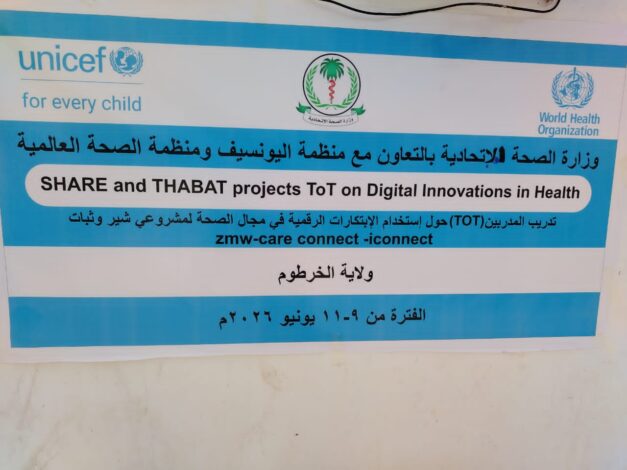
As part of efforts toward digital transformation, the Federal Ministry of Health, in collaboration with UNICEF and the World Health Organization (WHO), launched a three-day Training of Trainers (TOT) program today at Al-Rakouba Tourist Resort in Omdurman on the use of digital health innovations for the SHARE and THABAT projects. The training is being attended by participants from several states across Sudan.
Speaking at the opening session, Dr. Asmahan Al-Khair, Director of Maternal and Child Health and Acting Director General of Primary Health Care, stated that the training aims to build the capacities of trainers during a period of recovery for the health system, which has absorbed the shock caused by the war. She noted that despite the destruction and losses resulting from the conflict, it has encouraged innovative thinking and the adoption of new approaches, including a stronger commitment to digital transformation in support of health services and greater flexibility in the use of digital applications.
Dr. Al-Khair highlighted the challenge of ensuring the sustainability of digital applications and reaffirmed the Ministry’s support for health digitalization initiatives.
For his part, Eng. Musab Rahmatallah, Director of Information and Technology at the Federal Ministry of Health, emphasized that health digitalization greatly facilitates access to services.
He explained that the applications have gone through several stages of development before reaching their current form and noted that they have already been launched in a number of states. He added that UNICEF and WHO are key supporters of the project and stressed that significant challenges remain ahead.
Tamadur Mohamed Salih, the focal person for Smart Health Applications in Primary Health Care, pointed out that the health assistance project is funded by the World Bank through UNICEF and WHO. She explained that the project includes several components, including capacity building and the operation of 420 health facilities. She also noted that visits to a number of states have shown growing adoption of digitalization initiatives.