
Sudan Participates in the 23rd Arab Conference of Heads of Correctional and Rehabilitation Institutions
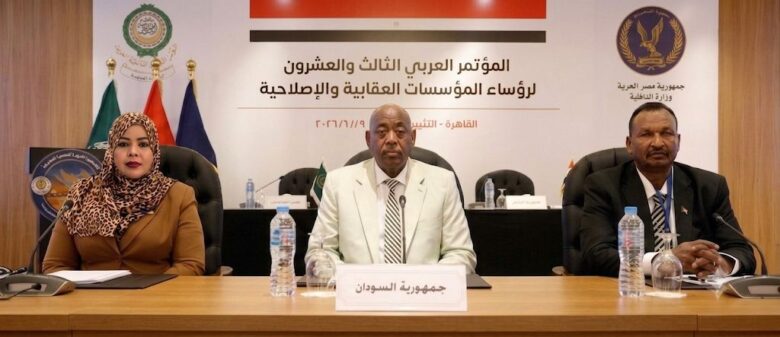
Cairo – Sudan took part in the 23rd Arab Conference of Heads of Correctional and Rehabilitation Institutions, held in Cairo on 29 June 2026 under the patronage of Egypt’s Minister of Interior, Major General Mahmoud Tawfik.
The Sudanese delegation, representing the Ministries of Interior and Justice, was headed by Lieutenant General of Police (Legal) Yasser Omar Abuzaid, Director General of the Sudan Prisons Forces. The delegation also included Major General of Police (Legal) Dr. Taj Al-Sir Babiker Sir Al-Khatim, Director of Prisons Forces in Khartoum State, and Legal Adviser Buthaina Mohamed Al-Tayeb Al-Toum from the Human Rights Department at the Ministry of Justice.
The conference was preceded by a workshop on improving healthcare services for inmates in correctional and rehabilitation institutions from a human rights perspective, followed by a field visit to a modern correction and rehabilitation center.
The opening session was attended by Major General Dr. Hossam Abdel Aziz, Assistant Minister of Interior for the Community Protection Sector and President of the Conference, along with senior representatives from the Ministries of Interior and Justice of Arab League member states.
Addressing the conference, Lt. Gen. Yasser Omar Abuzaid said Sudan’s participation reflects its strong commitment to Arab cooperation and the exchange of expertise in correctional and rehabilitation services. He noted that the Sudan Prisons Forces have made significant progress in modernizing the correctional system through rehabilitation and awareness programs designed to reform inmates and facilitate their reintegration into society as productive citizens after serving their sentences.
He reaffirmed the Sudan Prisons Forces’ commitment to benefiting from Arab experiences, strengthening cooperation in addressing common challenges, enhancing the effectiveness of correctional institutions, and promoting community security and stability. He also stressed the institution’s determination to continue improving its performance and adopting modern correctional practices.
Legal Adviser Buthaina Mohamed Al-Tayeb presented an overview of Sudan’s international obligations and the human rights conventions to which the country is a party. She also reviewed the national legal framework governing prisons and its consistency with international human rights standards, emphasizing that Sudan’s legislation protects the dignity and rights of inmates.
She explained that prison healthcare in Sudan is governed by a legal framework that combines international obligations with national legislation. Sudan is a party to several international treaties guaranteeing the right to health for all individuals, including persons deprived of their liberty, notably the International Covenant on Civil and Political Rights, which Sudan joined in 1986, and the International Convention on the Elimination of All Forms of Racial Discrimination.
She further highlighted the United Nations Standard Minimum Rules for the Treatment of Prisoners (the Nelson Mandela Rules), describing them as the internationally recognized benchmark that inspired Sudan’s prison legislation. These rules call for healthcare services in prisons equivalent to those available to the general public and prohibit torture and cruel, inhuman, or degrading treatment.
Reviewing the national legal framework, she noted that equality, non-discrimination, and the right to health are guaranteed by Sudan’s Constitutional Document as well as national laws and regulations. She referred to the National Prisons Organization and Treatment of Inmates Act of 2010 as the principal legislation governing prisons, noting that it aligns national laws with international standards and provides special protection for women inmates, particularly pregnant and breastfeeding women, as well as children accompanying their mothers in prison.
She concluded by affirming that Sudan has an advanced legal framework guaranteeing inmates’ right to healthcare, drawing on both Islamic Sharia principles and international human rights treaties.
During the conference’s regular agenda on member states’ experiences, delegates reviewed the experiences of three Arab countries in addressing correctional challenges.
Sudan also presented a specialized paper highlighting its experience in correctional and rehabilitation institutions, showcasing rehabilitation, vocational training, and reintegration programs that safeguard inmates’ rights and dignity in line with international conventions and human rights standards.