
Restarting a Transformer Factory in Khartoum to Compensate for War Losses
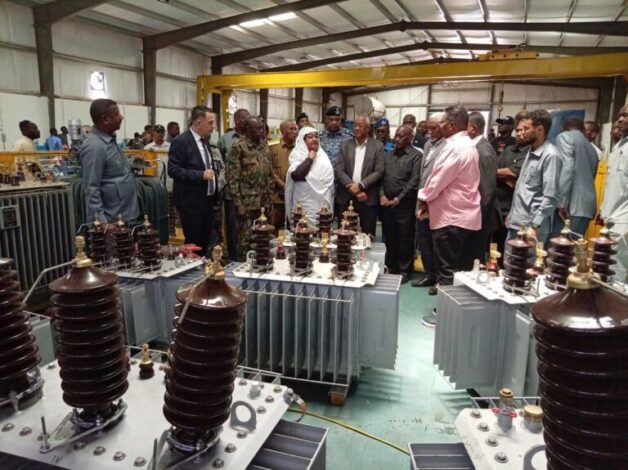
The Sudanese government restarted a transformer factory south of Khartoum on Sunday, in a move aimed at addressing the shortage of transformers, supporting the recovery of the industrial sector, and reviving production activity in the country.
The electricity sector’s infrastructure suffered widespread sabotage and looting as a result of the war. Estimates indicate the destruction of approximately 15,000 transformers of varying capacities, each valued at around $46,000. In addition, huge quantities of cables were looted for copper extraction, and electricity companies lost their entire stock of vital equipment in their warehouses, particularly in Khartoum, which was completely looted.
A statement issued by the Khartoum State government media office said that “the Minister of Industry and Trade, the Governor of Khartoum State, and the Governor of Gezira State inaugurated today the “Maxan” factory for electrical transformers in the Safola Industrial Area south of Khartoum, in the presence of a number of leaders in the electricity sector and members of the company’s board of directors.”
The statement added that the electrical transformer industry is a vital sector directly linked to the stability of electricity services and economic development. It emphasized that localizing this industry within the country contributes to cost reduction and accelerates maintenance, rehabilitation, and expansion of the electrical grid.
For his part, the Governor of Khartoum State, Ahmed Osman Hamza, revealed the extent of the losses suffered by the electricity sector as a result of attacks, looting, and sabotage targeting infrastructure. He explained that the state lost approximately 14,000 electrical transformers, in addition to the theft of large quantities of cables and electrical equipment and the destruction of extensive sections of the network.
The Governor described the reopening of the factory as a strategic step that will help address the severe shortage of electrical transformers. He called on the factory’s management to double production and expand manufacturing lines to meet the increasing demand during the reconstruction phase.
He also urged the factory management to add new production lines for manufacturing transformer accessories and components, as well as electrical connections, emphasizing the state government’s readiness to provide all necessary support and facilities to factories and producers.
He stressed his government’s commitment to providing protection and security for industrial zones and creating a stable environment that encourages investors and factory owners to resume their activities and contribute to driving economic development.
For his part, the Governor of Gezira State, Al-Tahir Ibrahim Al-Khair, praised the role of the national industrial sector in supporting the economy and meeting citizens’ needs, affirming that Sudanese businesspeople have proven their ability to overcome challenges and contribute to building a strong and sustainable national economy.
He explained that Gezira State includes eight industrial cities that continuously require the factory’s services, making the local production of electrical transformers a strategic necessity to support industrial and agricultural activity in the state.
For his part, Ibn al-Jarrah Ali, representative of the board of directors of the Mexan factory, announced the commencement of the factory’s actual operation with an initial production capacity of approximately 150 electrical transformers per month of varying capacities, operating on a single shift system. He emphasized that the factory has an operational plan to increase production in the coming phases.
He explained that the management intends to add new operating shifts and improve the efficiency of production lines to meet the growing demand for electrical transformers in various Sudanese states. He pointed out that the factory aims to contribute effectively to bridging the current gap and meeting the needs of reconstruction projects and the expansion of electricity services.
Earlier this month, the Sudanese Ministry of Energy and Petroleum announced an urgent plan with four main tracks to rehabilitate the electricity sector, improve supply, and achieve electricity stability. This includes expediting the maintenance and rehabilitation of the out-of-service power stations in Khartoum State and returning them to service to facilitate the return of citizens to their homes, in addition to strengthening distribution networks and providing new transformers to densely populated areas, especially in the East Nile locality.
Sudan’s electricity sector has suffered significant losses and damages estimated at around three billion dollars since the outbreak of war in April 2023, exacerbating the power outage crisis in a wide range of states and regions, according to the United Nations Development Programme.