
Engineering Safer Bread Designing Hygienic Chilled Water Systems for Modern Bakeries

By Eng. Abdelrahman Mohamed Zain (Magdi)
As the global refrigeration community prepares to celebrate World Refrigeration Day on 26 June, it is an appropriate moment to reflect on the often unseen technologies that contribute to food safety, public health, and industrial productivity.
World Refrigeration Day is observed annually on 26 June, marking the birthday of Lord Kelvin (William Thomson), whose pioneering contributions to thermodynamics and temperature measurement helped lay the scientific foundations of modern refrigeration and air conditioning. The occasion serves as a reminder that refrigeration is far more than a convenience—it is an essential technology that protects food, preserves medicines, supports industry, and improves quality of life around the world.
One of the lesser-known yet critically important applications of refrigeration engineering can be found inside modern bakeries, where chilled water systems play a vital role in producing consistent, high-quality bread while supporting food safety objectives.
Why Dough Temperature Matters
Bread is one of humanity’s oldest and most widely consumed foods. Yet behind every loaf lies a carefully controlled manufacturing process in which temperature management is essential.
During dough mixing, mechanical energy generated by the mixer is converted into heat. In warm climates and high-capacity bakeries, this heat can quickly raise dough temperatures beyond the desired range, leading to accelerated fermentation, reduced process control, and inconsistent product quality.
To overcome this challenge, bakeries use chilled water during dough preparation. Water supplied at temperatures typically ranging between 1°C and 4°C helps absorb excess heat generated during mixing and allows bakers to achieve their target final dough temperature.
The benefits include:
Improved dough consistency.
Better fermentation control.
Enhanced bread texture and volume.
Increased production reliability.
Improved shelf life and product quality.
As bakery production becomes increasingly automated and quality standards continue to rise, chilled water systems have become an indispensable component of modern bread manufacturing.
The Hidden Engineering Challenge
While chilled water is essential, the design of the cooling system itself deserves careful attention.
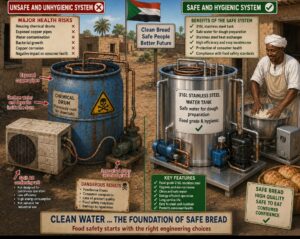
Traditionally, many systems have employed copper evaporator coils immersed directly in water storage tanks. Copper is highly valued in refrigeration engineering because of its excellent thermal conductivity and long history of successful use in heat transfer applications.
However, food manufacturers today must evaluate equipment not only from a thermal performance perspective but also in terms of hygiene, corrosion resistance, cleanability, maintenance requirements, and long-term food safety considerations.
Depending on water quality, dissolved oxygen levels, chloride concentrations, and maintenance practices, copper surfaces may gradually experience corrosion over time. Although properly maintained copper systems can operate effectively, the food industry increasingly favors materials that provide enhanced corrosion resistance and easier compliance with modern hygiene standards.
This shift reflects a broader movement toward hygienic engineering and risk management throughout the food production sector.

Stainless Steel: The Food Industry Standard
For many food processing applications, food-grade stainless steel has become the preferred material of choice.
Grades such as 304 and 316L stainless steel provide several advantages:
Excellent corrosion resistance.
Non-reactive surfaces.
Ease of cleaning and sanitation.
Long service life.
Compliance with food industry hygiene requirements.
In chilled water systems, stainless steel can be used for evaporator coils, storage tanks, piping systems, and plate heat exchangers.
Particularly in bakeries operating under modern food safety management systems, stainless steel is widely regarded as the benchmark material for equipment that comes into direct contact with process water.
Titanium: Premium Performance for Critical Applications
For facilities seeking the highest level of reliability and corrosion resistance, titanium heat exchangers offer an advanced solution.
Titanium is extensively used in pharmaceutical manufacturing, seawater cooling applications, and high-purity industrial processes due to its exceptional resistance to corrosion and long operational life.
Its advantages include:
Outstanding durability.
Minimal maintenance requirements.
Exceptional resistance to aggressive water conditions.
Long-term operational reliability.
Although titanium systems require a higher initial investment, they can provide significant long-term value in demanding applications.
The Rise of Indirect Cooling Systems
Another important trend in modern bakery refrigeration is the adoption of indirect cooling systems.
Rather than placing evaporator coils directly in process water, these systems use an intermediate cooling medium. Heat is transferred through food-grade stainless steel heat exchangers, creating a physical separation between the refrigeration circuit and the water used for dough preparation.
This approach offers several important benefits:
Enhanced food safety.
Reduced contamination risk.
Simplified maintenance.
Improved temperature control.
Greater operational flexibility.
As food safety standards become increasingly rigorous, indirect cooling systems are attracting growing interest throughout the bakery industry.
Key Design Recommendations
When designing chilled water systems for bakery applications, engineers should consider the following principles:
Use food-grade stainless steel, preferably 316L, for all components in direct contact with water.
Install circulation pumps to ensure uniform temperature distribution within storage tanks.
Apply high-quality thermal insulation to tanks and piping systems.
Incorporate water filtration systems to reduce fouling and mineral deposits.
Implement preventive maintenance programs and routine water quality monitoring.
Design equipment for easy cleaning and sanitation.
Ensure compliance with applicable food safety and hygiene standards.
These measures not only protect product quality but also improve equipment reliability and reduce long-term operating costs.
Investing in Food Safety
Although food-grade stainless steel and titanium systems may involve higher initial costs than traditional alternatives, the long-term benefits often justify the investment.
Improved hygiene, reduced maintenance, enhanced equipment longevity, greater operational reliability, and increased consumer confidence all contribute to a more sustainable and competitive bakery operation.
In today’s food industry, engineering decisions have a direct impact on public health. Every component that comes into contact with water used in food preparation should be selected with safety, reliability, and hygiene as primary considerations.
As we celebrate World Refrigeration Day and recognize the legacy of Lord Kelvin, it is worth remembering that refrigeration engineering extends far beyond cooling temperatures. It supports food security, protects public health, reduces waste, and helps deliver safe, high-quality products to consumers every day.
The future of bakery refrigeration is not simply about producing colder water—it is about producing safer food.
Because food safety begins long before bread reaches the oven.
It begins with sound engineering.
Suggested Cartoon Caption
The Safe Road to Better Bread
A modern bakery loaf chooses a Food-Grade Stainless Steel Chiller over an old cooling system, highlighting the importance of hygienic refrigeration engineering in food production.
Suggested Pull Quote
“Food safety begins long before bread reaches the oven—it begins with every engineering decision behind the chilled water system.”
About the author:
Eng. Abdelrahman Mohamed Zain (Magdi)
Industrial Refrigeration & VAM Chillers Specialist ASHRAE Member HSE Editor – The Citizen
E-MAIL: mr.zainrac@gmail.com