
Nilein University Holds Press Conference to Announce Al-Afad Caravan
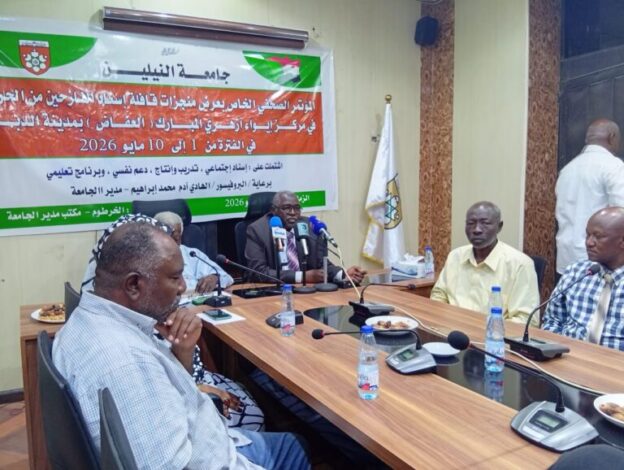
Nilein University held a press conference to announce the outcomes of the support caravan it dispatched to the Azhari Al-Mubarak shelter center in Al-Afad village, Al-Dabba locality, Northern State. The conference took place at the university administration building and was attended by Professor Al-Hadi Adam, the university director; Professor Mohamed Zayed Baraka, head of the support caravan; Dr. Othman Andali, Dean of Student Affairs; and the heads and members of the support teams from both inside and outside the university.
After welcoming the attendees, the university director explained the caravan’s organization and its origins, noting that the idea had initially been considered between the Nile River State and the Northern State. He stated that the caravan’s organizing committee was formed under the chairmanship of Professor Mohamed Zayed Baraka, comprised of a select group of professors and staff from the university and other institutions. The Al-Afad shelter center was chosen, and it was agreed that the caravan would move beyond traditional activities, offering psychological, social, recreational, dramatic, and sporting support, along with educational services and training for housewives in production. A group of Sudan’s finest individuals from various fields, not only from Nilein University but also from other universities and institutions, participated.
He added that this endeavor was made possible thanks to God, the leadership of the state and the Northern State government, and the supportive efforts of the executive director, the director of the shelter center, the leadership of the Ad-Dabba garrison, and all the security agencies that provided crucial support to the caravan، referring to the contributions of Dr. Abu Dhar Al-Kouda, a dedicated son of Sudan, in establishing a school to support the children of the camp and which served as a headquarters for many of the caravan’s activities. He emphasized that this was a humanitarian experience, even if it lacked some details, which did not detract from the caravan’s importance. He recommended that the experience be replicated in all institutions.
For his part, Mohamed Zayed Baraka, head of the support caravan, added during the conference that this initiative was unconventional, focusing on developing the skills and capabilities of women, and that the caravan had achieved more than expected.
He pointed out that the prevailing atmosphere of frustration and despair in the shelter center was brought about by the Nilein Caravan, which provided moments of joy and happiness.
Baraka confirmed that 15,500 children, both those enrolled in school and those not yet enrolled, are currently residing in the shelter. The convoy brought in educational figures and experts to train teachers, a commendable initiative within the framework of educational support. The experts were able to train thirty teachers, who will then become trainers themselves. It is hoped that this work will continue until a positive outcome is achieved, contributing to reducing educational loss.
Baraka stated that the psychological support provided was very well received by the camp residents. He emphasized that many suffer from psychological illnesses as a result of the war and displacement, and that a large number of patients have been treated and provided with therapy.
The conference included several presentations from members and heads of working groups, including Professor Siham Al-Awni, Dr. Saleh Abdul Qader, Dr. Ibrahim Darwish, and Adel Ali Al-Hassan Malik, founder of the Al-Mukhtabar Theater Group.