
Why Sudan Needs a Revolution in Health, Safety, and Environment!

A review of the Cyanide and Mercury in Gold Mining seminar – towards a life-saving national strategy
By: Eng. Abdulrahman Mohamed Zain (Magdi)
E.mail: mr.zainrac@gmail.com
Introduction : A decisive day in Sudan’s environmental safety history
On Sunday 12 April 2026, a scientific seminar organised by Al Wafa Organization for the University of Gezira, in cooperation with the University of Gezira Alumni Association, brought together a group of senior experts to discuss a topic that until recently remained confined to academic corridors: Cyanide and mercury compounds used in gold mining and their resulting health impacts.
The session was moderated by Dr. Adil Awad Eljeed Abdallah. The keynote speaker was Professor Nasr Eldin Kabbashi (Islamic University – Malaysia), an international expert in chemical and environmental engineering. The discussants were Professor Ihab El Sir Mohammed El Yass and Professor Nabil Hamid Hassan Bashir from the University of Gezira.
This was not merely a passing academic lecture. It was a clear indictment of a bitter reality endured by thousands of Sudanese workers and their families, and an open call for a radical review of how this vital sector is managed.
Having attended and participated in this seminar – asking questions and engaging with the speakers – and as a volunteer writer on the Health, Safety & Environment desk of The Citizen, I find myself with a professional and moral duty to bring the seminar’s findings to the public. Not to spread fear, but to spread awareness, prevention, and change.
This article is the first in our coverage of the seminar’s outcomes. It aims to :
1. Present the scientific facts as delivered by Professor Kabbashi, without exaggeration or sensationalism.
2. Link these facts to the gap in education and preventive culture in Sudan.
3. Propose a practical roadmap based on the seminar’s outputs, leading towards an initiative to establish a Ministry of Safety and Environment.
Part One: Shocking facts from the seminar – mercury kills silently
Professor Nasr Eldin Kabbashi presented precise scientific data, based on recent (2024) field studies in Abu Hamad and Darnali in River Nile State – two of the most active artisanal mining areas in Sudan.
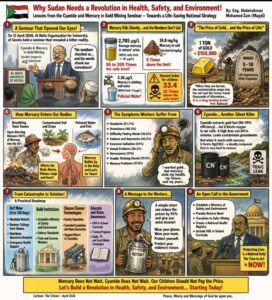
1. The scale of the catastrophe in numbers
Mercury levels in workers’ urine (Abu Hamad) :
· Average mercury concentration : 2,785 µg/L. The WHO safe limit is below 10 µg/L. That is 55 to 205 times above the safe level.
· Highest recorded concentration : 10,250 µg/L, exceeding the occupational exposure limit (50 µg/L) by 205 times.
· Percentage of workers exceeding the polluted threshold (100 µg/L): 98% – a collective health catastrophe by any measure.
Mercury in soil and water (Abu Hamad) :
· Highest soil mercury concentration : 34.8 mg/kg, exceeding the safe limit for residential/agricultural soil (6.6 mg/kg) by 5 times.
· A well near amalgam burning sites recorded 3.26 µg/L of mercury, exceeding WHO drinking water guidelines (1–2 µg/L).
· The Hazard Index (HI) for children in Abu Hamad reached 33.4 – that is 33 times above the safe limit.
In simple terms : A child living near an amalgam burning site in Abu Hamad is exposed to a health risk 33 times above the safe level. This is not a potential risk – it is actual harm.
2. A statement that shook the conscience – from gold to dust
In the midst of presenting these numbers, Professor Nasr Eldin Kabbashi said something that was not just information. It was a cry of conscience that shook everyone in the seminar. He said – may God protect him :
“The price of a ton of gold after extraction is around 150,000 US dollars today. But those who work with and inhale these fumes – their remaining lifespan is between five and ten years. And God alone knows the unseen. When they pass away and are buried in the earth, the contamination seeps into the soil and the fumes and toxic dust travel thousands of kilometres depending on wind direction and speed. It is a long-lasting bomb.”
There is no power nor strength except in God, the Most High, the Almighty.
These words sum up the entire tragedy :
· Gold worth $150,000 per ton – a high price.
· Workers’ remaining life expectancy : 5 to 10 years – the price of lives.
· Pollution does not die with the workers – it spreads through soil and air for thousands of kilometres – a time bomb with long-lasting effects.
Could there be a clearer picture of the corrupt model of “profit over lives”?
3. How does mercury enter our bodies?
Professor Kabbashi explained the mechanisms clearly :
· Inhalation of mercury vapour during open-air amalgam burning (the common method) is the most dangerous route of exposure.
· Open burning releases 100% of the mercury into the air, while a retort reduces emissions to less than 5% and recovers 95% of the mercury for reuse.
· Soil contamination around grinding and burning sites transfers to crops and groundwater.
· Mercury converts to methylmercury in water bodies – a highly toxic compound that accumulates in fish and moves up the food chain.
4. Documented health symptoms among workers
Professor Kabbashi presented shocking statistics from workers in Abu Hamad :
· Headache : 51.7%
· Drowsiness : 48.3%
· Difficulty finding the right word : 46.6%
· Sadness and depression: 46.5%
· Excessive salivation: 43%
· Sexual problems: 36.2%
· Nervousness: 31%
· Trouble thinking clearly: 29.3%
· Memory problems: 27.6%
These are not random symptoms. They are a full clinical picture of chronic mercury poisoning, affecting the central nervous system, kidneys, respiratory system, and cardiovascular system.
5. Cyanide – the other silent hazard
Professor Kabbashi also addressed cyanide :
· Cyanide is used in leaching to extract gold from low-grade ore, with efficiency of 80–95%.
· Its danger lies in blocking oxygen transport in cells, leading to death within minutes at high doses.
· Leakage of cyanide solutions from tailings dams contaminates groundwater and soil.
· Even more dangerous : the reaction of cyanide with mercury in illegal reprocessing operations produces Hg(CN)₂, a highly stable and difficult-to-remove compound.
Part Two : The deadly gap – between scientific knowledge and field reality
After reviewing these horrifying facts, I asked myself: How did we get here ?
Based on my experience in industrial safety and my participation in the seminar, the answer lies in the absence of an embedded safety culture :
At the education level :
Sudanese children are not taught from an early age about chemical hazards or how to act in emergencies. Safety is not in the curriculum.
At the training level :
The miner has received no training on using retorts, protective equipment, or how to handle spills.
At the institutional level :
There is no single body responsible for occupational health, chemical safety, and environmental supervision. Institutional fragmentation kills.
At the enforcement level :
Severe weakness in field inspection, and no deterrent penalties.
At the awareness level :
Workers and local communities do not realise the scale of the danger they live in.
At the alternatives level :
No national programmes exist to transition artisanal mining to safer technologies (gravity separation, flotation, controlled cyanidation).
Here, the role of science journalism becomes clear : Our task is not only to document the catastrophe, but to offer solutions.
Part Three : From the seminar to the ground – a proposed roadmap
Based on the outcomes of Professor Kabbashi’s seminar, and on subsequent discussions with a group of experts (Professor Asim Fadl Abu Sara, Eng. Ibrahim Mohammed Ali, and others), I present a practical roadmap that can be implemented immediately at low cost. It is divided into four tracks :
Track One : Stop the immediate bleeding (first 100 days)
· Mandatory use of retorts for amalgam burning by law (responsible : Ministry of Minerals/Environment) – expected impact : reduce mercury emissions by over 95%.
· Remove tailings from residential and agricultural areas (responsible : ministry + local community) – impact : reduce direct exposure to populations.
· Distribute illustrated awareness booklets in local languages (responsible: media + civil society) – impact : change wrong behaviours among workers.
· Create an occupational health emergency fund to support rural hospitals (responsible: Ministry of Health) – impact : provide initial treatment for acute cases.
Track Two : Build the institutional system – Ministry of Safety and Environment
As stated in our previous article, none of these solutions can succeed without a unified national body that brings together :
· Mining safety
· Occupational health
· Environmental supervision
· Implementation of international standards (Cyanide Code, Minamata Convention)
· Training and licensing
This proposed ministry is not a luxury. It is a life-saving mechanism at negligible cost compared to the scale of human and environmental losses.
Track Three : Cleaner technical alternatives
Professor Kabbashi presented an important comparison of gold extraction methods in terms of risk, efficiency, and cost :
· Mercury amalgamation: very high risk, 30–50% efficiency, low cost.
· Cyanide (uncontrolled): high risk, 80–95% efficiency, medium cost.
· Gravity separation: very low risk, 40–70% efficiency, medium cost.
· Flotation: medium risk, 70–90% efficiency, high cost.
· Controlled cyanidation (with waste destruction): low risk, 80–95% efficiency, high cost (pays off in the long term).
Practical recommendation : Gradual transition towards gravity separation for small areas, and controlled cyanidation with waste destruction for larger areas, with government support to reduce the cost of clean technologies.
Track Four : Education and awareness – the real investment
Nothing will change unless the minds of future generations change. Therefore :
· Integrate concepts of mercury and cyanide hazards into science curricula from primary school.
· Establish professional training programmes for mining workers, leading to certified qualifications.
· Launch national media campaigns via radio, television, and social media, in simple and engaging language.
· Train teachers themselves first in safety culture.
Part Four: An open call to the government and the Sovereignty Council
This is not a partisan issue. Not a regional issue. It is a humanitarian and national issue above all else.
The numbers presented by Professor Kabbashi speak for themselves, and his conscience-shaking words remind us that:
· 98% of miners in Abu Hamad suffer from chronic mercury poisoning.
· The Hazard Index for children is 33.4 – 33 times above the safe limit.
· The level of mercury in workers’ urine is the highest in the world according to available studies.
· Workers’ remaining life expectancy is 5 to 10 years after continuous exposure.
· Pollution is a long-lasting bomb that travels thousands of kilometres.
If this is not a national emergency, then what is ?
We at The Citizen call upon :
1. The Sovereignty Council to issue an immediate directive to begin executive procedures for establishing a Ministry of Safety and Environment, with the core mission of protecting lives and natural resources.
2. The Prime Minister to allocate an emergency budget to purchase and distribute retorts to artisanal mining areas.
3. The Ministry of Minerals to prepare a national plan to transition artisanal mining to safer technologies within 3 years.
4. The Ministry of Health to create a national registry for mercury and cyanide poisoning cases, and to provide free treatment protocols.
5. The Ministry of Education to immediately begin developing a Health, Safety, and Environment (HSE) curriculum for all levels.
Part Five : A message to the workers and local communities – you are not alone
I direct my final words to those who descend into the pits and burn amalgam with their bare hands – those of whom Professor Kabbashi said their remaining lifespan is only a few years:
· You are not weak. You are seeking a livelihood in the harshest conditions.
· But mercury’s toxicity has no mercy. It destroys your nerves, kidneys, lungs, and your children’s future.
· A simple retort can reduce your exposure to the poison by 95%, and recover mercury that you can sell for extra income. Demand it.
· Gloves and masks are not a luxury. Wear them.
· Do not grind ore with mercury inside homes. Do not dump tailings into rivers. Do not burn amalgam near children.
You deserve a life longer than 5 to 10 years. You deserve a safe life. This article is your voice.
Part Six : Breaking Development – A Warning from Wadi Halfa
Just as the ink of this article was drying, a disturbing development emerged from Northern Sudan — one that transforms the warnings discussed in this seminar from theoretical risk into a possible unfolding reality.
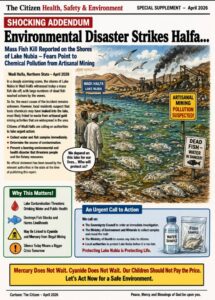
In Wadi Halfa, along the shores of Lake Nubia, large numbers of dead fish have been reported washed ashore in a deeply alarming scene that has shaken local communities.
At the time of writing, the exact cause of this mass fish mortality remains officially unconfirmed. However, residents in the area have raised serious concerns that the incident may be linked to toxic chemical contamination, most likely originating from artisanal gold mining activities widely practiced in the region.
This development is not isolated from the facts presented earlier by Professor Nasr Eldin Kabbashi. On the contrary, it may represent a real-world manifestation of the same risks:
Mercury released into the environment through open burning
Cyanide leakage from uncontrolled leaching operations
Contamination of water bodies leading to ecological collapse
Bioaccumulation of toxins in aquatic life
If these suspicions are confirmed, then what we are witnessing is not merely fish mortality — it is the early signal of a systemic environmental failure.
Why this matters urgently
Lake Nubia is not just a body of water. It is:
A source of drinking water for local populations
A foundation for fisheries and livelihoods
A critical ecological system in a fragile environment
Any contamination event carries consequences that extend far beyond the immediate scene:
Threats to human health through water consumption
Loss of biodiversity and fish stocks
Long-term accumulation of toxins in the food chain
Expansion of pollution across borders through water systems
An urgent call for immediate action
The situation demands a rapid and transparent response. Therefore, we call upon:
The Ministry of Environment and Minerals to immediately dispatch technical teams to:
Collect and analyse water and fish samples
Identify the source and type of contamination
The Ministry of Health to:
Assess potential risks to nearby communities
Issue public health advisories without delay
Local and regional authorities to:
Secure the affected area
Prevent the consumption or sale of contaminated fish
Independent experts and academic institutions to:
Participate in transparent investigation and reporting
At the time of publication, no official statement has been issued. This silence, in itself, is a risk.
From warning to reality
What was discussed in the seminar as a “long-lasting environmental bomb” may now be ticking in real time.
This incident reinforces a critical truth:
Environmental neglect does not remain hidden. It eventually surfaces — in water, in soil, in food, and in human lives.
A decisive moment
Wadi Halfa is sending a message — not only to Sudan, but to all regions facing uncontrolled extractive activities:
The cost of inaction is no longer theoretical
The consequences are no longer distant
The crisis is no longer avoidable
If immediate action is not taken, today’s dead fish may become tomorrow’s public health emergency.
Conclusion Extension
This breaking development does not weaken hope — it strengthens the urgency for action.
The call made in this article for a Ministry of Safety and Environment, for education reform, and for clean mining technologies is no longer a strategic vision for the future.
It is now an emergency necessity for survival.
Conclusion : The citizen between danger and hope
I returned from the seminar burdened by the facts, with Professor Kabbashi’s words echoing in my ears: “It is a long-lasting bomb.”
But I am not hopeless.
Because Sudan still possesses minds like Professor Nasr Eldin Kabbashi, Professor Asim Fadl, Professor Ihab El Sir, Professor Nabil Hamid, Eng. Ibrahim Mohammed Ali, and many others who have both knowledge and will, and who dare to speak the truth as it is.
Because independent media – represented by The Citizen – has decided to be part of the solution, not just a news carrier.
Because the Sudanese people, despite all the calamities, still cling to life.
But hope alone is not enough. We need brave decisions, swift implementation, and accountability for those who fail.
Mercury does not wait. Cyanide does not wait. The long-lasting bomb is being planted today, and our children will pay the price tomorrow.
It is time for a revolution in health, safety, and environment – from school desks to mining sites.
Peace, mercy and blessings of God be upon you.
Eng. Abdelrahman Mohamed Zain (Magdi)
After attending and participating in the Al Wafa Organization for University of Gezira seminar
The Citizen – Weekly Edition
20 April 2026
Editor’s note :
This article is part of the series published by Eng. Abdelrahman Mohamed Zain (Magdi) in The Last Page and the Health, Safety & Environment page.
Eng. Abdelrahman Mohamed Zain (Magdi)
Industrial Refrigeration and Absorption Cooling Expert, HSE Culture Specialist
Member ASHRAE (USA), Member Society of Environmental Engineers (UK)
After attending and participating in the Al Wafa Organization for University of Gezira seminar, Sunday 12 April 2026