
White Cheese (Duwaim Cheese) Between Animal and Plant Enzymes

The Jibbeen Plant (Solanum dubium / Solanum coagulans) as a Source of Plant-Based Milk-Clotting Enzymes in Sudan:
Traditional Potential and Opportunities for Industrial Development
By: Eng. Abdelrahman Mohamed Zain (Magdi)
With reference and technical support from: Dr. Abdelmonim Elias Al-Hussein
(Quality and Standards Expert)
Cheese making is one of the oldest traditional food industries in Sudan and remains closely linked to local culture and the rural economy. Among Sudan’s best-known dairy products is Duwaim white cheese, originating from the town of Ad-Duwaym on the banks of the White Nile River. Over time, this cheese has become a symbol of quality and authentic Sudanese craftsmanship.
Cheese production fundamentally relies on the coagulation process, in which liquid milk is transformed into a solid curd through specialized enzymes collectively known as rennet.
Traditionally, the primary source of these enzymes has been animal rennet, extracted from the stomach of suckling calves. This traditional method has historically given Sudanese white cheese its characteristic flavor and texture.
However, as global demand for dairy products increases and religious, ethical, and economic considerations evolve, interest has grown in alternative enzyme sources. These include microbial and plant-derived enzymes. Sudan’s natural ecosystem, rich in plant biodiversity, offers promising resources for such alternatives.
Among these resources is a wild plant locally known as “Jibbeen”, long used by pastoral communities to coagulate milk during traditional cheese production.
This article highlights the role of enzymes in Sudanese white cheese production, focusing on the traditional knowledge surrounding the Jibbeen plant and its potential for industrial development, particularly within the framework of quality improvement efforts led by the Sudanese Standards and Metrology Organization.
Animal Enzymes: The Traditional Foundation of Quality
The authentic traditional method of producing Duwaim white cheese relies on animal rennet extracted from the fourth stomach (abomasum) of milk-fed calves.
This stomach naturally contains chymosin, the key enzyme responsible for milk coagulation. Chymosin acts by cleaving a specific fraction of the milk protein casein, triggering the formation of the curd that becomes cheese.
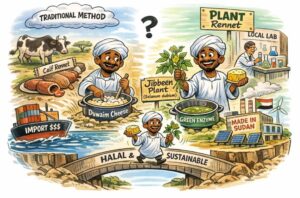
Historically, rural cheese producers obtained calf stomachs from local slaughterhouses or butchers. After cleaning and drying, a portion of the stomach lining would be soaked in salted water to extract the active enzymes.
According to experts such as Dr. Abdelmonim Elias Al-Hussein, calf rennet remains the primary reason for the distinctive taste and texture of traditional Sudanese white cheese. Alternatives can only achieve comparable quality if developed scientifically and carefully standardized.
Plant-Based Alternatives: Toward Sustainable and Halal-Compatible Sources
With increasing awareness of dietary preferences, religious requirements, and sustainability concerns, the global dairy industry has explored several alternatives to animal rennet.
Three major sources have emerged:
1. Microbial enzymes
Produced by certain microorganisms such as Rhizomucor miehei. These enzymes are widely used in modern cheese production and are suitable for many soft cheeses.
2. Fermentation-produced chymosin
Through biotechnology, the gene responsible for producing calf chymosin is introduced into microorganisms, which then produce an enzyme chemically identical to animal chymosin.
3. Plant-derived enzymes
Some plants naturally contain proteolytic enzymes capable of coagulating milk in a manner similar to rennet. Examples include thistle, fig leaves, safflower, and artichoke.
In Sudan, pastoral communities possess long-standing traditional knowledge of using certain wild plants for milk coagulation. One of the most notable among them is the Jibbeen plant, whose very name reflects its association with cheese making.
The Jibbeen Plant: A Traditional Resource Awaiting Scientific Development
Botanical description and distribution
The Jibbeen plant belongs to the nightshade family (Solanaceae) and is scientifically identified as Solanum dubium or Solanum coagulans.
It grows naturally in sandy soils and agricultural margins, particularly in the semi-arid savanna regions of Kordofan Region and White Nile State in Sudan.
The plant typically bears purple flowers and produces fruits that contain enzymes capable of coagulating milk. Pastoral communities have long recognized this property and used the plant in rural cheese production, as well as in leather processing and traditional medicinal practices.
Traditional use in cheese production
During field visits conducted by specialists from the Sudanese Standards and Metrology Organization as part of programs aimed at improving rural cheese packaging and quality, it was observed that some pastoralists use the fruits — and occasionally the leaves — of the Jibbeen plant to prepare natural coagulants.
These plant materials contain proteolytic enzymes capable of partially breaking down casein proteins in milk, thereby initiating the formation of curd.
This traditional knowledge represents a valuable cultural and technological heritage. The fact that the plant itself is locally named “Jibbeen” (cheese plant) highlights the deep connection between local communities and their natural resources.
Scientific Extraction Efforts
Researchers at Sudan University of Science and Technology have conducted preliminary attempts to extract the milk-clotting enzymes from the Jibbeen plant for potential industrial use.
The extraction process typically involves several scientific steps:
Grinding the fruits or other active plant parts
Extracting enzymes using aqueous buffers or suitable solvents
Filtration and purification
Sterilization and concentration
Packaging the final enzyme preparation as powder or liquid
Such research aims to develop a locally produced plant-based rennet that could support the Sudanese dairy industry.
Potential Industrial Advantages
If developed successfully, the Jibbeen plant could offer several strategic benefits:
1. A halal plant-based enzyme source
Plant rennet is naturally compatible with halal dietary requirements and vegetarian preferences.
2. Reduced reliance on imports
Many Sudanese dairy factories depend on imported enzyme preparations. Developing a domestic alternative could significantly reduce foreign currency expenditure.
3. Creation of a new agro-industrial sector
Cultivation and processing of the Jibbeen plant could support rural economies in semi-arid regions while generating new employment opportunities.
Agricultural and Environmental Considerations
Despite its potential benefits, experts warn of certain agricultural risks associated with the plant.
Studies indicate that the plant may act as a host for plant viruses transmitted by insects such as the whitefly, which can affect important crops including tomatoes, cucumbers, melons, and watermelon.
For this reason, experts recommend cultivating the plant in controlled or isolated areas away from vegetable farms, or focusing on enzyme extraction methods that ensure a safe, contamination-free final product.
Additional Traditional Uses
Beyond cheese production, the Jibbeen plant is used in several traditional applications.
In some communities, burned plant ash is applied to infected wounds to promote cleaning and healing. The fruits are also used in leather tanning due to their natural enzymatic and astringent properties.
Improving Quality and Safety in Cheese Production
As part of efforts to improve the safety and quality of traditional dairy products, the Sudanese Standards and Metrology Organization has conducted field visits and awareness programs among rural cheese producers.
One major issue identified was the use of welded metal containers for packaging cheese. These containers posed potential health risks due to contamination from welding materials.
Following guidance from the organization, many producers have shifted to food-grade plastic containers, significantly improving product safety and extending shelf life.
Conclusion and Recommendations
The Jibbeen plant (Solanum dubium / Solanum coagulans) represents a remarkable example of how traditional knowledge can inspire modern scientific innovation.
Field observations and preliminary studies suggest that this plant has real potential as a plant-based milk-clotting enzyme source, particularly in light of global interest in sustainable and natural food technologies.
Developing this resource requires coordinated efforts among researchers, regulatory institutions, and the private sector.
Experts therefore recommend:
Comprehensive research funding
Detailed studies of the plant’s enzyme composition and coagulation efficiency compared with animal rennet.
Safety evaluation
Rigorous testing to ensure the absence of toxins or contaminants.
Technology transfer
Establishment of pilot extraction facilities in regions where the plant grows naturally.
Producer education
Training traditional cheese producers in hygienic processing and safe packaging methods while preserving valuable indigenous knowledge.
Investing in this renewable natural resource could strengthen Sudan’s food industry, reduce dependence on imports, and position the country as a pioneer in sustainable dairy innovation rooted in its own ecological and cultural heritage.
Scientific References
Dairy Chemistry and Biochemistry – P.F. Fox & P.L.H. McSweeney
https://link.springer.com/book/10.1007/978-1-4615-2648-3
Dairy Science and Technology – Walstra, Wouters & Geurts
https://doi.org/10.1201/9781420028010
Jacob, M., Jaros, D., Rohm, H.
“Recent Advances in Milk-Clotting Enzymes.”
International Journal of Dairy Technology
https://onlinelibrary.wiley.com/doi/10.1111/j.1471-0307.2010.00633.
Ahmed, I.A.M. et al.
“Plant Proteases as Milk-Clotting Enzymes.”
Food Chemistry
https://www.sciencedirect.com/topics/food-science/milk-clotting-enzyme
Field reports – Sudanese Standards and Metrology Organization.
Appendix ; Expert’s Perspective
By Dr. Abdelmoneim Elyas Alhussein
(Expert in Quality and Specifications, Agricultural Processing, and Investment in Agricultural Residues)
I would like to begin by expressing my sincere appreciation for the excellent work presented in this article. What the author, Mr. Abdelrahman Mohamed Zain (Majdi), has written about white cheese (Gibna Al-Duwaym) and the plant Al-Jibbein (Solanum dubium / Solanum coagulans) is truly remarkable and scientifically outstanding. The article successfully highlights the rich traditional knowledge and the promising potential of this local plant as a natural coagulant for cheese making.
However, I must note that I do not fully concur with the paragraph addressing genetic modification. Genetic modification remains a subject of widespread scientific debate and global controversy. To date, there is no conclusive consensus that fully delineates its positive impacts from its negative ones. This has created significant sensitivity toward genetically modified products in many societies.
In Sudan specifically, this sensitivity may be heightened due to the limited availability of the advanced technical capabilities required for rigorous monitoring, continuous evaluation, and long-term impact assessment. This hesitation should not be interpreted as underestimating the competence of Sudanese scientists—on the contrary, we possess highly qualified scientific talents. However, the lack of advanced technological infrastructure sometimes poses a challenge to fully embracing such complex biotechnologies.
It is important to acknowledge that our colleagues at the National Biosafety Council are making commendable efforts in this field. Moreover, there is credible scientific work being conducted at several Sudanese universities, including the University of Khartoum and University of Gezira, as well as other research centers focusing on genetic transformation and biosafety issues.
Nevertheless, from a precautionary perspective, I believe it might be prudent in this particular article to avoid delving into the topic of genetic modification altogether. The core issue at hand—developing a local plant-based coagulant—can be effectively addressed without invoking this contentious subject.
For instance, regarding Al-Jibbein, there is a viable and more socially acceptable pathway: local communities in different regions could organize the collection of the plant’s fruits, followed by proper drying and primary processing. Subsequently, academic and research institutions such as Sudan University of Science and Technology could take the lead in developing improved scientific methods for enzyme extraction, purification, processing, and packaging. This would transform the traditional knowledge into a high-quality scientific and industrial product.
Such an approach would yield a plant-based coagulant that is not only effective but also culturally acceptable, potentially serving as a superior alternative to animal rennet in cheese production. It would reduce reliance on imports, valorize local biodiversity, and build upon existing traditional practices without venturing into the unresolved debates surrounding genetic modification.
In conclusion, I reiterate my admiration for this valuable contribution and encourage further research into Al-Jibbein as a model for sustainable, locally rooted innovation in Sudan’s food industry.
This appendix reflects the personal views of Dr. Abdelmoneim Elyas Alhussein and is appended to the article with his consent to provide additional context and perspective.