
When a Dog’s Bite and a Monkey’s Cough Are Sharper Than a Bullet

By: Engineer Abdelrahman Mohamedzain Abdeldafi (Magdi)
Lead: In the shattered landscape of Sudan’s war, the gravest threats now lurk not only in crossfires but in deserted streets, where abandoned corpses and returning wildlife signal a systemic collapse, turning preventable diseases into death sentences.
The danger stalking Sudan today is no longer measured solely in bullets and shells. It manifests in the eerie silence of abandoned neighborhoods, in the unburied dead, and in the animals—dogs and monkeys—reclaiming urban spaces vacated by humans and abandoned by the state. From Khartoum and Central Sudan to Kordofan and Darfur, the collapse of burial, health, and environmental systems has transformed rabies from a contained risk into a pervasive, everyday menace. This threat is compounded by an unsettling ecological shift: the return of wild monkeys to the heart of the capital.
In this context, the recent announcement by Professor Ahmed El-Tijani Al-Mansouri, Minister of Animal Resources and Fisheries, of a plan to vaccinate 70% of dogs against rabies represents a scientifically sound intention. The plan includes securing vaccines and establishing a unified reporting system. However, it begs a fundamental, haunting question: In a nation where the very systems that separate human and animal domains have disintegrated, how can such a program find footing?
The Preventable Scourge: Rabies
Rabies,a viral disease attacking the central nervous system, is primarily transmitted through the bite of infected dogs. Its terror lies in a stark medical reality: once clinical symptoms appear, death is nearly certain. Yet, it is almost 100% preventable through timely vaccination and post-exposure prophylaxis. In stable nations, rabies is a controlled narrative. In war-torn countries like Sudan, it re-emerges as a direct symptom of state failure.
The 70% vaccination target is not an arbitrary figure but a globally established epidemiological threshold necessary to break the chain of transmission. However, this benchmark presupposes functioning municipalities, available veterinary personnel, a reliable cold chain for vaccine storage, and security enabling access to communities—all commodities utterly devastated by Sudan’s conflict.
War’s Unintended Tenants: The Reclamation of Cities
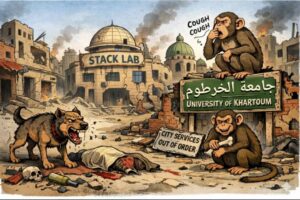
A stark symbol of this collapse is the unprecedented return of monkeys to occupy buildings at the University of Khartoum and facilities along Nile Street.This is not a quaint natural resurgence; it is a red flag for profound ecological and public health disruption. Wild animals infiltrate urban centers only under specific conditions: human absence, accumulated waste, collapsed environmental monitoring, and vanished health management. Today, Khartoum ticks every box.
A Dual Threat: Dogs, Monkeys, and the Epidemic Chain
While stray dogs pose the most direct rabies threat,the returning monkeys introduce a more complex danger. As biological cousins to humans, they are potential carriers of various zoonotic diseases. Scientific evidence indicates monkeys can transmit pathogens through coughs (respiratory droplets), contaminated surfaces, or direct contact. In an environment where sanitation is nonexistent and public health infrastructure is rubble, human-monkey interaction—especially near Nile Street—becomes a tangible epidemic risk.
Fueling the Crisis, Corpses and Waste
The widespread presence of unburied corpses and mountains of rotting waste creates a perfect breeding ground for stray dogs,wild monkeys, and rodents. This cycle amplifies the danger, escalating a manageable health issue into a full-blown public health catastrophe.
The Fall of a Bastion, Stack Laboratory
Central to any hope of disease control was the Stack Laboratory,the cornerstone of Sudan’s vaccine and serum production. Its destruction in the war represents a catastrophic loss, obliterating local vaccine production, quality control, and the backbone of the national cold chain. Consequently, any vaccination program, for animals or humans, now rests on fragile, failing ground.
Beyond Rabies: The Broader Zoonotic Peril
Rabies,though the most visible threat, is merely the tip of the iceberg. The return of wildlife signals risks from diseases for which vaccines may not be locally available, demanding precise epidemiological surveillance, advanced laboratories, and a functional “One Health” system integrating human, animal, and environmental health—all of which are currently absent.
A Personal Recollection: The Human Face of Rabies
Long before rabies became a statistic in WHO reports or a line in ministerial plans,it was, for me, a human face and a voice etched in childhood memory.
In the mid-1970s, in a modest neighborhood overlooking the Blue Nile, I witnessed two events that shaped my understanding of this disease. A simple cart driver named Eid Saeed was bitten by a stray dog. Despite elders’ pleas, he refused modern medical treatment, relying instead on the traditional belief that fire could cure all poison, declaring, “Poison does not survive fire.” Days later, my classmates and I, then sixth-graders, watched him die a horrific, symptomatic death outside the local health center. That was my first encounter with rabies—not in a book, but in a suffering man.
Later that same winter, over fifty of us—children and exam-taking students—gathered daily at my grandfather’s house, where we were served tea and milk. After exams ended, my uncle arrived with a list. Everyone named was to report for a course of 21 consecutive rabies injections. The reason was chilling: “The goat we milked from was coughing.” It was a crude but vital early lesson in zoonotic transmission and the imperative of preventive medicine—lessons learned when a state, however imperfect, still functioned.
Today, decades later, as I write about rabies in war, the return of monkeys, and the destruction of the Stack Lab, I recognize a terrifying amplification. I saw rabies kill a man half a century ago due to a lack of awareness. Today, I fear it will kill many more—not because knowledge is lacking, but because the state itself has vanished.
Final Highlight , When dogs, monkeys, and humans are forced to share the same shattered streets, the problem is not the animals… it is the absence of the state.
Conclusion
The crisis in Khartoum is more than a security breakdown;it is a fundamental rupture in the relationship between humans and their environment. Rabies, the return of wildlife, and the explosion of stray animals are not isolated events. They are interconnected symptoms of a single disease: war.
Ending the conflict is therefore not just a political priority but a fundamental public health emergency. Rebuilding veterinary and health systems, restoring the stack Laboratory, and reviving municipal services and the cold chain are not administrative luxuries. They are the essential prerequisites for survival, ensuring that neither a dog’s bite nor a monkey’s cough becomes a sharper instrument of death than a bullet.
References:
World Health Organization (WHO): Rabies – Fact Sheet
· World Health Organization (WHO): Zoonotic Diseases and Human–Animal Interface
· Food and Agriculture Organization (FAO): Animal Health in Emergencies and Conflict Zones
· World Organisation for Animal Health (WOAH): One Health Approach
· Centers for Disease Control and Prevention (CDC): Non-Human Primates and Zoonotic Disease Transmission