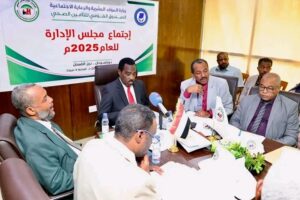
The National Health Insurance Fund (NHIF): Integrated Efforts and Strategic Plans to Achieve Social Protection

Report by: Haffiya Elyas
The year 2025 witnessed the cleansing of many areas where the brutal militia forces were deployed, highlighting the consequent need to accelerate the provision of health services to returnees and to continue providing them in the areas of displacement that resulted from the war in the country.
The Chairman of the Board of Directors, Minister of Human Resources Mutasem Ahmed Saleh, praised the great efforts made, appreciating the role that the Council has been playing, especially during the war. He said, “The performance of health insurance was exceptional and did well in restoring health services in all safe states.” The Minister stressed the obligation of the health insurance service to provide service to all citizens and added, “Our goal is to serve the citizen and provide a service worthy of him.”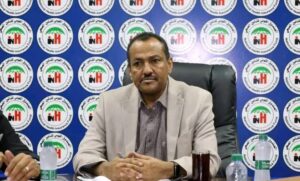
The Director General of the National Health Insurance Fund, Dr. Farouk Nour Al-Daem, emphasized the importance of supporting citizens in providing distinguished services throughout Sudan.
The Director General stressed that the 2026 plan is based on comprehensive population coverage for the entire population by introducing 500,000 new families, with a review of the target for population coverage for social support segments. The plan aims to restore health services by at least 80%.
The 2025 plan is considered an emergency plan that focuses heavily on the restoration of health services, responding to the humanitarian situation, providing health insurance services to IDPs and returnees, contributing to emergency support, preventing epidemics, and strengthening the health system to achieve social protection.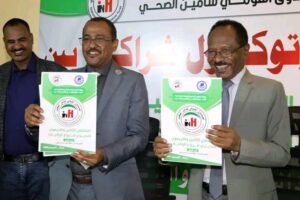
After the restoration operations, the health insurance focused on improving the health services provided to the insured public and citizens. It worked to review the possibility of horizontal and vertical expansion of health services in light of the Fund’s weak resources, which resulted from the security and economic situation in the country.
In 2022, 21.4 million citizens received health services through 3,690 service outlets. A total of 264 thousand surgeries and 29 million treatment prescriptions were disbursed, and the Fund ended the year with a debt of 56 billion due to the economic crisis.
In 2023, the health system and the provision of health services were affected by the war, as the number of health facilities decreased to 894. The frequency of medical services decreased to 11.1 million, with 126.2 thousand operations and 10.8 million prescriptions disbursed, leaving a cumulative indebtedness during the year 2023.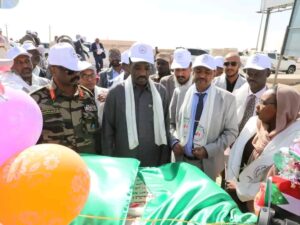
In 2024, the Gezira state was affected by the war, as most of the health facilities providing services in the state were withdrawn, which affected the availability and utilization of health services. The health facilities in the state of Sennar were reestablished during that period, and despite the restoration of (121) health facilities during the year, the total number of health facilities increased to (956).
By the end of 2024, the number of health facilities had risen to (956), and the expansion of facilities accelerated to reach (1,052) facilities in 2025, despite the closure of (39) health facilities in West Kordofan State.
During the year 2025, health insurance focused heavily on the provision of rural health services, the quality and integration of health services, and the strengthening of the collection system in the fund to provide the necessary funding.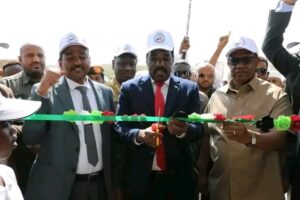
The Fund’s performance during the year 2025 witnessed integrated efforts through a number of qualitative programs and projects at the national and state levels, the most important of which are:
– Covering (86.2%) of the population in Sudan with (36.2) million subscribers until the end of 2025, an increase of (0.4) million subscribers compared to 2024.
The increase in the number of facilities provided for the service was (96) facilities compared to the year 2024, where the number of facilities provided for the service reached (1,052) facilities. The percentage of indirect facilities (health facilities from which health services are purchased for the insured) was (73%) and direct centers (owned by the Fund) accounted for (27%).
2. The abundance of drugs in all direct and model centers reached (96%) of the basic list.
3. A total of (12,508,651) patients visited the first level of health services, where (21,781,201) medical and pharmaceutical services were provided.
4. Referrals of (2,643,169) patients to meet specialists at the second level had a referral rate of (12%).
5. The frequency of (2,554,396) patients with chronic diseases was recorded.
6. The national ID number was frequented by (2,044,025) patients, which is considered a key indicator of the provision of services to the IDPs.
External Partnerships:
The National Health Insurance Fund has developed joint plans with international organizations and institutions. As a result, it has obtained support for efforts to train and provide technical assistance to the Fund in various fields, as follows:
– Participation of the Fund’s senior management in the course of developing and implementing social and health policies to achieve universal health coverage in the State of Japan, funded by the Japan International Cooperation Agency.
– Continuing to send six (6) students from the states to Japan to participate in the training course entitled “Strengthening Social Protection to Reach Universal Health Coverage,” as a continuation of the Fund’s capacity-building partnership with the Japan International Cooperation Agency.
– Identifying the experience of mandatory health insurance in Rumi and signing a memorandum of understanding to develop the health insurance system in Sudan.
– Completing the procedures for selecting a scholarship for a master’s degree in universal health coverage in the State of Japan.
– Joint operation of 24 outlets in 9 states with the World Health Organization (WHO) to provide free services to displaced people in these states.
– Assessing the institutional capacities of the fund funded by the Italian Cooperation Agency.
Human and Financial Resources:
The National Health Insurance Systems held the annual forum for managers of financial and administrative affairs in the branches in the state of Gezira , where the percentage of performance of the resources obtained during the year 2025 reached (52%) of the estimated linkage. The percentage of disbursement on medical services was (87.7%), goods and services (6.6%), non-financial assets (3.9%), and workers’ compensation (1.9%).
This led to continuous communication with funding partners at the federal and state levels, such as running ERP software with stakeholders and downloading state financial statements.
The audit of the final accounts for the year 2024 was conducted in all stable states through the National Audit Office.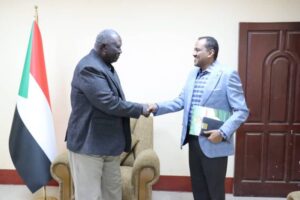
Challenges:
The National Health Insurance Fund has faced a number of challenges during the past period, including:
-The stability of the security and economic situation and the ability to finance the recovery plan;
– Collecting the Fund’s resources based on households and the approved subscription category for the year 2025.
– Collecting the Fund’s debts from the guarantors;
-Restructuring the Fund’s actuarial reserve;
– Keeping pace with the escalating need for medical services and increasing demand for them due to the current situation in the country;
– Rehabilitation and operation of health institutions that have been destroyed, and compensation for lost assets and work aids;
-Determining, unifying, and circulating the prices of health services in all states;
– Completing networking and increasing the coverage of computerized systems to achieve digital transformation;
– Expanding population and service coverage to achieve comprehensive coverage.
Recommendations
– Political support and prioritization of health insurance;
– The commitment of the financing entities to pay the subscriptions on a timely basis;
– Scheduling and repaying debts owed to financiers;
-Unifying and determining the prices of health services according to a scientific cost study;
– Continuing to reform the health financing system and diversify sources;
– Strengthening coordination with funding partners and health service providers;
– Use of the Fund’s surplus funds for medical investment.