
GIS Chief in Washington: Security Coordination and Counterterrorism
Significant Shifts as Washington’s Interest in the Sudanese File Grows
The Visit Carries a Deep Security Implication with Political and Diplomatic Dimensions
In Times of Great Turmoil, Washington Turns to Institutions Capable of Control and Restoration
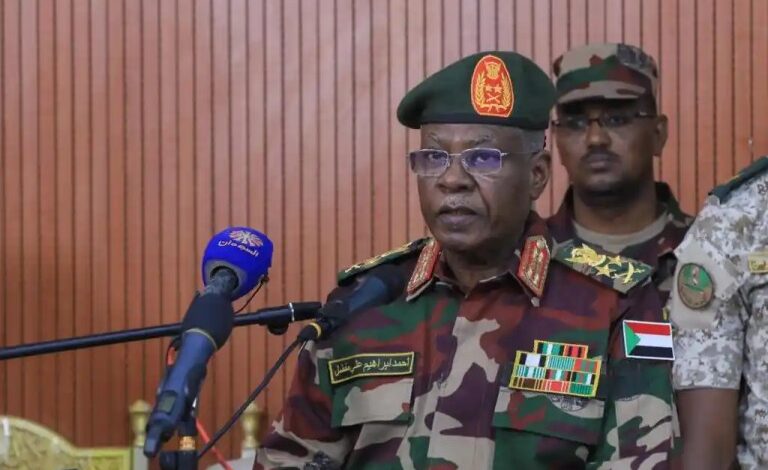
A significant trip was undertaken by the Director of the General Intelligence Service, Lieutenant General Ahmed Ibrahim Mufaddal, to the United States, where he held meetings with American officials.
Mufaddal’s visit included Washington and New York. According to news agencies, the Director of Intelligence held talks with the CIA and officials at the Department of Defense to discuss counterterrorism and security coordination.
A Strategic Gain
Sudanese-American relations are witnessing significant shifts as Washington’s interest in the Sudanese file increases. Trump’s intervention in the Sudanese crisis, at the request of Saudi Crown Prince Mohammed bin Salman during the latter’s visit to the United States, is not far removed from this context.
Journalist and political analyst Magdi Abdel Aziz says that the visit of Lieutenant General Ahmed Ibrahim Mufaddal, Director General of the Sudanese General Intelligence Service, to Washington cannot be interpreted outside the context of the ongoing shifts in the United States’ approach to the Sudanese issue, nor outside what has become known as intelligence diplomacy, where the most sensitive and influential matters are managed away from the media spotlight.
According to Magdi, the visit carries profound security implications, with clear political and diplomatic dimensions, more than just a routine round of contacts.
My source indicates that, based on the indicators we have observed in our monitoring, the topics of the trip likely revolved around combating terrorism and cross-border threats, exchanging intelligence information, and dismantling the networks fueling the war in Sudan, particularly those involved in recruitment, financing, and transporting mercenaries. These issues directly intersect with recent American actions, whether through sanctions or political and diplomatic pressure to halt hostilities.
Magdi Abdel Aziz believes that Lieutenant General Mufaddal deserves credit for leading this effort with a high degree of professionalism and strategic composure, presenting Sudan as a serious and trustworthy security partner, not merely a party to the conflict. The absence of official statements in this context is not a sign of emptiness, but rather an indication that what transpired falls within the realm of professional intelligence work, where trust is built first and permanent channels of communication are established before results manifest in the form of concrete policies or measures.
He added that the inclusion of New York among the stops on the visit, according to leaked information, reinforces the interpretation that the international dimension was present, whether in terms of coordinating positions or linking the security track with the political and humanitarian tracks. This aligns with the declared American approach of using security and financial tools to support de-escalation efforts and open humanitarian corridors.
Abdel Aziz concluded that the Sudanese General Intelligence Service, under the leadership of Lieutenant General Mufaddal, has once again proven itself to be more than just a traditional security apparatus, but an effective sovereign instrument in managing Sudan’s foreign relations and a crucial driving force in rebuilding the state’s image and its ability to protect its vital interests. This visit, in my estimation, represents a significant step forward in Sudan’s efforts to regain its natural position as an influential partner in the regional and international security equation. This is a strategic gain for the individual, the institution, and the state.
Repositioning
For his part, strategic expert and political analyst Dr. Ammar Al-Arki believes that the visit of the Director of the General Intelligence Service to Washington and New York, and his meetings with the CIA and the US Department of Defense, reflect the return of the Sudanese intelligence channel. Experience and past practice have shown this to be the most effective approach to rebuilding trust with the United States amidst the complexities of the political and military landscape.
Al-Arki added that in times of great turmoil, Washington tends to deal with institutions capable of control, coordination, and information sharing, rather than with fragile or conflicting political structures.
Notably, according to Dr. Ammar, the issue of combating terrorism has returned to the forefront of the dialogue agenda. This indicates a shared understanding that the continuation of the war and the disintegration of the state create dangerous spaces for the activities of transnational groups, not only in Sudan but throughout the entire region. From this perspective, Sudan appears as an indispensable security partner, not a marginal arena for conflict.
Ammar al-Arki pointed out that the joint emphasis on “rejecting the division of Sudan and not recognizing any parallel government” is the most sensitive aspect of the news. He stressed that this message should not only be interpreted as support for Sudanese unity, but also as a decisive and deterrent political signal against attempts to impose a political or geographical fait accompli through force or parallel arrangements outside the framework of the state. It also narrows the room for maneuver for those betting on a scenario of disintegration or “legitimizing” division.
Al-Arki continued, arguing that this intelligence activity reflects the return of the Sudanese file to American decision-making circles through the lens of national security, and that Washington has begun to draw clear red lines: the unity of Sudan is non-negotiable, and dealings will be with the state and its institutions, not with parallel alternatives or projects of disintegration. This shift is one of the most important indicators of Sudan’s repositioning on the international strategic map.