
Afwerki: The situation in Sudan is “not a civil war but a conspiracy and an overt and covert invasion,”
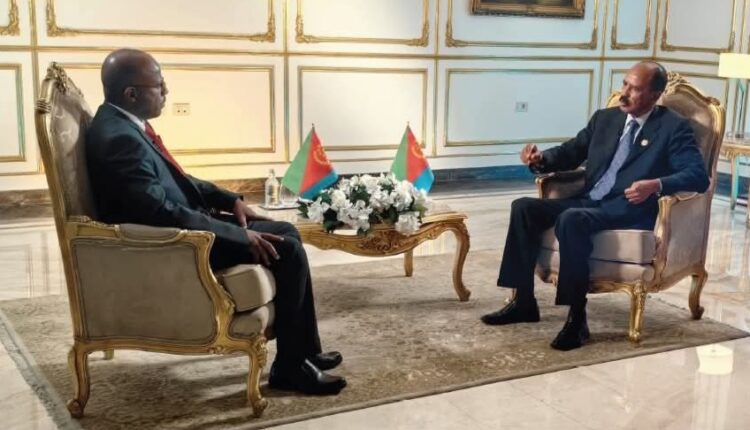
Eritrean President Isaias Afwerki affirmed that the security and stability of the Red Sea can only be achieved through cooperation among the littoral states.
He emphasized his rejection of any military interventions or foreign tutelage in the management of this vital waterway.
Afwerki’s remarks came in an exclusive interview with Eritrean television (ERi-TV) following his official five-day visit to the Arab Republic of Egypt (from October 30 to November 4). During his visit, he participated in the inauguration of the Grand Egyptian Museum and held extensive talks with President Abdel Fattah al-Sisi on shared regional issues.
Regarding his visit to Egypt:
Afwerki praised the opening ceremony of the Grand Egyptian Museum, describing the Egyptian experience as “inspiring and remarkable in its use of history and culture to serve future generations,” and calling for the exchange of cultural and artistic expertise among the peoples of the region.
Eritrean-Egyptian Relations
The Eritrean president explained that the relationship between Eritrea and Egypt transcends the bilateral dimension.
He pointed out that the two countries share a strategic vision aimed at “escaping the cycle of chaos and foreign interference in the region, and working to build a stable environment that guarantees development and security.”
He added that continuous communication and coordination between the two countries represents the cornerstone of building an effective regional partnership capable of confronting the serious challenges facing the Horn of Africa and the Red Sea region.
On the Sudanese Crisis
Afwerki described the situation in Sudan as “not a civil war, but rather a conspiracy and an overt and covert invasion.”
He considered that foreign interventions have disrupted the political transition process following the Sudanese people’s uprising.
He affirmed that his country and Egypt are making strenuous efforts to support the Sudanese in reaching an independent, internal solution.
He added: “We will continue our support because there is a shared strategic interest that unites Sudan and the peoples of the region, and we must help them without imposing any guardianship.”
Red Sea Security
Regarding Red Sea issues, Afwerki stressed that “this sea does not belong solely to the countries of the region, but is an international waterway of major geopolitical importance,” warning of the dangers of militarizing the region.
He stated that the solution lies in strengthening each country’s national capabilities to protect its coasts and establishing a regional cooperation mechanism based on clear legal agreements, independent of foreign military bases or narrow regional alliances.
He added, “No power can replace the Red Sea states, and their people must bear their historical responsibility in protecting it and safeguarding their interests.”
On Somalia and the Gulf of Aden
Afwerki addressed the situation in Somalia, emphasizing that its stability is a fundamental pillar for the security of the Red Sea, the Gulf of Aden, and the Indian Ocean.
He pointed out that the weakness of Somali state institutions has created a vacuum that some foreign powers have exploited to establish military bases in Socotra, Mayyun, and Zuqar, considering these practices a threat to regional security.
He called for coordinating local and regional efforts to confront these challenges.
He stressed that “regional stability is a historical responsibility, not a choice.”