
UN Commission Warns of Renewed Violence in South Sudan
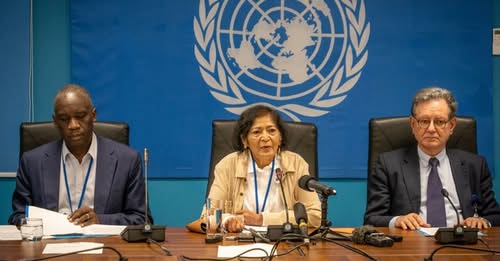
The UN High Commissioner for Human Rights in South Sudan warned that the escalating political crisis in South Sudan is exacerbating the resurgence of armed violence, exacerbating the already dire human rights and humanitarian conditions, and increasing regional instability.
It revealed that despite the efforts of the African Union and regional actors over a decade to support the peace process, South Sudan’s leaders have deliberately obstructed progress and pushed South Sudan toward a new abyss.
The Commission stated in a statement that armed clashes are occurring on a scale not seen since the signing of the Cessation of Hostilities Agreement in 2017, with civilians bearing the brunt of human rights violations and displacement.
It emphasized that the justice and accountability vacuum in South Sudan continues to fuel political intransigence, impunity, conflict, and corruption.
It continued, “The latest political split at the center has emboldened armed groups, sparked renewed conflict, and displaced thousands. As the Commission’s recent report—“Looting a Nation: How Endemic Corruption Unleashed a Human Rights Crisis in South Sudan”—demonstrated, endemic corruption and the systematic diversion of public resources remain a major driver of conflict, depriving the people of South Sudan of their most basic rights.
“The ongoing political crisis, escalating fighting, and rampant systemic corruption are all symptoms of a failure of leadership and consensus in implementing the commitments of the peace agreement and the political transition,” said Commissioner Barney Afako, who led the Commission’s mission to the African Union.
He added: “Unless there is immediate, sustained, and coordinated political engagement from the region, South Sudan risks slipping back into full-scale conflict, with dire consequences for the human rights of its people and the region as a whole.
The people of South Sudan are looking to the African Union and the region to save them from an avoidable fate.”
The Commission also engaged with African Union officials, emphasizing the urgent need to establish the transitional justice mechanisms reaffirmed in Chapter V of the 2018 Revitalized Agreement on the Resolution of the Conflict in South Sudan, particularly the Hybrid Court.
More than a decade after the conflict erupted in December 2013, victims in South Sudan are still awaiting credible justice and reparations for the grave violations and crimes they suffered.
Despite repeated calls by the African Union Peace and Security Council in March and June 2025 for the Government of South Sudan to cooperate with the African Union to develop guidelines and mechanisms for the establishment of the Hybrid Court, no tangible progress has been made.
“Justice is more essential for South Sudan than ever,” said Yasmin Sooka, Chair of the Commission.
She added that promises made to victims over the years have not been kept. The hybrid court must move from paper to concrete action. The African Union has a mandate and moral responsibility to ensure comprehensive transitional justice for South Sudan, in line with its Transitional Justice Policy.
She stated that a hybrid court that holds people accountable for past crimes—while simultaneously strengthening South Sudan’s justice institutions on the basis of complementarity—could leave a transformative legacy, promoting cohesion, the rule of law, and human rights in the country.
Renewed armed clashes have forced thousands of South Sudanese to flee once again. In 2025 alone, an estimated 300,000 South Sudanese fled the country, largely due to the escalation of conflict: 148,000 new arrivals to Sudan; 50,000 to Ethiopia; and 50,000 to Uganda. 30,000 to the Democratic Republic of the Congo; and 25,000 to Kenya.
Their protection and survival remain the responsibility of the region, which now hosts more than 2.5 million refugees from South Sudan.
South Sudan also has two million internally displaced people, while hosting an additional 560,000 refugees fleeing the war in Sudan.
Women continue to be disproportionately affected, bearing the brunt and risking forced displacement.
“The escalation of armed clashes, mass displacement, and the collapse of the seven-year-old peace agreement demonstrate that South Sudan cannot rebuild without stability and justice,” said Commissioner Carlos Castresana Fernandez.
“Credible and independent justice and accountability mechanisms are needed to deter recurring cycles of atrocities, break cycles of impunity, and heal the wounds of war. The African Union and regional partners must act now—not just to prevent another war, but to build the foundations for a just peace based on the rule of law.”
In Addis Ababa, the Committee consulted with the African Union Ad Hoc Committee on South Sudan (the P5), members of the African Union Peace and Security Council, the African Commission on Human and Peoples’ Rights, diplomats, the United Nations, the Intergovernmental Authority on Development, and senior African Union officials, including from the Office of the United Nations High Representative for South Sudan.