
Orbits: The mountain has labored and brought forth a. mouse!

By: Muawad Mustafa Rashid
The Sudan Quartet countries—Egypt, Saudi Arabia, the United Arab Emirates, and the United States—issued a joint statement calling for an initial three-month Humanitarian truce to enable rapid access for humanitarian aid throughout Sudan, leading immediately to a permanent ceasefire.
In their statement, they stated that a comprehensive and transparent transition process must be launched and concluded within nine months to meet the aspirations of the Sudanese people for an independent, civilian-led government with broad legitimacy and accountability. They noted that this is vital for Sudan’s long-term stability and the preservation of state institutions.
They added that they had held extensive consultations, at the invitation of the United States, on the conflict in Sudan, indicating that the ministers committed to a common set of principles for ending the conflict in Sudan. Foremost among these is that Sudan’s sovereignty, unity, and territorial integrity are essential to achieving peace and stability.
Among the principles under discussion is that there is no viable military solution to the conflict, and that the current situation creates unacceptable suffering and risks threatening peace and security. All parties to the conflict must facilitate rapid, safe, and unhindered humanitarian access throughout Sudan by all necessary means, protect civilians in accordance with international humanitarian law and their obligations under the Jeddah Declaration, and refrain from indiscriminate air and ground attacks on civilian infrastructure.
They agreed that the future of governance in Sudan is up to the Sudanese people to decide through an inclusive and transparent transition process, not under the control of any warring party. They stated that Sudan’s future cannot be dictated by what they called violent extremist groups that are part of, or clearly affiliated with, the Muslim Brotherhood, and whose destabilizing influence has fueled violence and instability throughout the region, according to the statement.
The ministers agreed to closely monitor the implementation of these timetables and affirmed their readiness to exercise their good offices and make all necessary efforts to ensure full implementation by the parties, including reconvening to discuss further steps.
Among the points they agreed upon, along with the United Arab Emirates, was their affirmation that external military support to the parties to the conflict in Sudan contributes to fueling and prolonging the conflict and destabilizing the region. Therefore, halting external military support is essential to ending the conflict.
They pledged to continue their engagement in supporting a peaceful solution, including exerting all efforts to support a negotiated settlement to the conflict with the effective participation of the Sudanese Armed Forces and the Rapid Support Forces; pressuring all parties to the conflict to protect civilians and civilian infrastructure and ensure humanitarian access to those in need;
They pledged to strengthen the conditions necessary to ensure the security of the Red Sea region more broadly; to confront transnational security threats from terrorist and extremist organizations and the conditions that allow them to spread; and to deny space to destabilizing regional and local actors who seek to exploit the ongoing conflict in Sudan.
The ministers affirmed their commitment to restoring peace and ending the suffering of the Sudanese people, and their readiness to cooperate with African and Arab countries and institutions, the United Nations, and international partners to achieve these goals.
The ministers discussed urgent humanitarian needs and early recovery requirements, and emphasized the need to continue mobilizing the international community to achieve this goal and build on recent humanitarian meetings.
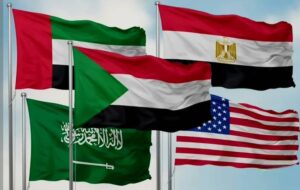
The ministers affirmed their determination to continue discussions, consultations, and meetings, at the ministerial and sub-ministerial levels, to enhance their coordinated efforts in support of ending the conflict in Sudan, including supporting the establishment and implementation of a comprehensive and transparent transitional process.
In this regard, the ministers expressed their support for the efforts of the Kingdom of Saudi Arabia and the United States, through the Jeddah Process, to achieve a permanent ceasefire in Sudan, as well as for Egypt’s efforts regarding the Sudanese Civilian and Political Forces Forum, the first session of which was held in Cairo in July 2024.
The ministers agreed to continue their consultations in this regard during the Quadripartite Ministerial Meeting in September 2025.
The Quartet statement equates the Sudanese Armed Forces as the legitimate representative of the Sudanese state and people, and renders our victorious army (one of the warring parties) the same as the criminal Janjaweed gangs!!
The statement says, amidst a series of explosive phrases: “The future of government in Sudan will be decided by the Sudanese people through a comprehensive and transparent transitional process not controlled by any of the warring parties.” This means that the army will either leave power in the coming period or be on an equal footing with the criminal militias in governing the country, so that no party dominates!!
The statement, signed by the US Secretary of State, says: “There is no military solution to this conflict.” If we accept this argument for the sake of argument, how does the US administration envision a military solution to the conflict in Gaza, including the attempt to assassinate Hamas leaders with drones in Qatar?!
It is surprising that the UAE participated in a meeting on peace in Sudan, despite being a key party to the war and the primary supporter of the rebel militia with weapons, military technology, and mercenaries. Its hands are stained with the blood of innocent Sudanese people and it is the primary reason for prolonging the war, while simultaneously marginalizing Sudan, the real stakeholder.
The statement would have been more appropriate if it included a clear obligation for the UAE to cease its support for the rebel militia with weapons.
A proper classification of this war represents the first and fundamental step toward resolving the conflict, which is a rebellion by an armed group against the state, supported by the UAE and other countries.
Equating the armed forces, which are fulfilling their constitutional and legal duty to protect the nation’s security, unity, sovereignty, and stability, with a rebel militia as two parties to the conflict represents a false classification that leads to false results.
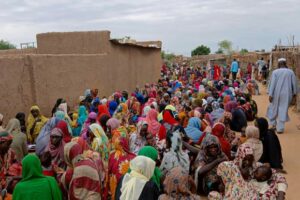
The deliberate disregard and failure to refer to the constitutional developments in Sudan toward democratic transition, the formation of a civilian government, and the serious steps taken toward Sudanese-Sudanese dialogue, as well as the ongoing efforts of the Sudanese government to deliver humanitarian aid and its cooperation with the United Nations to open numerous crossings, despite the rebellion and its supporters exploiting this opportunity to bring in weapons.
The failure to condemn the militia’s unjust siege of El Fasher and its denial of humanitarian aid to the besieged citizens in El Fasher and the displacement camps, and its refusal to implement Security Council Resolution 2743/2024, represents a clear double standard and bias, and is inconsistent with the required neutrality.
The claim that the Muslim Brotherhood has a role in determining Sudan’s future is an unacceptable accusation, based on no credible evidence or justification. It represents bias and a reiteration of the rebellion’s allegations and hostile parties have long used it as a flimsy justification for their conspiracy against Sudan.
What is contained in this statement represents clear and unacceptable bias and an attempt to impose international mandates on Sudan, in complete disregard for the Sudanese people’s inherent right to self-determination without any foreign interference or influence.
A just solution to the conflict in Sudan will not come through external statements or isolated meetings, but rather through Sudanese-Sudanese dialogue and support for the roadmap for democratic transition approved by the Sudanese government and endorsed by national and societal forces.
The Quartet statement ignores the fact that the armed forces are not waging a war of their own free will, but rather an existential battle against a brutal, criminal, foreign-backed armed militia that threatens the entire Sudanese state.
The Quartet statement cannot be read in isolation from attempts to impose external solutions that ignore the will of the Sudanese people and their national institutions.
Supporting peace in Sudan does not come through exclusionary statements or through involving countries involved in the conflict.

Rather, it comes through supporting the Sudanese army in its battle to protect sovereignty, backing national efforts to address the humanitarian crisis, and placing the country’s future in the hands of its people, not the agendas of others.
It goes without saying that all the Sudanese people are now unified in supporting their army in lliberating every inch of Sudan’s land.
We will not be deterred by attempts to halt the armed forces’ victories through isolated external actions or military or political support for the rebel Rapid Support Forces militia.
In short, the Quartet’s statement is rejected and will not affect the state’s plan to defeat the Rapid Support Forces militia.
The practical response will be more victories.