
Bernard-Henri Lévy Speaks Out
Report by Staff Reporter
The French philosopher and writer Bernard-Henri Lévy, one of France’s most prominent “new philosophers,” has long aroused controversy with his positions and interventions in international crises, from Bosnia to Libya, from Kurdistan to Ukraine. Born in 1948 to a Sephardic Jewish family in Algeria during the French colonial period, Lévy later emerged as a politicized intellectual who believes in what is known as “moral interventionism.” He uses his pen, his lens, and his influence in Western decision-making circles to shed light on what he asees as injustices.
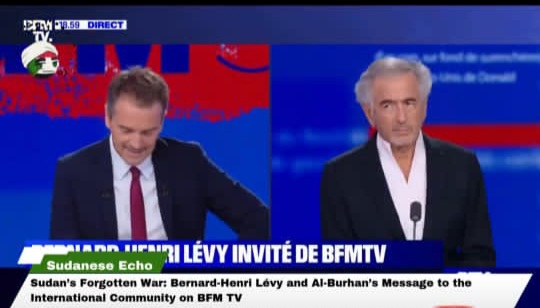
In a striking appearance on BFM Story on BFM TV, broadcasted live on July 30, Lévy described what he called “the fiercest and most forgotten war in the world today.” Returning from Sudan, Lévy painted a picture of a country torn apart by atrocities and mass displacement, stating: “There are 12 million displaced out of 51 million inhabitants.” Speaking alongside images from his Paris Match report, he stressed that what is happening is not a tribal or ethnic conflict, nor merely a rivalry between generals, but “a true political divide between two visions for the country.”
Lévy did not hesitate to describe the crimes committed by the UAE-backed Rapid Support Militia (Janjaweed), calling its leader “a general of terror whose troops move like death columns.”
He recounted howa their campaigns have been marked by burning, looting, rape, and systematic violence: “I collected testimonies from women that haunt you day and night.”
Lévy added that their methods are not only criminal but “terrorism in the most classic sense of the word, in the way of ISIS and Al-Qaeda,” framing the militia as part of the same brutal tradition.
For Lévy, this is not just a humanitarian catastrophe but a political project aimed at building what he called “a smuggler state,” a militia-run entity sold to neighbors or foreign powers at the expense of Sudan’s ancient civilization.
In that television interview Bernard referred to the personality of Lieutenant General Abdul Fattah al-Burhan, describing him as “the last pillar of the Sudanese state’s survival,” warning of catastrophic scenarios if Sudan were left prey to the rebel militia.*
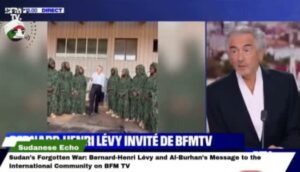
Levy spoke about his meetings with community and military leaders, noting that the scene in Sudan reminded him of scenarios before complete collapse, as happened in Libya or Syria. At the same time, however, he expressed admiration for what he described as “the military institution’s cohesion” in the face of collapse, and singled out al-Burhan for explicit expressions of support, noting that “the man is fighting for the state’s survival, not for power.”
This testimony is striking in the context of the general Western view, which typically views military leaders in the Third World with suspicion, accusation, and often with inferiority or subservience.
Levy also called for the active role of France and the European Union in halting this genocide and providing humanitarian protection for civilians, saying:
“We cannot stand idly by while entire villages are burned and entire tribes are exterminated without any accountability or international intervention.”
Bernard’s testimony is not the first about the war, but it may be the first to be picked up by serious Western media and incorporated into the moral and political agenda. It is a painful paradox that we wait for testimonies from abroad to confirm what we have experienced and know firsthand.
It is also a call to Sudanese elites and international stakeholders to continue documenting crimes.
It is high time to address the Western conscience in its own language, with its own tools, and with voices from within.
In this context, we must view Levy’s intervention not merely as an act of individual sympathy, but as an opportunity to rebuild the Sudanese war narrative in international forums.
What he presented is not only massacres, but also a renewed international moral failure.
It is an opportunity to embarrass the inactive world and push it toward recognition, then solidarity, and finally accountability.
But, in return, we must seize the moment and invest it in mobilizing international media, mobilizing human rights organizations, and mobilizing the voices of Sudanese communities in Europe and America to intensify pressure, translate local reports, and document violations in all the world’s languages.
We are not asking the world to fight for us, nor to embrace our causes without restriction.
Let us make good use of his testimony to uncover the truth, expose the killers, and direct the media and political compass toward this “forgotten war.”