
Dongola hosts A workshop on “Protecting Women and Girls First in Peace and War”
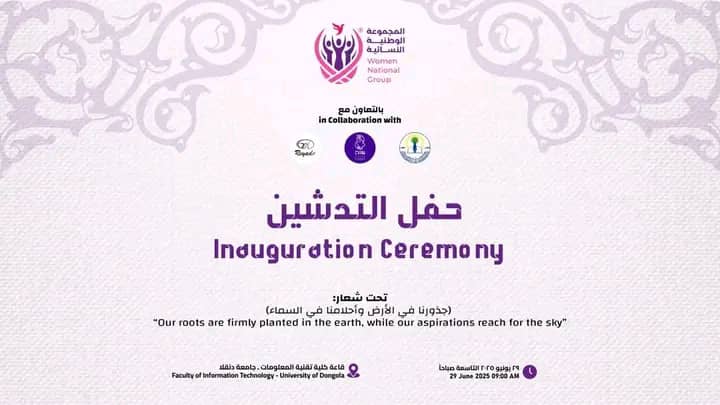
(Our Roots on Earth and Our Dreams in the Sky)
Report by /Haffiya Elyas
Women and girls of the groups protected by heavenly religions and national, regional, and international legislation in peace and war.
This protection can be direct or indirect, and the distinction between combatants and non-combatants, as well as military objectives and non-military objectives, is one of the basic pillars of customary humanitarian law.
It is ruled that it is not permissible to attack non-combatants in all their categories, including women, children, the elderly, and the like, as long as they do not fight or help to fight. However, if they participate in the fight directly or indirectly, it is permissible to engage them.
In Islamic law, we find that it has protected basic rights and personal sanctities in peace and war through the necessary purposes: preserving religion, preserving the soul, preserving money, and preserving honor and offspring.
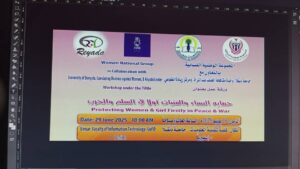
The Women National Group, in collaboration with the University of Dongola, the Combating Violence Against Women & Children Unit, and the Reyada Center, are organized a workshop titled “Protecting Women and Girls First in Peace and War” on June 29, 2025, at the Faculty of Information Technology, University of Dongola. The workshop was participated by a qualitative presence of social work leaders, along with a number of personalities, symbols, and representatives of the judiciary.
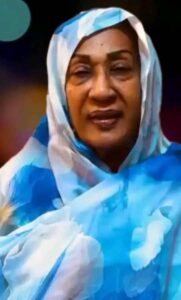
Chairman of the Board of Trustees of the National Women Group ، Dr. Sarah Abu, , said this is the first of the activities of the group in Dongola, which is distinguished in the history of Sudan in terms of governance, science, progress, justice, societal mixing, and embracing everyone who sets foot on the land of Sudan. The land of conquests, history, and antiquities.
Prof. Abdullah, as you are deputizing for the Rector of the University, we salute you and salute the leader Al-Fateh Fadl Al-Mawli, Commander Hussein, representatives of the judiciary, Dr. Amira Arman and her staff, Sister Amal Abdul Latif, professors, civil society organizations, the Anti-Violence Unit. The leadership and the group appreciate all the efforts to hold the workshop, attendance, participation, advocacy, and support.
We raise our palms to God to make everyone who rose up a martyr, to heal every sick, wounded, and missing person, and to return to the bosom of the homeland while it is rising to the age of every displaced person, refugee and homeless person.
And the last of our prayers is to ask him the decisive victory of our armed forces.
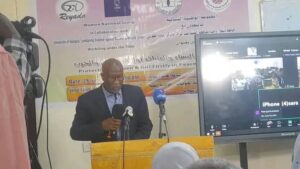
Prof. Abdullah, representative of the Rector of the University of Dongola, welcomed the attendees, valued the role of women in society, and said that they must be protected from all forms of violence.
Amira Hassan Abdulrahman, Dean of the College of Community Development at Dongola University and coordinator of the workshop, said that the aim of the workshop is to enhance awareness and knowledge about war-related violations in Sudan, empower actors to support women and girl victims, and advocate for access to justice and accountability.
She indicated that the idea for this workshop arose from the need to make a positive change in the lives of women and girls during and after the war.
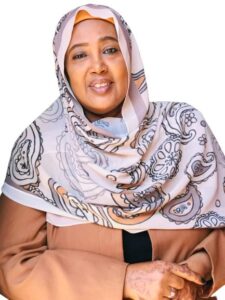
She added that the justifications for this initiative are that protection for women and girls in peace and war is achieved through dissemination and promotion of international humanitarian law, international human rights law, and international, regional, and local humanitarian frameworks and principles by the parties relevant to the application of laws internationally, regionally, or locally.
She said that the idea came from the importance of holding the workshop to enhance cooperation and coordination between partners to plan and implement activities for providing protection for women and girls in the event of peace and war, in addition to preventing violations and taking all legal measures to stop violations of international, regional, and local laws and conventions. The following are the rights of women and girls in peace and war.
Amira said that this workshop comes within the framework of cooperation and coordination between the University of Dongola and the National Women’s Group, following the signing of the memorandum of understanding that was recently established to provide awareness services in the areas of sustainable development.
Sulaima Ishaq Elkhalifa Sharif/Unit for Combating Violence against Women ، said the protection of women is not a luxury, nor a secondary issue, but the foundation of any genuine peace process, a pillar of social justice and societal stability.
“We have witnessed, and continue to witness, how wars and conflicts compound the suffering of women and girls, from displacement to direct physical and psychological violence. Therefore, it is our responsibility – as authorities, institutions, and civil society organizations – to work together to ensure that women and girls come first in protection, participation, and decision-making”.
Sulaima pointed out that UNHCR believes that the work to protect women and girls does not begin only when a violation occurs, but through prevention, awareness-raising, and strengthening laws and mechanisms that ensure justice, fairness, and accountability.
“We are – and will continue to work – to develop national policies and strategies that place women and girls at the center of protection and response efforts, and we are working with partners to build the capacity of communities to be protectors rather than silent, and initiative, not spectators”, she added .
A number of papers have been presented during the workshop, including a paper on the causes and effects of health (physical, psychological, and mental), educational, social, and economic violations of the rights of women and girls in peace and war, with a focus on the effects of the war of April 15, 2023, on women and girls, health care services, and psychosocial support for victims, as well as social care and rehabilitation of victims.
The workshop pointed out to the the historical background and the international, regional, and local legal framework for the protection of women and girls in peace and war, as well as the protection of civilians and humanitarian service providers.
The workshop also addressed the issue of protecting women and girl prisoners in international humanitarian law, along with The issue of smuggling, selling, and trafficking crimes against women and girls .
There have been an open dialogue during the workshop on how survivors can support the available psychological, medical, and legal services to create a future roadmap for coordination between civil society organizations to provide services to women and girl victims.