
Joint cooperation between the Ministry of Social Development and the United Nations

Report by /Haffiya Elyas
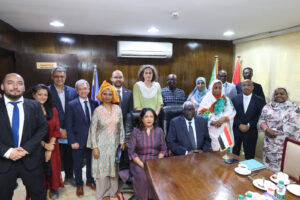
The Minister of Social Development, Ahmed Adam Bakhit, met with the Special Representative of the Secretary-General on Sexual Violence in Conflict (SRSG-SVC), Ms. Pramila Patten, in Port Sudan
During the meeting, joint cooperation was signed between the Government of Sudan, represented by the Ministry of Social Development, and the United Nations,the Special Representative of the Secretary-General on Sexual Violence in Conflict (SRSG-SVC),
This coincides with the passage of two years of war in Sudan and the violations witnessed by the country of women, girls and children in all its forms, as well as the use of sexual violence as a weapon that was more lethal than the weapons of war.
This joint agreement strengthens services related to the prevention and response to sexual violence health, psychological, legal and social and works to focus on zero impunity while improving the effectiveness of legal frameworks that facilitate and facilitate women’s and children’s access to justice for women, children and even men.
The agreement will support the State’s ongoing efforts to respond and prevent sexual violence.
The Government of the Sudan welcomed the Special Representative’s offer to deploy a technical team to support the development of an implementation plan. The process will be led by the Ministry of Social Development and will engage other relevant national authorities and institutions, including the Sudanese Armed Forces.
It is worth noting that the landmark agreement, signed with the Government of the Republic of the Sudan, in accordance with Security Council resolution 2467 (2019), prioritizes a number of areas such as the provision of holistic services for survivors; supporting the review and/or adoption of legislation to strengthen protection from conflict-related sexual violence; engaging with Sudanese justice and security actors, including to enhance capacity for the investigation and prosecution of crimes of sexual violence; and, engagement with other relevant actors such as tribal, religious and community leaders, civil society including women and youth-led organisations and survivors themselves who will be at the heart of all efforts.