
Algeria considers UAE Ambassador Persona non grata
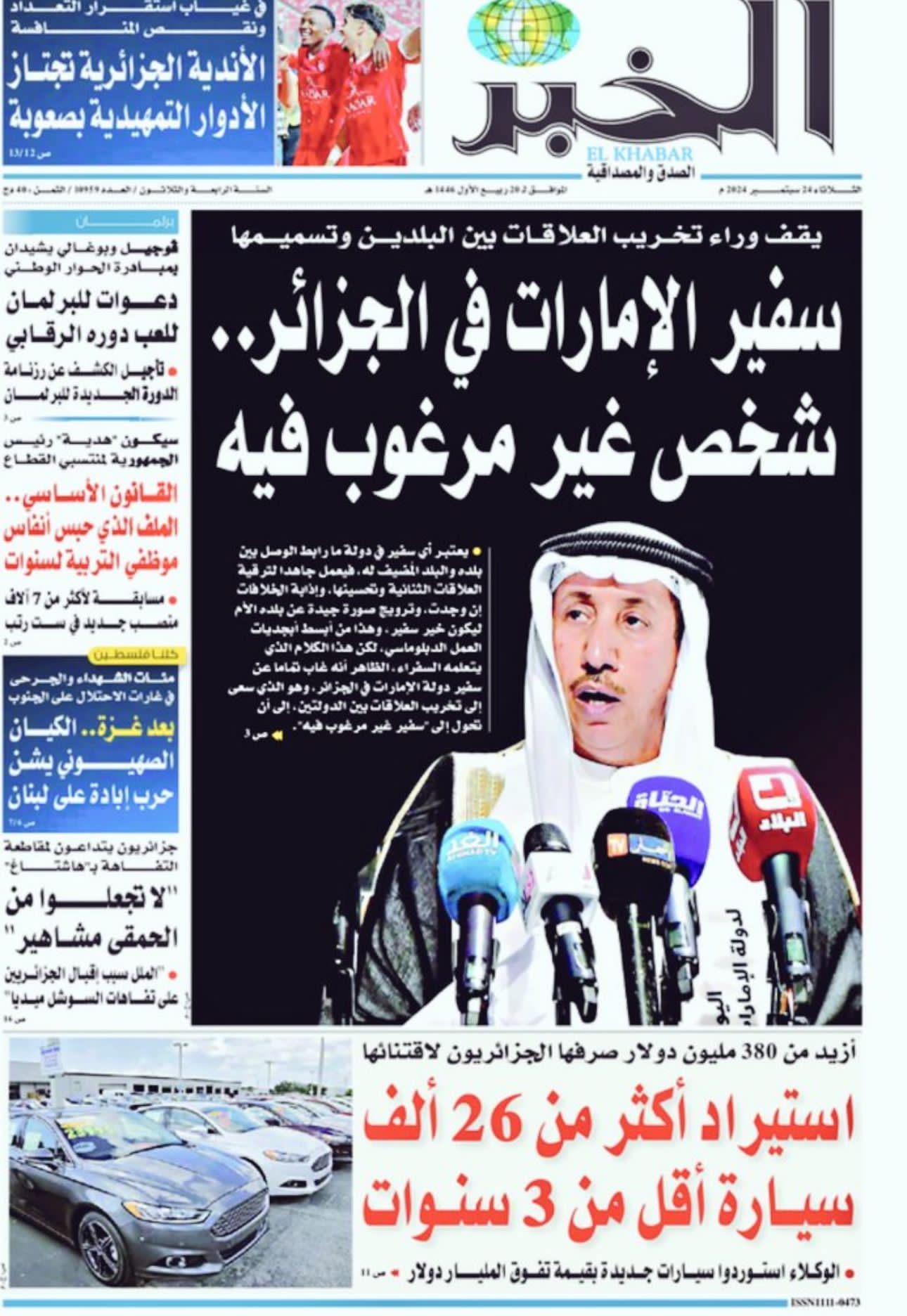
Any ambassador to a country is considered the link between his country and the host country. He works hard to promote and improve bilateral relations, resolve differences, if any, and promote a good image of his home country to be the best ambassador. This is one of the simplest ABCs of diplomatic work, but this talk that ambassadors learn, it seems that it was completely absent from the UAE Ambassador to Algeria, who sought to sabotage relations between the two countries, until he turned into an “unwanted ambassador.”
In any tension in relations between two people or two countries, you find a third party standing in the way, seeking to pollute and disturb the ties, and it is like the devil’s temptation that promises people poverty and orders them to commit indecency, and that is indeed what the UAE Ambassador to Algeria, Youssef Saif Khamis Saba’a Al Ali, was doing, who did not spare his effort or time in poisoning relations, exceeding all customs and diplomacy and its traditions, and disregarding the principles of hospitality. In light of these shameful acts committed by this ambassador who offended his country and his people, he has indeed become, within the framework of diplomatic custom, an “undesirable person” in Algeria, as dealing with him will become difficult, if not prohibited, due to his actions that did not respect diplomatic etiquette.
Algeria, like any other country, has the right to declare any ambassador or other member of the diplomatic mission as “persona non grata”, according to Article 9 of the Vienna Convention on Diplomatic Relations signed in 1961, which states that “the receiving State may, at any time, without stating the reasons, notify the accredited State that the head of the diplomatic mission or any member of the staff of its mission has become (persona non grata), or that any member of the staff of its mission (other than diplomats) has become (persona non grata)”.
The UAE ambassador was not classified as “persona non grata” in Algeria unless it was proven beyond a shadow of a doubt that he insisted on violating the laws and regulations of the receiving State and avoiding interference in its internal affairs, or that he began to make inappropriate statements against Algeria and its officials or to practice incitement.
There is no harm here in recalling that the UAE has recently practiced hate and incitement campaigns against Algeria and its leadership, reaching levels that are unacceptable, neither diplomatically nor morally.
However, Algeria has maintained its self-control despite the dangerous hostile actions, including, but not limited to, providing Morocco with an advanced system designed to spy on Algeria, developed by the Zionist company “Quadrim”, aimed at hacking the phones of officials and journalists in 10 countries, including Algeria. Moreover, Emirati officials wanted, at any cost and by any means, to impose their country’s presence in the Sahel region and the intention of their plan is to besiege Algeria.
Perhaps the most prominent evidence of this is the major operation that the Algerian army forces thwarted by foiling an attempt to smuggle, last year, 1.7 million hallucinogenic pills into Algeria, which were being traded by the son of General Haftar with the support of Emirati officials. Reliable international reports did not hide that the UAE was involved in espionage cases after it was proven that it imported Israeli espionage technologies for the benefit of the Emirati authorities.
The international media has also accused it more than once of trying to direct the internal and external policies of some countries, with the aim of building a “new regional order” that is consistent with its perceptions, and to achieve this, it launches attacks aimed at preventing the promotion of democracy and spreading chaos in many countries.