
Multilateralism Is Never a Bridge Too Far. Let Us Build It from Both Banks
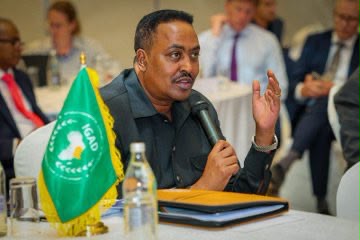
By Workneh Gebeyehu.
The threats that will decide 2030 keep no borders, so the answer to them cannot either. Cooperation, and the institutions that carry it, are the only grounds on which durable development has stood. I write not from theory but from a region that learned it the hard way.
Four decades ago, when the skies failed, IGAD was born. Six governments, having buried hundreds of thousands of their people, accepted what the winds of drought and the spectre of famine taught them as they swept across our borders alike: that failing rains do not stop at the frontier, that no army can defeat hunger, that no nation can endure the Horn of Africa alone. Our founding name carried the word that compelled it: the Authority on Drought. Cooperation, for us, was never an abstract doctrine. It was the arithmetic of survival.
This instinct is older than my region. When Europe lay in ruins, its wisest architects built peace not from proclamations but from a solidarity of concrete facts; and from our own continent, an earlier generation insisted that Africa’s development be authored in its own regional hand or not at all. IGAD claims no novelty in calling cooperation the load-bearing wall of any civilisation, we only occupy a vantage point from which its cracks are all too easy to read.
The argument is simple. Every ambition fixed for 2030 rests on problems that have slipped from their national moorings: a drought crosses frontiers, and so does a flood, a virus, a price shock, a rising tide. A Nobel Prize was awarded, not long ago, for proving what every herder in my region has always practised, that a community sharing a commons can govern it wisely without a sovereign above it, so long as the rules are written close to the ground by those who live under them. This planet is our commons. It will be sustained by our agreement or perish for lack of it.
I will not pretend that the wall now stands sound. The retreat from cooperation now heard in many quarters is, in part, a verdict on promises poorly kept: solidarity has too often arrived as debt, and a seat at the table has rarely matched the size of the stake. To those who call cooperation utopian, a bridge too far, my answer is to be found in the IGAD region, which built such a span once from the rubble of famine. The financing gap for the SDGs has surpassed four trillion dollars a year, and not one of the seventeen is on course; the remedy for imperfect cooperation is cooperation done better, and nearer to those it serves.
Nearer carries a call for concrete reform: direct a defined, predictable share of global development and climate finance through the regional bodies closest to each problem and seat those regions on the boards that govern the money. Spend ahead of disaster, not only behind it. Some nine of every ten humanitarian dollars are released only once the catastrophe has passed the point of no return, while finance that pays out on a forecast can reach millions before the famine arrives.
There is a reflection folded into our 40th IGAD anniversary. A drought summoned this institution into being; forty years on, the Horn has weathered the worst drought since our founding, one that drove more than two and a half million people from their homes and killed over thirteen million head of livestock. A cynic may call this a failure of multilateralism; I call it the measure of how much solidarity we have left undone. Agreement, on which the commons depends, is forged in rooms, and forums like this Hamburg Sustainability Conference are where a tired architecture can be redrawn and the South seated not as a guest but as a partnering host.
To our partners in Europe and around the world, IGAD extends its hand, from conviction rather than need. We draw breath from one atmosphere and stand equally unguarded before the next pandemic; a stable Horn of Africa is no charity the world performs for us, but a stake it holds with us. We ask to be neither administered nor rescued, but to co-invest as equals in goods that belong to no one alone: not patron and client, but two banks of one river. The order of this century has to be assembled from its most vulnerable regions or it will not hold, and sustainable development will be reached as my region learned to outlast a merciless sky: by reading the horizon together, and by building, from both banks at once, a bridge equal to the crossing.
Author: Workneh Gebeyehu is Executive Secretary of the Intergovernmental Authority on Development (IGAD), a regional organisation encompassing states in the Horn of Africa.
How can sustainable development be advanced in a world shaped by geopolitical tensions, economic constraints, technological disruption, and competing political priorities? In cooperation with the Hamburg Sustainability Conference, the Table.Forum “Sustainable Development 2030 and Beyond” brings together leading voices from politics, international organizations, business, academia, and civil society to discuss solutions, priorities, and partnerships for the years ahead. At the center of the forum are the main themes of HSC 2026,