
From Factory to Dining Table: How Chemicals and Industrial Practices Are Finding Their Way onto Our Plates

The Hidden Journey of Chemical Hazards from Industry to Everyday Life
An Exclusive Interview with Eng. Hesham Mohamed Al Said Aly
HSE Editor
The Citizen Newsletter
Guest
Eng. Hesham Mohamed Al Said Aly
Engineering Consultant in Occupational Safety, Health and Environment (OSH&E)
Director, Occupational Safety and Health Consultancy Center
Cairo, Egypt
Introduction
Food safety is often associated with hygiene, proper cooking, and food storage. However, an emerging concern among health, safety, and environmental professionals is the increasing presence of chemical contaminants entering the food chain through industrial practices, agricultural activities, household products, and everyday consumer habits.
To explore this important issue, The Citizen Newsletter’s HSE Editor spoke with Eng. Hesham Mohamed Al Said Aly, a distinguished specialist in occupational safety, health, and environmental risk management. In this exclusive interview, he explains how chemical hazards can travel from factories and industrial processes to our dining tables, creating what he describes as “a silent public health challenge.”
HSE Editor:
Occupational safety professionals recognize inhalation, skin absorption, and ingestion as the three primary routes of chemical exposure. Why has ingestion become such a critical concern today?
Eng. Hesham Mohamed Al Said Aly:
In industrial workplaces, employees are usually protected through engineering controls, personal protective equipment, monitoring programs, and strict safety procedures.
The general public, however, does not enjoy the same level of protection.
Today, ingestion has become one of the most significant pathways of chemical exposure because people are unknowingly consuming trace amounts of chemicals through food, beverages, contaminated utensils, pesticide residues, and even household cleaning products.
Unlike an industrial accident, these exposures are often small but continuous. Over time, repeated exposure can contribute to chronic health problems that may remain unnoticed for years.
This is why I consider chemical ingestion one of the most underestimated public health risks of our time.
HSE Editor:
You often speak about food adulteration. Can you explain what concerns you most?
Eng. Hesham Mohamed Al Said Aly:
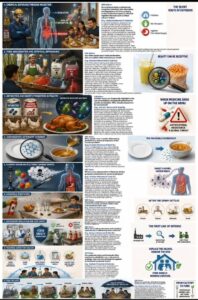
One of the most troubling examples involves products that rely on visual appeal to attract consumers.
Take fresh sugarcane juice, for example. Naturally, it begins to oxidize shortly after extraction, gradually changing color from light green to brownish tones. This is a normal and harmless process.
However, some vendors may attempt to preserve an artificial appearance by using unauthorized whitening agents or chemical additives. Similarly, certain roasted seed products and snacks may be treated with non-food-grade coloring or bleaching substances to create a brighter, more attractive appearance.
Consumers often associate bright colors with freshness and quality, while in reality they may be exposing themselves to substances that have no place in the human diet.
This is a classic example of commercial deception based on appearance rather than genuine product quality.
HSE Editor:
Another issue you frequently highlight is the use of antibiotics and growth promoters in poultry production. Why should consumers be concerned?
Eng. Hesham Mohamed Al Said Aly:
Modern poultry farming faces significant economic pressure to maximize productivity.
To maintain flock health and achieve rapid growth, antibiotics are sometimes used extensively. The real problem arises when withdrawal periods are not respected before slaughter.
Withdrawal periods are designed to allow the animal’s body sufficient time to eliminate drug residues.
If these periods are ignored, traces of antibiotics may remain in edible tissues and enter the human food chain.
The consequences extend beyond individual consumers. Continuous low-level exposure may contribute to antimicrobial resistance, one of the most serious global public health threats identified by modern medicine.
We are no longer discussing agriculture alone; we are discussing the future effectiveness of lifesaving medications.
HSE Editor:
Many people never consider dishwashing products as a source of exposure. Is this concern justified?
Eng. Hesham Mohamed Al Said Aly:
Yes, it is a legitimate concern when cleaning practices are inadequate.
Dishwashing liquids contain surfactants specifically designed to cling to grease and surfaces. If dishes are not thoroughly rinsed, microscopic residues may remain.
When hot food or beverages are later served in these utensils, residual chemicals can dissolve and be ingested.
The solution is simple:
Use adequate amounts of clean running water.
Prefer warm water whenever possible.
Avoid excessive detergent use.
Ensure proper rinsing and drying.
Good household practices can significantly reduce unnecessary chemical exposure.
Editorial Note
This interview reflects the professional opinions and risk-management perspectives of Eng. Hesham Mohamed Al Said Aly, based on his extensive experience in Occupational Safety, Health and Environmental (OSH&E) management. The discussion is intended to raise public awareness of potential chemical exposure pathways and to encourage informed decision-making regarding food safety, public health, and environmental protection.
Interview Conducted by
Eng. Abdelrahman Mohamed Zain (Magdi)
HSE Editor
The Citizen Newsletter
E-mail: mr.zainrac@gmail.com
Published by The Citizen Newsletter
Health, Safety & Environment Awareness Series
“Promoting Healthier Communities Through Safety Knowledge and Environmental Awareness.”
Copyright © The Citizen Newsletter. All rights reserved.