
Sudan Partakes in the UN Conference on Landlocked Developing Countries
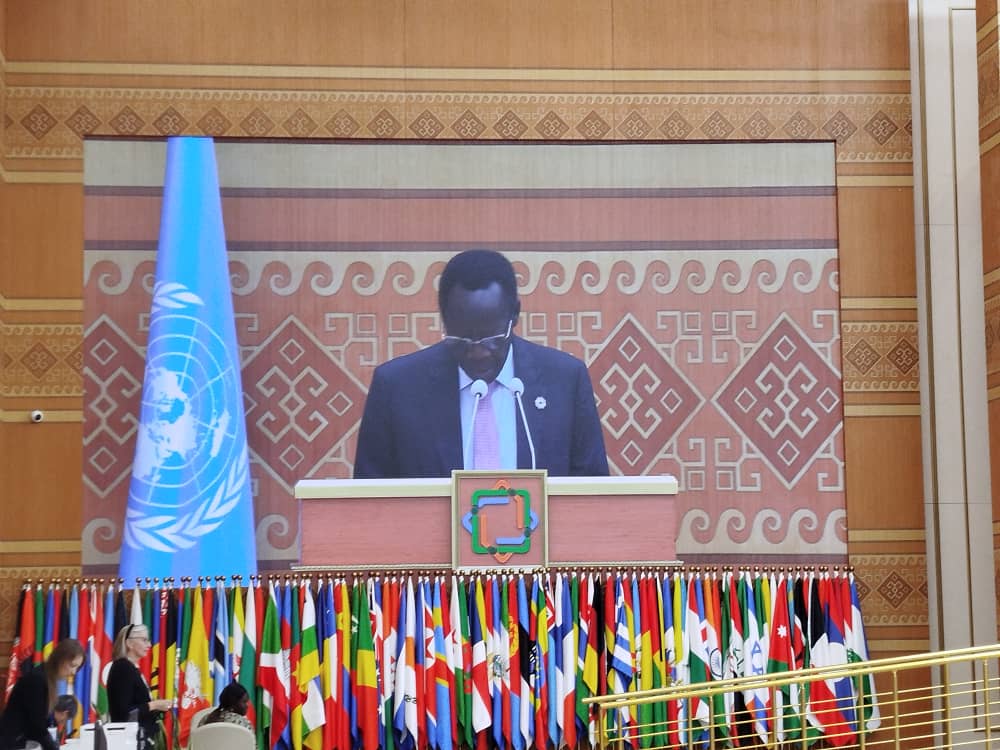
Ambassador Idris Ismail Faraj Allah, Acting Undersecretary of the Ministry of Foreign Affairs, accompanied by Ambassador El-Sadig Abdullah El-Yas, Director of the Department of African Affairs, participated in the UN Conference on Landlocked Developing Countries, held in the tourist city of Awaza in Turkmenbashi, Turkmenistan, from August 5 to 8, 2025.
The conference was opened by Turkmen President Serdar Bermukhamedov, in the presence of UN Secretary-General António Guterres. Approximately 20 heads of state and government participated, in addition to leaders of international and regional organizations and approximately 3,000 participants from various sectors. A joint invitation was extended by the Turkmen President and the UN Secretary-General to the Head of the Sovereignty Council to attend this conference, which is held every ten years in support of 32 landlocked developing countries with a population of approximately 600 million.
The conference discussed the “OASA 2024–2034 Action Plan,” which focuses on five key areas: structural transformation, infrastructure and connectivity, trade facilitation, regional integration, and resilience building. This is supported by initiatives including infrastructure investment, food security, freedom of transit, digital connectivity, and a special trade program for these countries within the framework of the World Trade Organization.
In his speech, Ambassador Idris Ismail emphasized Sudan’s contribution to enabling neighboring landlocked countries to access its ports and the importance of cooperation between rich and developing countries to achieve sustainable development and respect the privacy of peoples. He called for the implementation of cross-border projects linking landlocked countries to ports via land, rail, and energy networks, and for reforming the global financial system to become more just and transparent, while facilitating financing for developing countries without complex conditions.
Sudan also stressed the need to enhance capabilities in the fields of energy, transportation, and technology, and to reduce the digital divide, as well as the importance of cooperation between developing countries to control borders, prevent resource smuggling, combat drugs, and confront the infiltration of mercenaries who have committed horrific crimes in Sudan and pose a threat to a number of African countries.