
Modern Jewelry “Kursi Jaber” Necklace
By: Dr. Salwa Abdel-Majeed Ahmed Almushly
The “Kursi Jaber” necklace is one of the well-known jewelry pieces that women from the Gulf proudly wore during the period of labor migration and cultural openness among the Gulf Co-operation Council( GCC ) countries. It became a symbol of prestige and high social status.
Although this exotic necklace is imported and not originally local, Sudanese jewelers in Omdurman’s gold market on Al-Adani Street and its workshops imitated its design, crafting it as a long, heavy necklace made of gold-plated copper.
Description of the ” Kursi Jaber” Necklace:
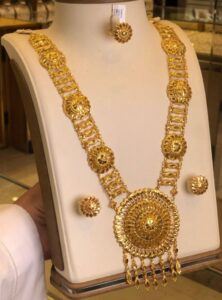
A wide gold necklace featuring three long chains on each side, joined by two engraved circular pieces. These chains meet at the center in a larger inscripted circle, which ends in multiple hanging tassels. The necklace can include varying numbers and designs of circular motifs, and there are sets available with different decorative styles.
Who is Jaber, the namesake of the necklace?
It appears that the necklace was made in Kuwait. I “ven’t t been able to determine exactly who it was named after, but it’s likely the name originated from Kuwaiti goldsmiths, as jewelry is often named after iconic or socially prominent figures.
Similarly, in Sudan, jewelers named certain designs after notable individuals — for instance, the “Ein Zaroug” bracelet with a black turquoise stone, named after the famous politician Zaroug and inspired by the shape of his wide eye.
The name “Kursi Jaber” for this type of chain is widespread throughout the Gulf and even in Iraq. Due to its grand and sizable design, the necklace was likely named after Sheikh Jaber Al-Ahmad Al-Sabah (1926–2006), the 13th ruler of the Al-Sabah dynastyv and the third Emir of Kuwait after its independence from the United Kingdom(U.K)..
He was the third son of Sheikh Ahmad Al-Jaber Al-Sabah and Sheikha Bibi Al-Salem Al-Sabah, daughter of Kuwait’s ninth ruler, Sheikh Salem Al-Mubarak Al-Sabah. Sheikh Jaber was the visionary leader behind the founding of the Gulf Cooperation Council (GCC), established in 1981.
Many institutions across and outside Kuwait bear his name in honor of his humanitarian contributions, including streets in Egypt and Saudi Arabia, and a medical hall in Yemen.
Types of Kursi Jaber Necklaces:
A long, lightweight chain with the same classic design.
A larger version with more chains and heavier weight.
A full set including the large necklace, earrings, and a ring — curiously, this set does not include a bracelet, which is unusual for a complete set.
PS: For any further reading , please check ” The Cultural Significance of Traditional Sudanese Jewellery” 2018, un-published book by Salwa Abdel-Majeed Ahmed Al-Mashaly