
Egyptian Assistant Foreign Minister: We reject any dictates to the Sudanese people, and Sudan’s unity is non-negotiable
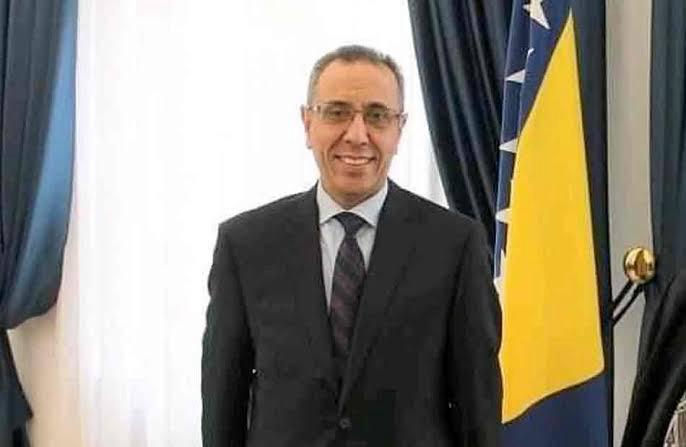
Ambassador Yasser Sorour, Assistant Foreign Minister and Director of the Sudan and South Sudan Department at the Egyptian Foreign Ministry, confirmed that the Sudanese army has made significant progress on the ground and is on the verge of taking full control of Khartoum.
In a meeting with a number of Egyptian journalists on Wednesday, Sorour said that Sudan is directly linked to Egypt’s national security on the political level, as it is a geographically neighboring country, in addition to the special relationship that binds the Egyptian and Sudanese peoples, as well as water security, the Nile water issue, stability in the Horn of Africa, and the situation in the Red Sea.
He added that Egypt’s actions in the Sudanese file are based on several principles, including preserving the unity and territorial integrity of Sudan, which is non-negotiable, and preserving the institutions of the Sudanese national state. He emphasized that any solution to the Sudanese crisis must come from the Sudanese themselves, not from the dictates of any external forces.
He cited the conference of Sudanese political forces hosted by Cairo last July as evidence of this, explaining that Egypt is the only country that was able to bring together this number of Sudanese political forces.
He said the purpose of the meeting was for the Sudanese political forces to agree on a plan for the country’s future without external pressure or dictates. Sorour stressed that Egypt’s assistance to Sudan on the political level also lies in the fact that there are several international initiatives that Sudan was not a part of, but in light of Egypt’s presence in these initiatives, we were rejecting any dictates to the Sudanese people. He pointed out that on the humanitarian level, some countries are seeking to impose certain conditions on the entry of aid to Sudan, but Egypt stands against this issue and stresses the necessity of the entry of aid without conditions.
He explained that Egypt spoke with Sudan about opening the Adri crossing and extending the opening period of this crossing. He said that Head of the Sovereignty Council, Lieutenant General Abdel Fattah Al-Burhan, extended the opening period of the crossing on February 15 for a period of three months, and we welcome this step and seek to extend the opening period of the crossing.
He pointed out that Egypt is also working to strengthen communication between Sudan and United Nations organizations specialized in the humanitarian dimension. He said that thanks to Egyptian efforts, humanitarian centers have been established to store and distribute relief aid to Sudan.
He added that among the common files between Egypt and Sudan is the security of the Red Sea, which also relates to Egyptian national security, and the movement of shipping in the Suez Canal, pointing to the negative impact of recent movements as a result of the situation in Gaza on the movement of shipping in the Suez Canal. Sudan’s geographical location also adds to its importance in the Red Sea security issue.
Regarding the role of regional organizations regarding the situation in Sudan, Sorour stated that Egypt had made efforts with the African Union, which were commended by the Sudanese side, as well as by the major international actors involved in this issue. Most notable was the visit of the African Peace and Security Council delegation, under Egyptian chairmanship, to Port Sudan and the delegation’s meeting with the Head of the Sovereignty Council. He added that it was a positive visit and a true beginning for the African Union’s engagement with the government in Port Sudan. He continued that the Peace and Security Council’s statement at the summit held on February 14 was very balanced regarding developments in Sudan. He said that the Peace and Security Council moved to reject the announcement by the Rapid Support Forces militia and some of its allied political forces of their intention to form a parallel government and sign a founding charter in Nairobi.
He indicated that Egypt completely objected to two fundamental points in the founding charter in Nairobi, which stipulated the establishment of a parallel government. He added that following Egypt’s statement, statements were issued by other countries, such as Saudi Arabia, Qatar, and Kuwait, rejecting the charter, considering it a prelude to the division of Sudan and a move that would place it in a cycle similar to the Libyan scenario.
Sorour considered that the situation in Sudan is much more complex than the situation in Libya. He said that the second point in the founding charter that Egypt rejects is that the charter did not mention the unity and integrity of Sudan, and gave some negative indications because the unity and territorial integrity of Sudan is a non-negotiable matter for Egypt.
He added that the position of the international community on the move was consistent with the general trend of rejecting this move, which included a statement by the presidency of the Security Council rejecting the formation of a parallel government, a statement by Britain, a separate statement from the United States, and a statement by the European Union. He pointed out that Egypt conducted intensive contacts with the ambassadors of the European Union, within the framework of the contacts conducted by the Ministry of Foreign Affairs, headed by the Egyptian Minister of Foreign Affairs and Immigration, Dr. Badr Abdel Aati, to discuss the Sudanese file.
Sarour warned that the process of Sudan’s division will not stop at Darfur, but rather may split into several countries as a result of tribal entanglements. He stated that the impact of divisions in Sudan will extend to the entire Horn of Africa region.
He noted that a conference will be held in Britain on April 15th, with broad participation, to discuss the Sudanese crisis. Egypt will also participate to affirm its position on the Sudanese issue. He pointed out that the Arab League has issued resolutions, both at the summit level and at the foreign ministers’ level, all of which are consistent with the Egyptian position on Sudan.
He emphasized that the Sudanese want to benefit from the Egyptian plan to rebuild Gaza by developing a plan for the reconstruction of Sudan. He explained that the Egyptian Peacekeeping Center has conducted several training courses for Sudanese diplomats to discuss reconstruction and the rehabilitation of Sudanese people on the economic, social, and political levels, not just from a structural perspective.
He stated that the return of Sudanese displaced persons is related to the stability of the country, and called on the international community to fulfill its obligations and international commitments, not only towards Egypt, but also to all countries neighboring Sudan. Sarour stated that negotiations on the Grand Ethiopian Renaissance Dam have stalled because they cannot continue as long as there is a certainty of a lack of political will to reach a binding agreement. He emphasized that Egypt’s political efforts are still ongoing, and that the international community is well aware of the justness of the case for Egypt. He added that because we demand the implementation of international law regulating the use of shared rivers, Egyptian diplomatic efforts have not stopped for a single moment. He added that regarding the water issue that unites Egypt and Sudan, it is an existential issue that unites the two countries as downstream countries. Egypt is also one of the countries most affected by the Nile River crisis, as it receives more than 97% of its water via the Nile. Given the decline in rainfall, coordination with Sudan on this issue is imperative, and it is progressing well, better than before. Sorour considered that the core of the problem lies in the lack of political will among the Ethiopians to reach a binding agreement, noting that the studies presented by Ethiopia regarding the dam are incomplete, and that Addis Ababa has not provided any studies on the safety of the dam. He explained that there is no dam without side effects, but the role of the agreement between the concerned parties lies in limiting these negative effects of this dam, but this did not happen. He said that Egypt entered into negotiations for 12 years in good faith in order to reach an agreement on filling and operating this dam, but we did not reach an agreement because the Renaissance Dam file is a politicized file and not only has differences on the technical aspect.