
The Hidden Ethiopian-Emirati-Israeli Alliance and the Engineering of Maritime Security

By: Abdel Nabi Shaheen – Riyadh
Recent studies confirm that the security of the Gulf and that of the Horn of Africa are increasingly intertwined, and that rivalry among Gulf powers is carrying part of their conflicts into the states bordering the Red Sea. The declared partnership between the “active duo” of the United Arab Emirates and Israel on one side, and Ethiopia on the other, which is determined to reach a sea outlet by peace or by war, together with the open Ethiopian threats against Eritrea, has put the entire region on the edge of a volcano that could erupt at any moment. Saudi Arabia, meanwhile, is occupied with repelling Houthi aggression, and Sudan with repelling the aggression of the Rapid Support Forces militia.
The principal danger to Saudi Arabia is not the fall or survival of Abiy’s government, nor any development inside Ethiopia. It is the spillover of the Ethiopian-Eritrean conflict into the Red Sea, which will happen the moment Ethiopia makes its first move on the Eritrean port of Massawa, a target of Prime Minister Abiy Ahmed. At that point, the UAE and Israel will play their hand in support of their Ethiopian ally and reshape the Red Sea security order. This will subject Saudi Arabia to intense pressure to define its position in the new maritime security equation, even as it is preoccupied with answering Houthi threats against its own territory.
Riyadh, which founded the maritime defence alliance whose military effectiveness has yet to be proven in practice, must therefore move on to the more important stage: joining Egypt, Sudan, Eritrea and Somalia in the “engineering of maritime security”, without leaving Kenya and Tanzania exposed to Emirati-Israeli blandishments. It must also understand that, for Abu Dhabi and Tel Aviv, Ethiopia is not merely a friendly African state but a strategic gateway to the heart of the Horn of Africa. That is why they are working to strengthen it militarily by every means, and to help it reach a sea outlet.
In January 2026, the UAE and Ethiopia announced a comprehensive strategic partnership covering security, economic interests and territorial integrity. Historically, and more significantly, specialised research reports indicate that the UAE played an important role in backing Abiy Ahmed’s government during the earlier Tigray war, including through the use of drones.
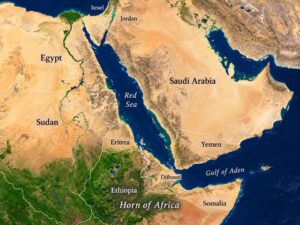
Saudi Arabia knows that any security vacuum will draw in international alliances or illegitimate forces that will set the rules of the game on its western security flank facing the sea, in ways that do not serve its interests. That is precisely what is happening now. Israel is working from behind the scenes, through its “Arab” and “African” arms, to re-engineer the security of the Red Sea and the Bab al-Mandab Strait away from the interests of the littoral states. It does so by encouraging Ethiopia and supporting it militarily to reach a sea outlet at the expense of Eritrea’s unity and sovereignty.
According to strategic studies, Saudi-Emirati rivalry has become one of the factors reshaping security in the Horn of Africa and the Red Sea, with a clear difference in the two countries’ styles of partnership. The UAE relies heavily on ports, infrastructure, networks and local organisations within states, while Riyadh tends to deal with states and official institutions.
It is evident that the maritime security order Israel is working to build, through the UAE with its stake in African ports and through its backing for their “African arm”, by which I mean Ethiopia, in reaching a sea outlet by force at the expense of Eritrean sovereignty and of Egyptian, Saudi and Sudanese strategic interests, will extend Israeli influence from the Gulf to the Horn of Africa, then to East Africa, then to the Bab al-Mandab Strait and on to the Indian Ocean and the countries of Asia. The Red Sea would thus become a direct extension of Israeli security, and all of this would lie far from the interests of Saudi Arabia, Yemen and the states on the sea’s western shore, by which I mean Egypt, Sudan, Eritrea, Somalia, Djibouti, Kenya and Tanzania.
End