
Sudan Opens the Red Sea to Russian Investments
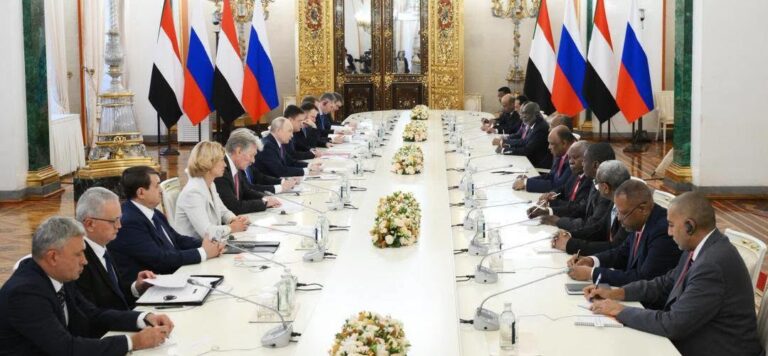
Head of Sudan’s Sovereignty Council , Abdel Fattah al-Burhan, presented a package of economic proposals to Russian President Vladimir Putin during their meeting in Moscow on Friday.
Burhan’s proposals included offering Russia strategic locations for investment in gold, copper, and other mineral extraction.
According to the Russian news agency TASS, Burhan proposed establishing a free economic zone on the Red Sea coast, which Moscow could use to build vital facilities for storing wheat and fuel.
The talks also touched on Khartoum’s efforts to expand the infrastructure of the national railway network. The Sudanese official proposed the participation of Russian companies in developing the railways and establishing logistics chains for transporting goods.
Roadmap and Growing Trade Cooperation
For his part, Russian President Vladimir Putin affirmed his country’s readiness to cooperate with Khartoum in “modern fields” including industry, healthcare, education, digital development, and logistics, presenting the Sudanese authorities with “a roadmap for promising areas of cooperation between the two countries.”
Putin noted the continued development of bilateral trade and economic relations despite the political complexities facing African countries.
Russia Today quoted the Russian president as confirming that trade between the two countries more than doubled in 2015 and increased by 25% between January and August 2016, placing Sudan among Russia’s top 10 trading partners in Africa.
The Sudanese Crisis and Paths to Resolution
During the meeting, Putin discussed ways to de-escalate the situation in Sudan, explicitly calling for a cessation of hostilities and a move towards a comprehensive political settlement.
In a related context, Burhan emphasized in his address yesterday, Thursday, to the Russia-Africa Summit that achieving peace in his country must be “purely Sudanese, free from external dictates and interference.”
Burhan explained that the government is working to create the appropriate conditions for a civilian democratic transition through a Sudanese-Sudanese dialogue that lays the foundations for sustainable political stability, through a transitional period followed by free and fair elections under regional and international monitoring.