
Peppermint ; A Small Crop with the Potential to Transform Sudan’s Economy

A Health, Safety, and Environment Perspective
By Eng. Abdelrahman Mohamed Zain(Magdi)
As Sudan searches for practical pathways to rebuild its economy, create employment opportunities, and diversify its exports, one promising sector deserves far greater attention: medicinal and aromatic plants. Among them, peppermint (Mentha × piperita) stands out as a high-value crop with strong and growing demand in international markets.
Recently, a Sudanese YouTube content creator, Thabit Omer, highlighted the economic potential of peppermint cultivation and encouraged Sudanese farmers and investors to consider it as a strategic agricultural opportunity. While some of the production and price figures circulating on social media should always be verified against current market conditions and international trade data, the central message is both timely and compelling: Sudan possesses the natural resources needed to become a significant producer of peppermint and other medicinal plants.
Peppermint is far more than a popular herbal tea. It is an essential raw material for numerous global industries, including pharmaceuticals, food processing, oral healthcare products, cosmetics, perfumes, personal care products, and aromatherapy. The essential oil extracted from peppermint is widely valued for its applications in digestive health, headache relief, respiratory care, and flavoring.
Moving Beyond Traditional Farming
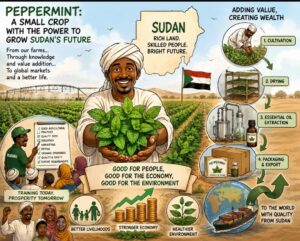
The real economic opportunity lies not simply in cultivating peppermint, but in agro-processing. Instead of exporting fresh leaves with limited shelf life, Sudan can add significant value by producing dried peppermint, extracting essential oils, packaging certified products, and exporting finished or semi-finished goods to international markets.
This approach generates substantially higher returns while creating employment throughout the agricultural value chain.
Empowering Smallholder Farmers
One of the greatest strengths of this opportunity is its suitability for smallholder farmers. Through agricultural cooperatives, producer associations, and contract farming systems, thousands of rural families could participate in a coordinated production network.
With access to improved planting materials, technical guidance, drying facilities, quality assurance systems, and reliable export channels, small-scale producers can become important contributors to Sudan’s agricultural economy.
Agricultural Training: The Foundation of Success
No national strategy for medicinal plants can succeed without comprehensive agricultural training. Farmers require practical knowledge in:
Selecting high-quality peppermint varieties.
Good Agricultural Practices (GAP).
Efficient irrigation and nutrient management.
Harvesting at the optimum stage for maximum essential oil content.
Modern drying techniques.
Organic production standards.
Quality assurance and food safety systems.
Export certification and international market requirements.
Training is not merely an educational activity—it is an investment in productivity, quality, and competitiveness.
Health, Safety, and Environmental Benefits
From a Health, Safety, and Environment (HSE) perspective, peppermint cultivation aligns closely with the principles of sustainable development.
Responsible cultivation can:
Diversify Sudan’s agricultural production.
Encourage environmentally responsible farming practices.
Reduce dependence on environmentally harmful inputs through organic cultivation where feasible.
Generate rural employment and reduce poverty.
Promote clean agro-industries with relatively low environmental impact.
Increase vegetation cover and contribute to ecological sustainability.

When supported by responsible water management and sound agricultural practices, medicinal plant production can become an important component of Sudan’s green economy.
A National Opportunity Worth Pursuing
Peppermint should not be viewed simply as another agricultural crop. It represents an entire value chain—from seed production and cultivation to drying, essential oil extraction, packaging, branding, certification, and export.
Sudan possesses many of the natural advantages required for success: fertile agricultural land, favorable climatic conditions, abundant labor resources, and a strategic geographic location connecting African, Middle Eastern, and international markets.
With appropriate investment, research, training, and supportive government policies, Sudan could establish itself as a competitive exporter of medicinal and aromatic plant products.
A Call to Action
We encourage Sudan’s Ministries of Agriculture, Investment, Industry, universities, agricultural research institutions, financial organizations, and private investors to work together in launching a National Medicinal and Aromatic Plants Initiative.
Such a program should prioritize:
Farmer training and extension services.
Establishment of drying and essential oil processing facilities.
Support for smallholder producers.
Development of quality certification systems.
Export market development.
Public-private partnerships that strengthen the agricultural value chain.
The future of Sudan’s economy will not depend solely on traditional commodities. It will increasingly depend on innovation, value addition, knowledge-based agriculture, and sustainable industrial development.
Peppermint may appear to be a modest crop, but with vision, scientific management, and coordinated national effort, it could become one of the many building blocks of a greener, more diversified, and more resilient Sudanese economy.
References
Food and Agriculture Organization of the United Nations (FAO). Medicinal and Aromatic Plants Resources. https://www.fao.org
International Trade Centre (ITC). Trade Map Database. https://www.trademap.org
World Health Organization (WHO). Traditional, Complementary and Integrative Medicine. https://www.who.int
International Society for Horticultural Science (ISHS). Medicinal and Aromatic Plants. https://www.ishs.org
About the author:
Eng. Abdelrahman Mohamed Zain(Magdi)
Health, Safety and Environment (HSE) Editor
The Citizen Newspaper
Email: mr.zainrac@gmail.com