
Noorai’s Jar

By: Hashim Mahmoud Hassan
In that remote village, some seventy kilometers from the nearest city, whose rugged road is intersected by three valleys and river-beds that channel the torrents of rainwater from the mountains down to the sloping lands toward the village and its surroundings, most of the inhabitants work in seasonal autumn farming, while others herd livestock and sheep in the green pastures that cloak the region. The village hosts small cafés and scattered restaurants, the most famous being Muhammad Ahmed’s eatery, renowned for its meats, and the Youth Café, alongside several shops, most notably Haj Darhowi’s and Haj Al-Hassan’s general stores.
The village has two modes of travel: traditional busses in summer, and lorries (four-wheel-drive pickup trucks) in autumn. These busses and lorries bear names, as is the custom in villages, where they name animals, farms, valleys, and wells. Among the bus names are: Sannito, Dankalia, and Al-Asil; and among the lawari names: Ibtisam and Santo, inscribed on their sides or fronts. With the rainy season, the village becomes isolated from the world, connected only by the lorry Ibtisam or Santo, which navigate the treacherous routes between valleys and mountain slopes—sometimes reaching their destination, but often breaking down, extending the isolation for nearly four full months.
The villagers spend their days between farms and herding, and in the evenings they gather in the market circles—their sole outlet—where they listen to news from local and international radio stations like the BBC and Monte Carlo, eagerly awaiting the arrival of the lorry Ibtisam or Santo in front of the police station. Another circle sits near the clinic, where Doctor Qasim Allah’s radio plays—he is one of the village’s notable figures, who came as a stranger but settled and blended in with its people.
Noorai bought a jar from the city and reserved a seat for it on the bus, wrapping it in a quilt to shield it from the rugged road’s twists and turns. When departure time came, the other passengers pleaded with him to tie it on the bus roof so he could give up its seat to an elderly sheikh. Noorai reluctantly agreed, convinced that its wrappings and quilt would suffice to protect it.
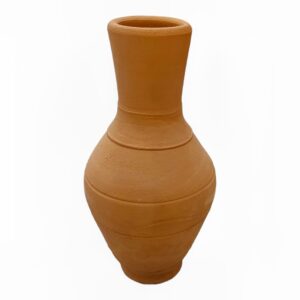
Noorai began to muse to himself about his jar’s fate, imagining filling it with water, then wrapping it in damp burlap, watching droplets seep steadily through its pores, and in the coming Ramadan, with the heat intense, he would offer his neighbors its cool water before sunset. The bus set off, its engine roaring through the winding roads, tilting right and left, while Noorai envisioned the jar’s condition and whispered prayers. With every descent into a valley, the youths atop the bus would shout and holler, and Noorai would reassure himself that his jar was safe, that it was just teenage antics.
The bus stopped at its first station, and passengers got off for lunch and necessities. Noorai climbed to the roof to check on his treasure and found it exactly as he had left it; he patted it tenderly and returned to his seat. The bus moved on toward its next destination, and Noorai conversed with his friend Noor about various matters, exchanging talk, laughter, and gestures when they could not hear each other over the noise.
But the treasure had been affected by the bus’s violent motion through some valleys, causing a fine crack between the jar and its neck. The bus arrived at the village, and passengers began disembarking with their luggage, while Noorai climbed to the roof and shifted his wrapped jar without inspecting it, then called to his friend Noor to receive it from him. Noor climbed two steps up the rear iron ladder; Noorai untied the rope, slipped his hand in to lift it before unwrapping the quilt, and moved with it a few steps toward Noor, who remained standing on the ladder. Everyone watched the scene: Noorai lying on his stomach, gripping the jar’s neck, trying to hand it over—then he released it, thinking Noor had caught hold of it. The jar slipped free, its neck remaining in Noorai’s hand. In that instant, he heard the sound of it striking Noor’s head; he crawled further to reassure himself, denying what he had heard, only for the jar and its pieces to fall, and all three—Noorai, Noor, and the shattered jar—tumbled down beneath the bus, fragments scattered on the ground in sorrow and regret.