
Can Sudan’s Livestock Sector Become a US$50 Billion Economy?

A Strategic Conversation with Professor Faisal Al-Zubair
By Eng. Abdelrahman Mohamed Zain (Magdi)
Sudan’s Untapped Livestock Wealth
Sudan possesses one of the Africa’s largest livestock resources, yet much of its economic potential remains unrealized. During this conversation, Professor Faisal Al-Zubair explains how science, investment, infrastructure, and value-added industries could transform livestock into one of Sudan’s most important economic sectors.
From Exporting Animals to Exporting added Value
When asked why Sudan has not fully benefited from its livestock wealth, Professor Faisal pauses before offering a simple but powerful observation.
“For decades, Sudan has exported live animals instead of exporting wealth.”
He explained that every animal exported alive represents lost opportunities for meat processing, dairy production, leather manufacturing, pharmaceuticals, fertilizers, and thousands of industrial jobs.
According to Professor Faisal, modern livestock economies no longer depend on selling animals alone; they build complete value chains that multiply economic returns while creating sustainable employment.
Creating an Investment Environment
Discussion then turns to investment.
Professor Faisal believes that investors first look for confidence before they look for opportunity.
That confidence depends on political stability, transparent legislation, reliable veterinary services, internationally accredited slaughterhouses, modern infrastructure, and efficient transportation networks.
Without these foundations, attracting large-scale long-term investment becomes extremely difficult.
Why Processing Matters
Professor Faisal stresses that the greatest economic value comes after the animal leaves the farm.
Instead of exporting live cattle or sheep, Sudan could produce premium meat products, dairy products, leather goods, gelatin, pharmaceuticals, organic fertilizers, animal fats, and numerous industrial by-products.
Each additional processing stage creates new businesses, skilled employment, and greater export earnings.
Science as the Engine of Development
Throughout the conversation, Professor Faisal repeatedly returns to one central message.
“Science must guide development.”
He emphasizes that veterinary medicine, animal genetics, reproductive biotechnology, laboratory diagnostics, and modern farm management are no longer optional—they are essential components of a competitive livestock industry.
Investing in Better Genetics
The discussion naturally moves toward dairy development.
Professor Faisal described the Brazilian Girolando breed as one of the world’s outstanding examples of successful tropical dairy breeding.
Rather than importing large numbers of live animals, he recommends introducing superior genetics through embryo transfer and other modern reproductive technologies.
This strategy reduces disease risks, lowers transportation costs, and accelerates national genetic improvement.
Building Human Capital
Professor Faisal also emphasizes that modern technology alone cannot transform agriculture.
Veterinarians, animal scientists, laboratory specialists, dairy technologists, artificial insemination technicians, processing engineers, and professional farm managers are all indispensable to building a competitive livestock sector.
Education, therefore, becomes one of the country’s most important long-term investments.
A Long-Term Economic Vision
As the discussion draws to a close, Professor Faisal shares his broader vision.
He believes that if Sudan successfully develops integrated livestock value chains, strengthens veterinary services, expands processing industries, improves infrastructure, and adopts modern reproductive bio technologies, the livestock sector could eventually become one of the country’s largest contributors in growth domestic product.
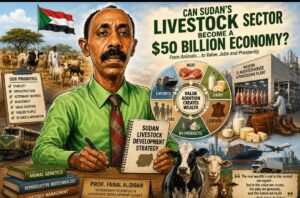
He emphasized that this is a strategic long-term aspiration rather than a short-term forecast and would require sustained investment, sound governance, and consistent implementation over many years.
Final Reflections
Professor Faisal Al-Zubair’s vision invites Sudan to reconsider livestock not merely as animals destined for export, but as the foundation of an integrated agro-industrial economy.
The conversation highlights a simple but profound principle: nations create lasting prosperity not by exporting raw resources, but by investing in science, innovation, skilled people, and value-added industries.
If Sudan succeeds in combining its abundant natural resources with modern knowledge and long-term planning, its livestock sector could become one of the country’s strongest engines of economic growth and food security.
Editorial Note:
The economic figures discussed in this interview, including the possibility of the livestock sector eventually contributing up to US$50 billion annually, are presented as Professor Faisal Al-Zubair’s long-term strategic vision. They should be understood as aspirational scenarios that would depend upon sustained policy reforms, infrastructure development, scientific advancement, and successful implementation over an extended period.About the author:
Eng. Abdelrahman Mohamed Zain (Magdi)
Health, Safety & Environment Editor – The Citizen Newsletter
mr.zainrac@gmail.com