
At a Human Rights Council event: Experts warn of West and Central Africa becoming a hotbed of extremism due to RSF leaking sophisticated weapons to terrorist organizations
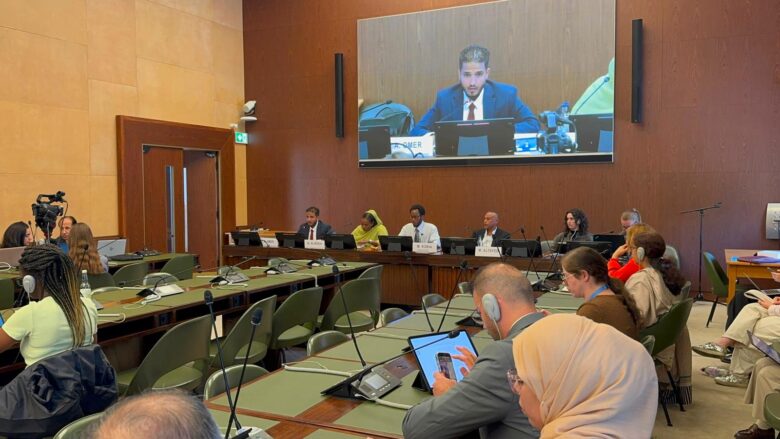
Sudanese experts, human rights activists, and journalists issued dire strategic warnings from the heart of the United Nations Palace in Geneva, during a high-level human rights event held as a side event to the 62nd session of the UN Human Rights Council. The seminar, organized by the International Organization for the Elimination of All Forms of Racial Discrimination (EAFORD), was titled “Transitional Justice and the Rule of Law in Post-Conflict Societies,” highlighting the complexities of the humanitarian and security situation in Sudan and its disastrous repercussions for regional and international security.
The event focused primarily on the problem of widespread weapons proliferation and the unprecedented spread of military equipment outside institutional frameworks.
Journalist Mohamed El Tayeb, a specialist in covering conflict zones and a human rights defender, reviewed the threats facing the post-conflict phase. Al-Tayeb pointed out that the massive arms caches and open arsenals seized by the Rapid Support Forces (RSF) from Sudanese army garrisons, coupled with the continuous influx of astronomical and sophisticated weapons from their regional backers, are now flowing without any mechanism for control or institutional oversight. He asserted, based on field observations and journalistic reports, that this rampant chaos strongly suggests, to the point of certainty, that these sophisticated weapons are being smuggled across porous borders and directly into the hands of extremist terrorist organizations active in sub-Saharan and the Sahel region of Africa. He warned of a catastrophic trajectory: the emergence of new terrorist organizations from within the RSF itself, especially since these forces have adopted an operational and behavioral pattern that structurally and functionally aligns with the tactics of transnational extremist groups such as ISIS, Boko Haram, and al-Qaeda. This dangerous convergence is evident in the adoption of policies of intimidation, mass killings, and reliance on ransom and kidnapping as a primary source of funding, threatening to destabilize the security landscape and transform Central and West Africa into an uncontrollable hotbed of extremism that strikes at the very heart of international peace and security.
Furthering this fragile and volatile security environment, civil society activist Amira Al-Rayah, specializing in women’s and children’s issues, reviewed the multifaceted dimensions of the societal trauma resulting from the war. She explained that the absence of the rule of law allowed the Rapid Support Forces militia to use sexual violence, gang rape, and enslavement as a systematic tactical tool to terrorize the population, effect demographic change, and subjugate local communities. Al-Reeh cited documented reports from the Office of the United Nations High Commissioner for Human Rights, Human Rights Watch, and the African Centre for Justice and Peace Studies, which recorded hundreds of confirmed cases of abduction and grave violations against women and children. She emphasized that recovery and the mending of the social fabric require the establishment of rigorous accountability mechanisms and welcoming and supporting survivors to break the barrier of silence and social death.
For his part, independent journalist and human rights defender Ahmed Omar addressed the other facet of this war: the digital battle, the war of narratives, and the silencing of dissent. Omar explained that the independent media landscape has been completely decimated through the destruction and militarization of independent newspaper and television stations by parties to the conflict. He cited reports from UNESCO and the Sudanese Journalists Union documenting the killing and abduction of numerous journalists in recent years to impose a total media blackout and create blind spots in areas like Darfur and Kordofan. He also highlighted the resilience of conscious youth groups and collaborative emergency response teams, which face vicious smear campaigns, defamation, and deep-seated disinformation disseminated through artificial intelligence by war media outlets. These young people are developing local and field-based mechanisms to verify news and refute hate speech, protecting civilians and ensuring the delivery of life-saving aid.
The experts concluded the UN event by presenting a set of urgent demands to the Human Rights Council, calling for strict diplomatic and legal pressure on the regional powers supplying the Rapid Support Forces with weapons to prevent their leakage to extremist groups, with the need to design urgent international programs to rehabilitate victims and develop an early disarmament strategy, stressing that any political settlement that ignores mending the torn social fabric and holding perpetrators accountable will not find a way to be truly implemented on the ground.