
Summary of Key Interventions at the UN Security Council Session on Sudan on Friday
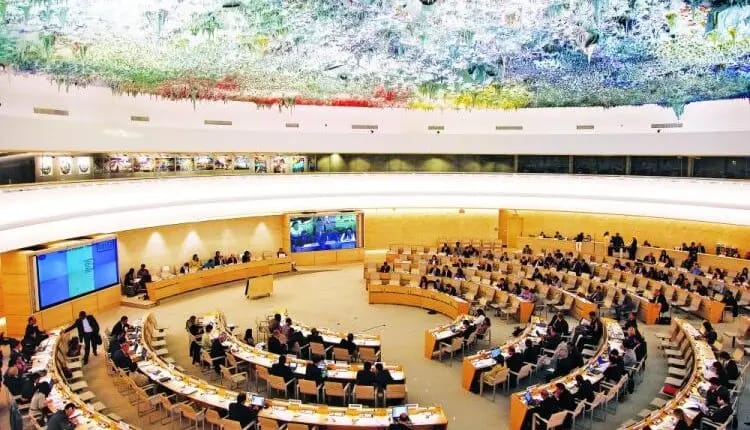
The UN Security Council session on Sudan on Friday was marked by several important interventions, which can be summarized as calls for an end to the aggression against El Obeid and for Sudanese-owned dialogue. Sudan, for its part, affirmed its readiness for a ceasefire that does not aim to empower militias. The following is a summary of the key interventions.
Sudan’s Representative:
Sudan’s Permanent Representative to the United Nations, Ambassador Al-Harith Idris Al-Harith, affirmed before the session that “the Sudanese government does not oppose a ceasefire, but rejects any process that serves the interests of the militias.” He urged the Council to “support the Jeddah Declaration as the only achievement to date, support national ownership of the political process, establish border monitoring mechanisms to address the flow of weapons across borders, and work to end foreign interference in the conflict.”
Idris added that international partners could pressure the United Arab Emirates to stop supplying the rebels with weapons, at which point the war would end completely.
Ambassador Al-Harith stated that the multiplicity of forums and negotiation tracks has hampered settlement efforts, describing them as “fragmented” and lacking coordination. He added that some of these tracks have even excluded influential Sudanese actors.
Furthermore, the root causes of the crisis remain unaddressed. He explained, “This is why we have not reached a robust peace strategy.”
The ambassador emphasized that Sudan rejects any process that benefits the militias, accusing them of committing genocide. He described the international community as failing to fulfill its moral and legal responsibilities, instead engaging in “cover-up and passive neutrality.”
The ambassador condemned the militias’ looting and export of gold to the United Arab Emirates, a trade that has ballooned to 56 tons, valued at over $56 billion.
Regarding US allegations that the Sudanese army used chemical weapons, Ambassador Al-Harith stated that the US had failed to provide any evidence to substantiate these claims. He affirmed that Sudan could submit a memorandum this week outlining its approach to the US on this “extremely serious” issue.
However, he recommended that the matter be referred to the Organisation for the Prohibition of Chemical Weapons (OPCW), of which Sudan is a member of the Executive Council.
The Ambassador reminded the Security Council that despite the signing of the Jeddah Declaration in May 2023, the Rapid Support Forces (RSF) remained intransigent, insisting on maintaining their presence in government bodies, public institutions, and civilian homes. He added that Sudan had accepted mediation efforts from Middle Eastern and European countries and had agreed to cooperate with the United States, Egypt, Saudi Arabia, and Turkey—despite reservations about the UAE’s participation as a mediator. He further stated that Sudan had been in contact with the Special Envoy of the Secretary-General but had not been invited to the meetings held in Paris, Geneva, London, and Berlin.
He emphasized, “Any sustainable settlement must be purely Sudanese-led and Sudanese-owned.”
Under-Secretary-General:
Meanwhile, Under-Secretary-General for Political and Peacebuilding Affairs, DiCarlo, stressed that the escalation in El Obeid would expose hundreds of thousands of civilians to the immediate risk of widespread violence.
Hanan Suleiman, Deputy Executive Director of the United Nations Children’s Fund (UNICEF), affirmed that Sudan remains the world’s largest humanitarian crisis, with children bearing the brunt of the suffering. She noted that an estimated 500,000 civilians are at risk as fighting intensifies in and around El Obeid, recalling a similar situation in 2015 in El Fasher. She stated that more than 1,500 grave violations against children have been verified.
European Positions:
Speakers from European countries focused on calling on “those fueling the conflict to stop,” warning that El Obeid is on the brink of atrocities that would compound the wounds inflicted on Sudan by El Fasher.
Representatives from Greece and Denmark echoed these concerns, warning that the White House must not become “another Fasher” and that “this Council has a responsibility to act early to prevent mass atrocities, not merely to react after it is too late.”
The Latvian representative stated that “the warnings in and around El Obeid are loud and clear,” adding, “We have seen this pattern before.” The Panamanian representative, recalling the “devastating” consequences for civilians in El Fasher and the Zamzam refugee camp, noted that Sudan is facing a “massive protection crisis,” emphasizing that the grave human rights violations occurring there require an urgent response and protection for survivors.
China’s Position:
Meanwhile, the Chinese representative stressed the need for any international mediation to fully respect Sudan’s sovereignty.
He indicated that China calls for an immediate ceasefire in El Obeid, adding, “We must call for an immediate ceasefire,” emphasizing that the Rapid Support Forces (RSF) have deployed “significant reinforcements” around El Obeid and intensified drone attacks. He warned that the atrocities of El Fasher must not be repeated and urged the RSF to de-escalate and abide by international humanitarian law.
Russia’s Position:
The representative of the Russian Federation urged the Council to adopt a more positive approach that takes into account the government’s wishes and establishes a frank and constructive dialogue.
Ambassador Anna Evstineva, the representative of the Russian Federation, stated that the events unfolding around El Obeid “leave no doubt about the true objectives of Sudan’s enemies,” namely, “to create the conditions for the partition of its territory.”
She emphasized that this situation requires the Council to adopt a more constructive approach to the situation in Sudan, one that takes into account the government’s wishes.
Saudi Arabia and Egypt:
The Saudi Arabian Ambassador, Abdulaziz bin Abdulwasil, stated that ending the conflict requires an internal Sudanese political solution rooted in state institutions. He reiterated his country’s support for Sudan’s unity, sovereignty, and territorial integrity.
Meanwhile, Egypt stressed that the Sudanese crisis is “manufactured.” The Egyptian Ambassador, Ihab Mustafa Awad, stated that Sudan is bearing the brunt of a “manufactured crisis” and condemned the systematic attempts to undermine Sudan’s institutions and create a new reality that threatens its unity and territorial integrity.
The Turkish Position:
Turkey warned that the Rapid Support Forces’ attacks only exacerbate the suffering of the Sudanese people. The Turkish representative stated, “The core issue in Sudan should not be treated as a matter of balancing between parties.” “Equal.”
The African Trio:
Somalia called for an end to the siege of El Obeid. Mohamed Rabie Yusuf, Somalia’s representative, speaking also on behalf of the Democratic Republic of Congo and Liberia, said: “We demand an immediate halt to all military advances towards El Obeid.” He condemned in the strongest terms the Rapid Support Forces’ attacks against civilians, conflict-related sexual violence, attacks on humanitarian workers and infrastructure, as well as other violations of international humanitarian law.