
Stay on Your Game During Sudan’s Recovery and Reconstruction Season

Edited by:
Eng. Abdelrahman Mohamed Zain (Magdi)
Industrial Refrigeration & VAM Chillers Expert
HSE Editor – The Citizen Newsletter
Member, Society of Environmental Engineers (SEE-UK)
Associate Member, ASHRAE (USA)
mr.zainrac@gmail.com
Sudan Is Recovering – But Safe Restarting Matters
As Sudan enters a period of recovery and reconstruction, thousands of families are gradually returning to their homes, businesses, schools, hospitals, and workplaces. While this return brings hope and optimism, it also presents significant technical challenges for refrigeration, air-conditioning, electrical, and solar energy professionals.
Many buildings have remained unoccupied for months or even years. Air conditioners, refrigerators, solar systems, and electrical installations have been exposed to dust, humidity, insects, rodents, vandalism, and prolonged shutdown periods. As a result, restarting equipment without proper inspection may lead to costly failures, safety hazards, and unnecessary downtime.
Recent discussions within the Refrigeration Division WhatsApp Group, which brings together more than one thousand technicians, engineers, contractors, equipment suppliers, and educators from across Sudan, highlighted the importance of adopting a professional and systematic approach during this critical phase.
The following recommendations summarize key lessons learned and are intended for citizens, technicians, engineers, equipment suppliers, and solar energy professionals participating in Sudan’s recovery journey.
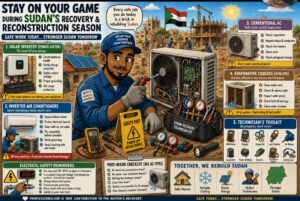
1. Solar Power Systems: The Foundation of Safe Operation
In many parts of Sudan, solar energy has become the primary source of electricity. However, numerous solar installations have suffered from poor maintenance, prolonged inactivity, improper modifications, or war-related damage.
Before energizing any air conditioner, refrigerator, freezer, or electrical appliance, verify:
Battery condition and state of charge.
Proper operation of the charge controller.
Integrity of wiring and connections.
Stable output voltage.
Effective grounding and surge protection.
Understanding the Solar Inverter
A solar inverter is responsible for converting DC power from batteries or photovoltaic panels into AC power used by household appliances.
Common post-recovery issues include:
Voltage fluctuations.
Overloaded systems.
Damaged batteries.
Poor-quality installations.
Missing grounding systems.
Lack of surge protection devices.
These issues can damage sensitive electronic equipment, including modern air-conditioning systems.
Recommendations
Install surge protection devices (SPDs).
Verify grounding continuity.
Use high-quality charge controllers.
Inspect all solar wiring before reconnecting loads.
Avoid operating large loads until system stability has been confirmed.
2. Inverter Air Conditioners: Smart Technology Requires Smart Maintenance
One of the most common misunderstandings today is the confusion between a solar inverter and an inverter air conditioner.
An inverter air conditioner uses advanced electronic controls and variable-speed compressor technology to improve efficiency and reduce energy consumption.
Unlike conventional air conditioners, inverter systems contain :
Inverter control boards.
Power electronic modules.
Variable-frequency compressor drives.
Sensitive sensors and communication circuits.
These components provide superior performance but require additional care during maintenance.
Before Restarting an Inverter Air Conditioner
Inspect for :
Moisture inside the electrical compartment.
Insect or rodent contamination.
Corroded electrical terminals.
Dust accumulation on heat exchangers.
Damaged communication wiring.
Loose electrical connections.
The Most Expensive Mistake : Washing an Inverter Air Conditioner Incorrectly
Many inverter board failures occur immediately after improper cleaning procedures.
Common mistakes include:
Spraying water directly onto the outdoor unit electronics.
Using high-pressure washers near inverter boards.
Applying steam cleaning methods.
Restarting the system before complete drying.
Best Practice
Disconnect power completely.
Protect or remove sensitive electronic boards when necessary.
Clean coils using compressed air and soft brushes.
Ensure complete drying before startup.
Inspect all connectors and terminals before energizing the system.
Remember: replacing an inverter board may cost far more than the entire cleaning service.
Electrical Safety During Maintenance
Technicians may occasionally measure voltages between 50 and 100 volts on refrigerant piping or metallic cabinet surfaces when using digital multimeters.
In many cases, this is caused by induced voltage or capacitive coupling associated with electronic filtering circuits and does not necessarily indicate a dangerous fault current.
Nevertheless, technicians should always :
Verify grounding integrity.
Disconnect power before maintenance.
Avoid touching metallic components with wet hands.
Wear appropriate personal protective equipment (PPE).
Confirm electrical safety before commencing work.
3. Conventional Air Conditioners Still Require Care
Although conventional systems are generally less sensitive than inverter models, they also require careful inspection after extended shutdown periods.
Key inspection points include :
Capacitors.
Contactors and relays.
Fan motors.
Refrigerant charge.
Coil cleanliness.
Electrical insulation condition.
4. Evaporative Coolers (Khalaya)
Evaporative coolers have regained popularity in many Sudanese communities due to their low operating cost.
Before restarting:
Drain and clean the water reservoir.
Replace deteriorated cooling pads.
Inspect water pumps.
Check drive belts and bearings.
Clean water distribution channels.
Failure to perform these steps may result in poor cooling performance, unpleasant odors, and premature equipment failure.
5. The Sudan Recovery Technician’s Toolkit
Every professional technician should carry :
Digital multimeter.
Insulation resistance tester (Megger).
Refrigeration manifold gauge set.
Electronic leak detector.
Air blower.
Electronic contact cleaner.
Assorted capacitors.
Fuses and relays.
Inverter sensors and thermistors.
Grounding and electrical safety tools.
Final Message
Sudan’s recovery is not only about rebuilding roads, bridges, and buildings. It is also about restoring the systems that make homes, hospitals, schools, and businesses functional again.
Every solar system safely recommissioned, every inverter air conditioner protected from premature failure, every refrigeration system professionally serviced, and every technician committed to quality workmanship contributes directly to the resilience and recovery of Sudan.
Professionalism is more than a technical responsibility—it is a contribution to national reconstruction.
Sudan deserves the safest systems, the most skilled technicians, and the highest engineering standards as it rebuilds for the future.