
Robotic Talk: Modern Air Defense Systems
By: Alaa Babiker
Modern attacks between countries are now operating at air. The latest and most devastating weapons are to be fired through air, with less soldiers on the ground and more effective destruction.
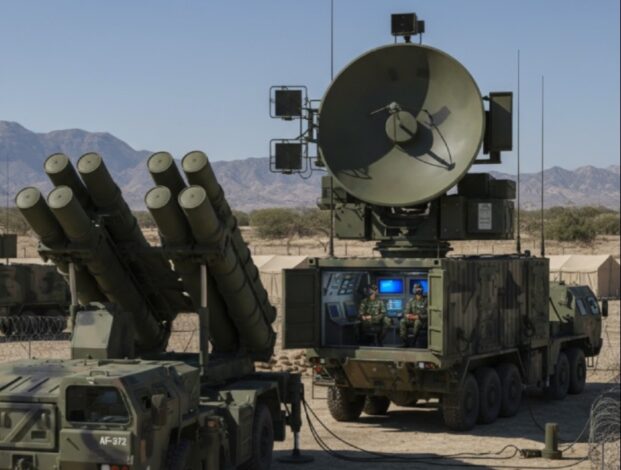
Developed countries use Air Defense Systems that protect sovereign airspace by creating a multi-layered shield against diverse aerial threats. Driven by the proliferation of low-cost drones, precision-guided munitions, and hypersonic missiles, modern warfare requires a highly integrated approach to airspace protection. Rather than relying on a single weapon, contemporary nations deploy an Integrated Air Defense System (IADS) that networks multiple sensors, command structures, and specialized interceptors together.
The Core Architecture of Air Defense
An air defense system functions through three interconnected phases: detection, tracking, and interception.
Sensors: Active radars, passive radio-frequency (RF) arrays, and electro-optical/infrared (EO/IR) towers continuously scan the horizon for anomalies.
Command and Control (C2): Centralized hubs ingest sensor data via multi-sensor fusion algorithms, evaluate threat profiles, and assign the optimal weapon system.
Effectors: Anti-aircraft guns, kinetic missiles, and electronic jamming units execute the physical or electronic neutralisation of the target.
To counter different categories of weapons effectively, defense planners categorize systems into overlapping altitude and range bands. This design ensures that if an incoming threat slips past a long-range envelope, shorter-range effectors can engage it.
Emerging Challenges and Future Technology
The nature of aerial threats is shifting rapidly, forcing innovations in system design.The primary stressor on modern air defense is economic saturation. Sophisticated interceptor missiles can cost millions of dollars each, which creates an unsustainable cost asymmetry when fighting swarms of cheap, mass-produced loitering drones.
To mitigate this, military research organizations are pivoting heavily toward Directed Energy Weapons (DEWs), including high-energy lasers and high-power microwave systems, which offer a virtually infinite magazine and a negligible cost-per-shot.
Dealing with these threats requires space-based tracking layers and highly distributed, automated sensing networks to compress engagement timelines.
It is important for countries with air threats to have installation of Air Defense Systems to protect their land and population.