
Household Refrigeration, Food Safety and Energy Efficiency

By Eng. Abdelrahman Mohamed Zain (Magdi)
Introduction
For many Sudanese households, a refrigerator or freezer is much more than a household appliance. It is a vital food safety system that protects family health, preserves valuable food supplies, reduces waste, and helps households cope with high ambient temperatures.
In Sudan and many neighboring countries, temperatures frequently exceed 40°C. Combined with occasional power interruptions, these conditions place considerable demands on refrigeration equipment. Understanding how to select, operate, and maintain refrigerators and freezers correctly can help families improve food quality, reduce electricity consumption, and avoid foodborne illnesses.
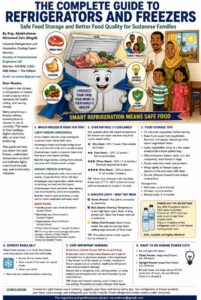
This guide explains how to choose the right freezer, understand freezer ratings and indicator lights, store food safely, maintain refrigeration equipment properly, and respond effectively during power outages.
Choosing the Right Freezer
Consumers considering the purchase of a standalone freezer are generally faced with two choices: a chest freezer or an upright freezer.
A chest freezer opens from the top and is particularly well suited to long-term food storage. Because cold air naturally remains inside the cabinet when the lid is opened, chest freezers tend to consume less electricity than upright models. They also retain low temperatures for longer periods during power outages, making them especially attractive in regions where electrical supply may be unreliable. In addition, chest freezers are usually less expensive than upright freezers of comparable capacity.
The main disadvantage of chest freezers is that food organization can be more difficult. Items stored at the bottom may be harder to access, and the appliance requires more floor space.
Upright freezers resemble conventional refrigerators and offer a more convenient storage arrangement. Shelves and compartments make it easier to organize frozen foods and locate items quickly. They occupy less floor space and are generally more comfortable for daily use.
However, upright freezers lose cold air more rapidly when the door is opened and usually consume somewhat more electricity than chest freezers. They also tend to warm up more quickly during power failures.
For many Sudanese households, chest freezers remain the preferred choice for storing large quantities of meat and food reserves, while upright freezers are often favored by families seeking convenience and easier organization.
Understanding Freezer Star Ratings
Most consumers have noticed star symbols displayed on freezer labels without fully understanding their significance.
These symbols indicate the freezer’s ability to maintain low temperatures and preserve food safely.
A one-star freezer is capable of maintaining temperatures around minus six degrees Celsius and is intended only for short-term frozen food storage.
A two-star freezer can achieve approximately minus twelve degrees Celsius and provides improved storage performance.
A three-star freezer operates at approximately minus eighteen degrees Celsius, which is internationally recognized as the minimum temperature required for long-term preservation of frozen foods.
A four-star freezer not only maintains temperatures of minus eighteen degrees Celsius or lower but is also designed to safely freeze fresh food products.
For Sudanese climatic conditions, consumers should ideally select a freezer with a minimum three-star rating to ensure reliable long-term food preservation.
Understanding Indicator Lights
Many freezers are equipped with indicator lights that provide important operating information.
The green indicator light usually signifies that electrical power is available and the appliance is operating normally.
The red indicator light generally serves as a warning that the internal temperature has risen above the recommended range. This may occur due to a prolonged power outage, a door left open, excessive loading of warm food, or a technical malfunction.
The yellow or orange indicator light commonly indicates the activation of the fast-freeze function. This feature is intended to rapidly freeze newly added food and is typically used only for limited periods.
Maintaining Proper Storage Temperatures
Correct temperature control is one of the most important aspects of food safety.
Refrigerators should normally operate between two and four degrees Celsius. At these temperatures, bacterial growth is significantly slowed while food quality is preserved.
Freezers should ideally maintain temperatures of minus eighteen degrees Celsius or lower. This temperature does not completely eliminate microorganisms but effectively prevents their growth and helps maintain food quality during extended storage periods.
Organizing Food Correctly
Proper organization improves both food safety and refrigeration efficiency.
Ready-to-eat foods, dairy products, and leftovers should be stored on upper shelves where temperature conditions are generally stable.
Milk, beverages, and eggs are best stored on middle shelves.
Raw meat and poultry should always be stored on lower shelves in leak-proof containers to prevent cross-contamination.
Fresh fruits and vegetables should be kept in designated drawers whenever available.
Many households unknowingly overload refrigerators, restricting air circulation and reducing cooling performance. Adequate space should always be maintained between stored products to allow cold air to circulate freely.
Fresh Fruit and Vegetable Storage
Proper handling of fruits and vegetables can significantly extend their shelf life.
Fresh produce should generally be stored dry whenever possible. Excess moisture promotes spoilage and mold growth. Leafy vegetables often remain fresher when wrapped in absorbent paper before storage.
Whenever practical, fruits and vegetables should be stored separately. Certain fruits naturally release ethylene gas, which accelerates the ripening and aging of nearby vegetables.
Prepared vegetables intended for freezing should be cleaned, dried, packaged properly, and labeled with storage dates.
Common Household Mistakes
Several common practices can compromise both food safety and appliance efficiency.
Placing hot food directly into a refrigerator raises the internal temperature and forces the refrigeration system to work harder. Food should first be allowed to cool appropriately before refrigeration.
Frequent opening of refrigerator and freezer doors allows cold air to escape and increases energy consumption.
Refreezing thawed raw meat without cooking may also increase food safety risks and should generally be avoided.
Safe Meat Storage
For best quality, frozen beef and lamb can often be stored for several months when maintained continuously at minus eighteen degrees Celsius.
Poultry products generally retain acceptable quality for extended periods under similar conditions.
Ground meat typically has a shorter recommended storage period due to its greater surface area and increased exposure to air during processing.
All frozen foods should be packaged in airtight freezer-grade materials and clearly labeled with freezing dates to facilitate stock rotation.
Defrosting a Freezer Safely
Frost accumulation reduces cooling efficiency and increases electricity consumption.
When frost becomes excessive, the freezer should be defrosted according to the manufacturer’s instructions.
Sharp objects such as knives, screwdrivers, or metal scrapers should never be used to remove ice. Damage to refrigeration tubing can result in refrigerant leakage and costly repairs.
Equipment Care During Long Periods of Non-Use
Modern domestic freezers frequently use evaporators manufactured from aluminum or coated steel rather than copper because of economic considerations.
When refrigeration equipment remains unused for extended periods in humid environments, moisture exposure may contribute to corrosion and eventual refrigerant leakage.
Although occasional operation may help reduce moisture-related deterioration, proper cleaning and storage practices are equally important.
If a freezer must remain out of service for a prolonged period, it should be thoroughly cleaned, completely dried, and left slightly open to promote ventilation. Protection from moisture and adherence to manufacturer recommendations can significantly reduce the likelihood of corrosion-related damage.
Emergency Food Safety During Power Outages
Power interruptions remain a challenge for many households.
During an outage, refrigerator and freezer doors should remain closed as much as possible. Every unnecessary opening allows valuable cold air to escape and accelerates temperature rise.
A fully loaded chest freezer may often maintain acceptable storage temperatures for approximately one to two days, depending on insulation quality and ambient conditions.
An upright freezer generally maintains safe temperatures for a shorter period.
Food safety should always take priority. If there is significant doubt about the safety of meat, poultry, or other highly perishable foods following a prolonged outage, disposal is usually the safest option.
Using Thermal Storage Bottles
Thermal storage bottles can provide additional protection during extended power interruptions.
Food-grade propylene glycol solutions are widely used throughout the refrigeration industry because of their favorable thermal characteristics and low freezing points.
When properly sealed inside suitable containers, such thermal storage packs can help slow temperature rise within refrigerators and freezers during outages.
However, users should ensure that only food-grade materials are employed and that all containers are clearly identified and safely stored.
Energy Saving Recommendations
Simple maintenance practices can significantly reduce electricity consumption.
Keeping condenser surfaces clean, maintaining good door seals, minimizing unnecessary door openings, providing adequate ventilation around the appliance, and avoiding installation near heat sources can all improve efficiency and prolong equipment life.
Ten Practical Tips for Better Refrigerator Performance and Longer Service Life
Proper use and routine maintenance can significantly improve refrigerator performance, reduce energy consumption, and extend equipment life.
Avoid overloading the refrigerator. Cold air must circulate freely between stored items to maintain uniform temperatures and ensure efficient cooling.
Allow hot food to cool before refrigeration. Placing hot food directly into a refrigerator increases the internal temperature and forces the compressor to work harder.
Minimize frequent door openings. Every opening allows cold air to escape and warm air to enter, increasing energy consumption.
Provide adequate ventilation around the appliance. Sufficient clearance around the refrigerator helps the condenser reject heat effectively.
Maintain door gaskets in good condition. Clean and inspect door seals regularly to prevent cold-air leakage.
Follow good practices during power interruptions. Avoid reconnecting the appliance immediately after power restoration ; waiting a few minutes helps protect the compressor.
Avoid leaving a refrigerator idle for long periods. If long-term shutdown is necessary, clean and dry the appliance thoroughly and leave the door slightly open for ventilation.
Adjust temperature settings according to seasonal conditions. Extremely cold thermostat settings are not always necessary and may increase electricity consumption.
Clean the appliance regularly. Periodic cleaning improves hygiene and maintains cooling efficiency.
Allow time for stabilization after transportation. Whenever a refrigerator is moved, especially if tilted during transport, it should remain upright for several hours before being switched on.
A refrigerator is one of the few household appliances that operates continuously throughout the year. Proper operation and preventive maintenance significantly improve reliability, reduce operating costs, and help ensure safe food storage.
As refrigeration professionals often say ;
“A refrigerator that is used correctly lasts longer, performs better, and consumes less energy.”
Final Thoughts
Whether choosing a chest freezer or an upright freezer, proper equipment selection, temperature control, maintenance, and food handling practices remain essential for food safety and appliance reliability.
For Sudanese families living in hot climates and facing occasional power interruptions, understanding basic refrigeration principles can help preserve food quality, reduce waste, save energy, and protect public health.
A refrigerator or freezer is not simply a household appliance. It is an investment in food security, family well-being, and community health.
About the Author
Eng. Abdelrahman Mohamed Zain (Magdi) is an Industrial Refrigeration and Absorption Chillers Specialist with extensive experience in refrigeration technology, energy efficiency, environmental protection, technical education, and public awareness.
He serves as Health, Safety and Environment Editor for The Citizen Newsletter and is a member of internationally recognized engineering organizations dedicated to sustainable development and professional excellence.
For comments and technical inquiries :
mr.zainrac@gmail.com