
Beijing is ready to support Sudan’s reconstruction and expand investments as soon as the situation stabilizes، Interview
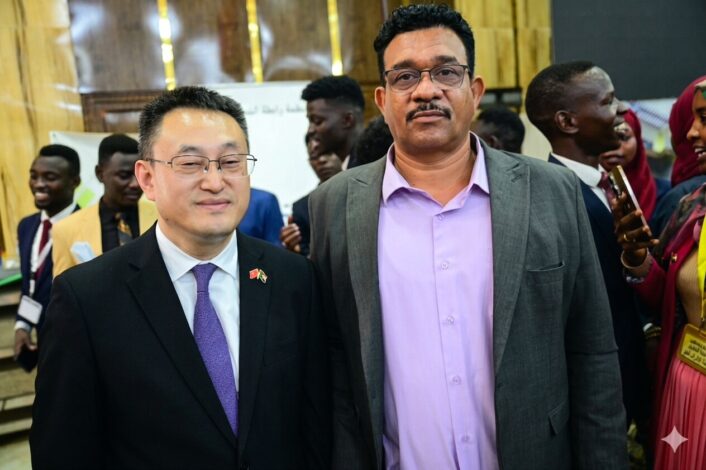
* China affirms its support for Sudan’s unity and sovereignty.
* Sudan’s debt to China is less than 4%, and we will continue to support its development and recovery.
*
* The relationship between Sudan and China is a strategic one.
Interviewed by: Mohammed Babiker
Introduction
At a time when Sudan is going through one of its most complex periods, both politically and economically, Sudanese-Chinese relations stand out as a crucial issue attracting the attention of the public and policymakers, especially given the challenges posed by the war and the resulting urgent needs for reconstruction and development.
In this exclusive interview with the Citizen Newspaper, the Chinese Ambassador to Sudan speaks candidly about the future of the strategic partnership between Khartoum and Beijing, his country’s position on the Sudanese crisis, the prospects for the return of Chinese investments, debt issues, reconstruction, and the prospects for economic and cultural cooperation between the two countries.
He also addresses a number of regional and international issues currently dominating the political scene.
Through this interview, the Ambassador conveys clear messages affirming China’s commitment to supporting Sudan on its path towards peace, stability, and economic recovery, and its readiness to contribute to reconstruction and development efforts, building on historical relations and a strategic partnership that has spanned decades and served as a model of cooperation between the two friendly nations.
Excerpts:
Q1. Sudan is facing unprecedented political and economic turmoil caused by the protracted conflict. How do you assess the current state of bilateral relations during this special period? What is the top priority of the Chinese Embassy in Sudan right now? And what is China’s position on the ongoing conflict in Sudan?
A: China and Sudan have a long history of friendly interactions, with bilateral relations growing stronger along the journey. Since the establishment of diplomatic relations 67 years ago, the bilateral relationship has been developing steadily and soundly, with tangible results achieved through practical cooperation in various fields, setting a fine example of the relations between China and Arab states and between China and African countries. In 2015, our two states forged a strategic partnership, marking a new historic stage of bilateral relations. In 2022 and 2024, President Xi Jinping and Chairman Abdel Fattah Al-Burhan met twice, drawing the blueprint for the China-Sudan strategic partnership. This year marks the beginning of the next decade of our strategic partnership, opening up broad prospects for the future of bilateral relations.
Over the decades, China and Sudan always give each other understanding and support on issues concerning our respective core interests and major concerns. China supports Sudan’s efforts to safeguard sovereignty, independence and territorial integrity and to keep the future of development firmly in its own hands. China sincerely hopes that Sudan will restore peace and stability at an early date, so as to return to the path of development and enable its people to live in peace and security. China stands ready to do what it can to help Sudan with its post-war reconstruction and economic and social development. China will continue to speak up for our Sudanese friends at the U.N. and other multilateral settings, and make positive contributions to the political settlement of the Sudan issue. China highly appreciates the commitment of Sudan to the one-China principle, its opposition to “Taiwan independence” and its support for China’s cause of reunification.
For the Chinese Embassy in Sudan, our current top priority is to earnestly implement the important common understandings reached between the two heads of state, deepen the traditional friendship between us and promote practical cooperation in various fields, so as to substantiate our strategic partnership.
Q2. How do you think the situation in Sudan is affecting Chinese investment in the country?
A: China is one of the most important investment partners of Sudan. Since the armed conflict erupted in Sudan in 2023, most foreign enterprises have withdrawn from the country due to the turbulent security situation. Yet, Chinese companies have been closely monitoring developments in Sudan and hope to resume economic and trade cooperation with the country. As a matter of fact, China-Sudan trade has not stopped. China continues to supply Sudan with merchandise and services in the areas of electricity, telecommunications, machinery, transportation, and daily necessities, providing important support for ensuring the basic needs of the Sudanese people and restoring key production facilities.
Since 2025, China-Sudan cooperation in economic and trade fields has been gradually recovering, as Sudan accelerates its reconstruction. In this process, Chinese companies have been collaborating with Sudanese counterparts in mining, agriculture, transportation, telecommunications, and the digital economy. According to Sudanese customs statistics, China regained its position as Sudan’s largest source of imports in 2025. Chinese enterprises have provided Sudan with large quantities of mechanical equipment, transportation vehicles, construction materials, power equipment, and new energy products, all of which are urgently needed by Sudan, lending strong support to its reconstruction process. We believe that once the security situation in Sudan stabilizes further and its infrastructure is gradually restored, many more Chinese enterprises will return to the country for broader investment cooperation.
Q3. There is some controversy over Sudan’s debt to China. How will China demonstrate that practical cooperation between Sudan and China will bring about mutual benefits and win-win results, rather than placing additional economic burdens on Sudan?
A: China-Sudan cooperation in financing is committed to mutual benefits and win-win results. There are some misunderstandings regarding Sudan’s debt to China. First of all, China’s financing to Sudan, which supports key sectors, is offered on favorable terms and with no political strings attached. This has effectively met the country’s funding needs and provided tangible support for its development. On projects such as oilfield exploitation, the Meroe Dam, the Khartoum thermal power plant, highways in Darfur and Kordofan, among others, not a single loan has failed to make a difference. Second, Sudan’s debt to China accounts for only a small portion of its total external debt. It is not China that has placed a heavy debt burden on Sudan. According to debt statistics jointly released by Sudan and the International Monetary Fund (IMF), the vast majority of Sudan’s external debt is owed to Europe, the U.S. and Arab countries, while its debt to China accounts for less than 4 percent. Third, China has never pressured Sudan on debt repayment. Chinese financial institutions and companies have maintained friendly communication with Sudan’s Ministry of Finance and Central Bank. In fact, even when Chinese companies did not receive full payment for some projects, they still completed the work for the benefit of Sudan’s development. A report by the Central Bank of Sudan reveals that in 2025, Sudan’s external loan repayments primarily went to the World Bank.
Q4. What role will China play in humanitarian aid to Sudan and in the country’s post-war reconstruction?
A: China firmly supports Sudan when it comes to humanitarian aid and post-war reconstruction. The first is providing emergency humanitarian assistance to address Sudan’s most urgent needs. China has already provided the Sudanese government with various supplies, including rice, medical supplies, tents, bed nets, insecticides, and water purifiers, and will continue to provide relevant assistance. The second is enhancing the production and construction capacity of Sudan to bolster its long-term development. China-made power equipment, mechanical equipment, telecommunications equipment, construction materials, new energy products, and the related technologies will meet the reconstruction and development needs of the country. China encourages Chinese enterprises to have in-depth exchanges with Sudanese counterparts so as to help Sudan boost its development capacity. The third is establishing mechanisms for smooth cooperation. China welcomes Sudan’s efforts to increase exports to China by making full use of zero-tariff treatment on its exports. China is also ready to promote the establishment of channels for cooperation between financial institutions of our two nations, so as to facilitate and secure the flow of goods and capital. Furthermore, China is discussing with Sudan a framework agreement on economic partnership for shared development, which will build a solid institutional foundation for comprehensive economic cooperation between the two countries in the future.
Q5. How do you see China’s image in the eyes of the Sudanese people? To deepen the friendship between the two peoples, does China have plans to offer more scholarships, training opportunities, or hold cultural exchanges?
A: China and Sudan enjoy traditional friendship, having always been good friends supporting each other, good partners pursuing common development and good brothers sharing a common destiny. Our bond of friendship is evident everywhere, from the Khartoum Friendship Hall and the new presidential palace, to the China-Sudan friendship school and friendship hospital, and to the Sudanese Acrobatic Troupe – hailed as the “flower of China-Sudan friendship”. China-Sudan relations began with friendship and prospers through friendship. Friendship now runs through every aspect of our cooperation. Since I came to work here, I have felt the genuine friendship of the Sudanese people toward the Chinese people everywhere I go, and I am so proud of that.
This year marks the 70th anniversary of the beginning of diplomatic relations between China and Arab states and between China and African countries. This year is also designated as the China-Africa Year of People-to-People Exchanges. As a major African country, Sudan has witnessed this historic process and more importantly, actively participated in and contributed to it. This year, with efforts of the Chinese Embassy, our two sides have launched an array of cultural events, including the “Happy Chinese New Year” celebration, the “International Chinese Language Day” event, the “Thank You, China” event, the “Chinese Bridge” final, and the reception celebrating the 55th anniversary of the establishment of the Sudanese Acrobatic Troupe. In addition, the Chinese Embassy paid visits to local schools and universities, including Red Sea University, University of Dongola, University of Kassala, the Sinkat China-Sudan Friendship School and the Oseif Port Farouk Primary School, where we presented the China-Sudan friendship scholarships to outstanding student representatives. We welcome people from various sectors of the Sudanese society to continue supporting and participating in activities for China-Africa Year of People-to-People Exchanges. Through people-to-people exchanges, our two peoples will be bound by deeper friendship and instill unceasing dynamism into the China-Sudan strategic partnership.
China will continue to provide outstanding Sudanese students with Chinese government scholarships. We welcome more young people from Sudan to further their studies in China, so that they can see more of our country and become youth envoys of China-Sudan friendship and cooperation.
Q6. Following the tensions in the Middle East, Chinese President Xi Jinping put forward four propositions for safeguarding and promoting peace and stability in the Middle East. Could you share with the Sudanese people these propositions and China’s position on the current conflict in the region?
A: The protracted conflict involving the U.S., Israel and Iran remains unresolved, with its spillover effects continuing to spread. The ongoing hostilities have caused heavy civilian casualties and severe damage to infrastructure, dealt a serious blow to the region’s development gains, and posed grave challenges to the security of energy corridors as well as global industrial and supply chains. China believes that this is a war that should not have happened – it is a war that does no one any good. China opposes military operations that have no authorization of the U.N. Security Council and attacks on civilians and civilian facilities. History has proven time and again that war does not bring true security; it only drives up antagonism and prolongs instability.
Recently, President Xi Jinping made four propositions for safeguarding and promoting peace and stability in the Middle East. First, stay committed to the principle of peaceful co-existence. China supports regional states in improving their ties. It’s important to work to build a common, comprehensive, cooperative and sustainable security architecture of the Middle East and the Gulf region. Second, stay committed to the principle of national sovereignty. The sovereignty, security and territorial integrity of the Gulf states should be earnestly respected. Third, stay committed to the principle of international rule of law. It is important to firmly uphold the international system with the U.N. at its core, the international order based on international law, and the basic norms governing international relations underpinned by purposes and principles of the U.N. Charter. We should prevent the world from returning to the law of the jungle. Fourth, stay committed to a balanced approach to development and security. China stands ready to share with regional countries the opportunities through Chinese modernization. All sides should work to create a sound environment for the development of the Gulf states.
This four-point proposition is fully aligned with the vision of building a community with a shared future for humanity, the Global Security Initiative (GSI), the Global Governance Initiative (GGI) and other important initiatives proposed by President Xi Jinping. It fully embodies China’s consistent position and active efforts to promote peace, end hostilities, and advocate resolving disputes through dialogue. As a Chinese solution to end the conflict and realize peace, the proposition has received growing recognition and support from regional countries and the international community.
Q7: Lai Ching-te, leader of the Taiwan region, has recently traveled to Eswatini on the private jet of the King of Eswatini. What is China’s comment?
A: Even though there was widespread opposition, Lai Ching-te sneaked onto the private plane of the King of Eswatini and cheated himself into Eswatini, showing the world how little he respects relevant countries’ airspace and sovereignty. The whole thing is nothing but a ridiculous stunt performed in front of the world. His “stowaway-like” travel to Eswatini is perfect proof that “Taiwan independence” separatism is just shady business and unacceptable to the international community. Some politicians in Eswatini who are kept in Taiwan’s pay have been wrongly providing space for “Taiwan independence.” China strongly condemns it. There’s but one China in the world and Taiwan is an inalienable part of China’s territory. Facts have shown time and again that the one-China principle is an international consensus that has solid support and is simply unshakable.
On the Taiwan question, our Sudanese friends are always sharp-eyed. In history, Sudan was one of the countries that co-sponsored and voted in favor of U.N. General Assembly Resolution 2758, making historic contributions to the restoration of the lawful seat of the People’s Republic of China (PRC) in the U.N. Since the establishment of diplomatic relations between our two countries, Sudan has long been committed to the one-China principle and has offered China valuable support on issues concerning its core interests and major concerns. Over the recent years, Sudan has voiced on multiple occasions its support for China’s efforts in safeguarding sovereignty, independence and territorial integrity, as well as its firm opposition to “Taiwan independence”. Not long ago, member of Sudan’s Transitional Sovereignty Council (TSC) Abdullah Yahya publicly reaffirmed Sudan’s firm support for the one-China principle, and the League of Peoples Organization in Sudan sent a special message to express its support for the one-China principle. Multiple media professionals published articles to expose and criticize Lai Ching-te’s scandalous visit to Eswatini. China highly appreciates these acts. We are convinced that with the joint efforts of Chinese on both sides of the Taiwan Strait and the staunch support of the international community including Sudan, the complete reunification of China will be achieved.